Facts
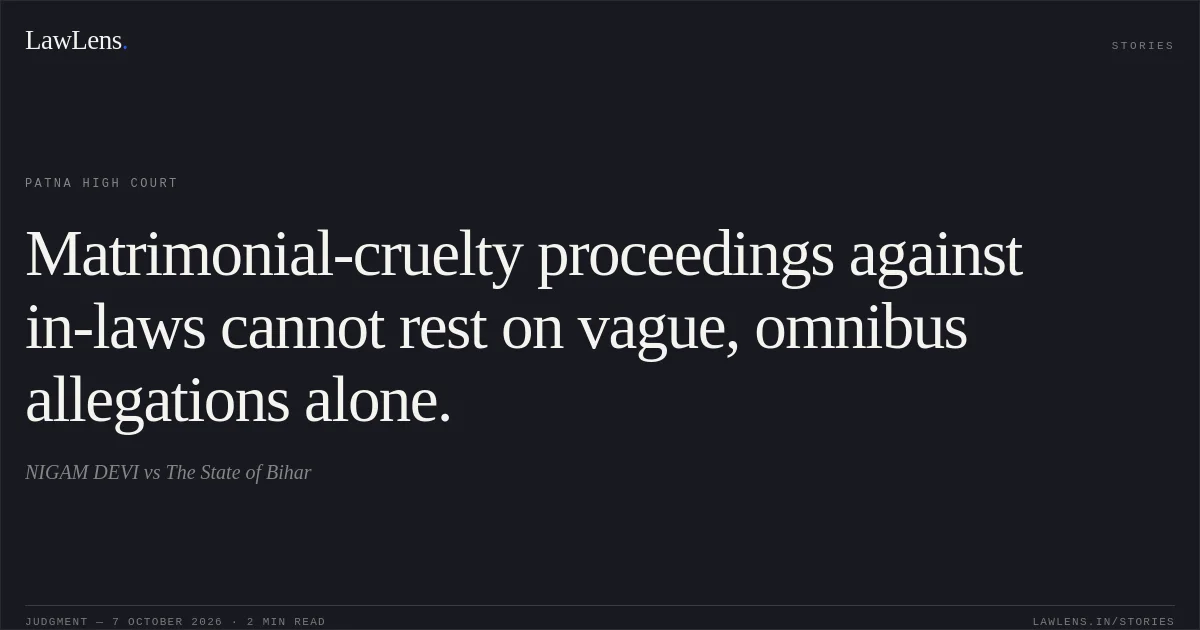
The complainant married Gaurav Kumar on 25 June 2010 and alleged that her husband and in-laws subjected her to cruelty and harassment over dowry and eventually ousted her from the matrimonial home.
Source reference: para. 3The Sub-Divisional Judicial Magistrate, Patna, took cognizance against the petitioners—her mother-in-law and father-in-law—under Section 498A of the Indian Penal Code and Section 4 of the Dowry Prohibition Act by order dated 3 May 2023.
Source reference: para. 2The petitioners sought to quash that order, arguing that the allegations against them were general and omnibus, that the complaint was filed in 2022 after a delay of more than four years, and that it followed a 2018 complaint by the complainant’s husband against her and her family; the husband had also filed a divorce petition in 2022.
Source reference: paras. 4–6The complainant opposed the application, maintaining that she had suffered cruelty at the hands of her husband and other family members.
Source reference: para. 7Issues
Whether the cognizance order and resulting prosecution against the petitioners should be quashed where the complaint contains general and omnibus allegations but no specific instances or roles attributed to them.
Source reference: paras. 8–12Whether the proceedings against the petitioners amounted to an abuse of the process of the court in light of the matrimonial dispute and the surrounding litigation.
Source reference: paras. 8, 11–12Law Applied
Section 482 of the Code of Criminal Procedure empowers the High Court to quash criminal proceedings to prevent abuse of the process of any court or otherwise secure the ends of justice.
Source reference: paras. 10–11In Kahkashan Kausar & Ors. v. State of Bihar & Ors., (2022) 6 SCC 599, the Supreme Court held that relatives of a husband should not be made to undergo trial on general and omnibus allegations in the absence of a specific role attributed to them; courts should exercise their inherent powers to quash such proceedings where appropriate.
Source reference: para. 10The alleged offences at the cognizance stage were under Section 498A IPC and Section 4 of the Dowry Prohibition Act.
Source reference: para. 2Reasoning
The Court found that the complaint did not attribute specific dates, instances, or roles to either petitioner and that the allegations against them were mostly general and omnibus.
Source reference: paras. 8, 11It also considered the prior 2018 complaint filed by the husband and the divorce petition filed in 2022 as evidence of a dispute between the spouses.
Source reference: para. 8Applying the principle in Kahkashan Kausar, the Court concluded that the petitioners’ relationship to the husband, without specific allegations of their involvement, did not justify subjecting them to trial; continuing the proceedings against them would amount to an abuse of process.
Source reference: paras. 10–12Holding
The High Court allowed the application and quashed the 3 May 2023 cognizance order and all consequential prosecution only insofar as they related to the petitioners.
It clarified that the proceedings against the complainant’s husband would continue in accordance with law.
Source reference: para. 14Acts & Sections Cited
2 provisions across 2 statutes referred to in this judgment. Each provision opens on LawLens.
Dowry Prohibition Act, 19611
Code of Criminal Procedure, 19731
Original Court PDF
NIGAM DEVIvsThe State of Bihar
Click to open original judgment
Original judgment, available to read, download and summarize on LawLens.in