Facts
The appellant (complainant) married respondent No. 3 on June 17, 2012.
Source reference: para. 2She alleged that shortly after the marriage, the respondent and his family demanded dowry (including a car and ornaments) and subjected her to physical and mental cruelty
Source reference: para. 2On February 3, 2016, she was allegedly assaulted and ousted from her matrimonial home, leading to an FIR filed on February 8, 2016
Source reference: para. 2The Trial Court, via judgment dated July 27, 2023, acquitted the co-accused in-laws but convicted the respondent-husband under Sections 498-A and 323 of the IPC, sentencing him to six months and two months of simple imprisonment, respectively
Source reference: para. 3On appeal, the Court of the Additional Sessions Judge, Durg, reversed this decision on May 25, 2024, acquitting the husband
Source reference: para. 4Issues
1. Whether the First Appellate Court’s judgment of acquittal was perverse, arbitrary, or based on an impossible view of the evidence warranting interference in an acquittal appeal
Source reference: para. 102. Whether the prosecution proved the allegations of cruelty and harassment in connection with dowry demands beyond a reasonable doubt
Source reference: para. 11, 14Law Applied
The Court primarily applied Section 498-A (cruelty by husband or relatives) and Section 323 (punishment for voluntarily causing hurt) of the Indian Penal Code
Source reference: para. 1It relied on the evidentiary standard for material contradictions and omissions under Section 161 of the CrPC
Source reference: para. 11Regarding the scope of appellate interference, the Court applied the principle established in State of Rajasthan v. Kistoora Ram (2022), which mandates that an order of acquittal should not be disturbed unless the view taken by the lower court is "impossible or perverse," even if a second view favoring conviction is probable
Source reference: para. 9, 15Reasoning
The High Court observed that the First Appellate Court conducted a "threadbare analysis" of the testimonies of the complainant (PW-1) and her relatives (PW-4, PW-5, PW-6)
Source reference: para. 11The Court found material contradictions and "material improvements" in the witnesses' court testimonies compared to their statements under Section 161 CrPC; specifically, allegations regarding demands for a scooty, bus fare, and Rs. 50,000/- were absent from the initial FIR
Source reference: para. 11The Investigating Officer (PW-8) admitted these omissions, rendering the testimony unreliable
Source reference: para. 11Furthermore, the complainant admitted in cross-examination that no complaints were made during long periods of alleged harassment, no dowry was demanded at the time of marriage, and the parties had resumed cohabitation after previous compromises
Source reference: para. 12The Court also noted a 16-day delay in lodging the FIR and medical evidence (PW-7) suggesting injuries were simple or potentially self-inflicted
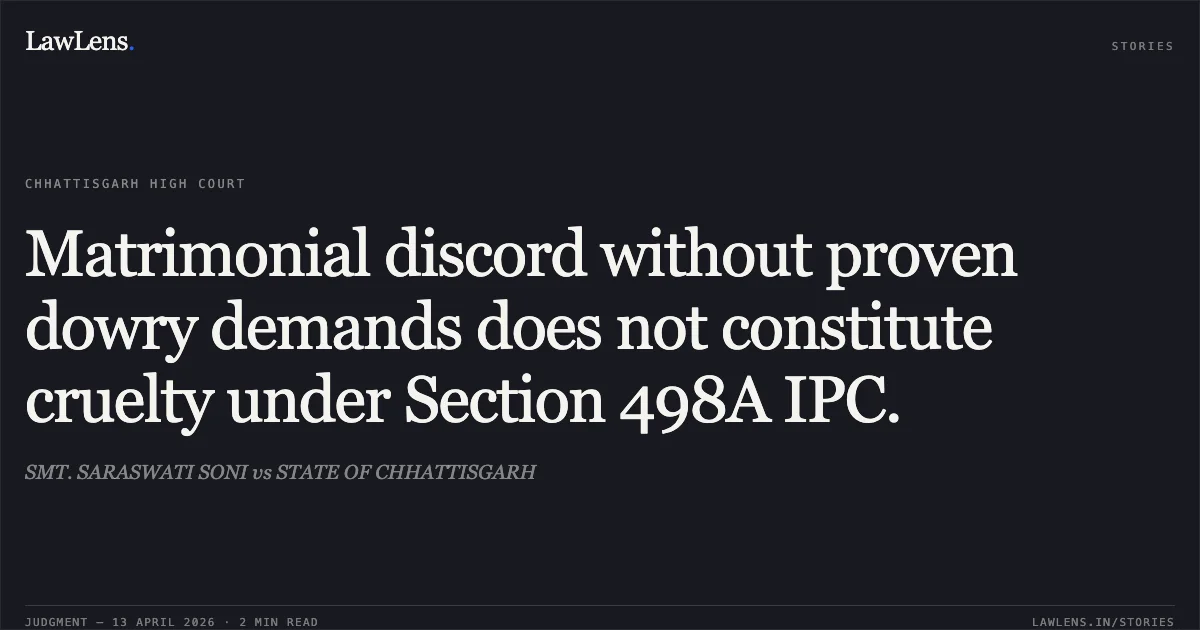
Source reference: para. 13Finally, the Court reasoned that while matrimonial discord existed, it did not constitute "cruelty" under Section 498-A IPC as the link to unlawful dowry demands was not established beyond reasonable doubt
Source reference: para. 14Holding
The High Court held that the First Appellate Court’s view was plausible, reasonable, and supported by a proper appreciation of evidence
It affirmed that the presumption of innocence is strengthened by an acquittal and found no perversity or illegality in the impugned judgment
Source reference: para. 15, 17The High Court dismissed the acquittal appeal, maintaining the acquittal of respondent No. 3
Source reference: para. 18Acts & Sections Cited
2 provisions across 1 statute referred to in this judgment. Each provision opens on LawLens.
Indian Penal Code, 18602
Original Court PDF
SMT. SARASWATI SONIvsSTATE OF CHHATTISGARH
Click to open original judgment
Original judgment, available to read, download and summarize on LawLens.in


![Subsequent exoneration does not retrospectively invalidate a finalized promotion select list.. UNNIKRISHNAN M vs M/o Environment And Forests. CAT - ['Ernakulam']. LawLens](/stories/thumbnails/subsequent-exoneration-does-not-retrospectively-invalidate-a-finalized-promotion-select-li-ce80a0e84f2f4887857271e8b4341c42.webp)