Facts
The parties solemnized their marriage on 22.02.2023 at Jaiora as per Hindu rites; differences subsequently arose and they began residing separately
Source reference: para. 2The petitioner-wife filed a restitution petition under Section 9 of the Hindu Marriage Act, 1955 before the Family Court, Indore (RCSHM No. 2577/25) and a maintenance application under Section 144 of the BNSS (No. 277 of 2026), both pending with the respondent's appearance awaited
Source reference: para. 2The respondent-husband then instituted a divorce suit (RCS HM 95/2025) before the II Additional District and Sessions Judge, Jaiora, District Ratlam, upon summons from which the petitioner filed the instant transfer petition under Section 24 CPC seeking transfer to the Principal Judge, Family Court, Indore
Source reference: para. 1–2The petitioner pleaded apprehension of the respondent's local influence, political approach and financial condition; her responsibility toward aged retired parents and a mentally retarded brother; the ~170 km one-way distance between Indore and Jaiora; and the hardship of travelling alone on every date without any maintenance
Source reference: para. 3Issues
1. Whether the divorce case RCS HM 95/2025, filed by the respondent-husband and pending before the II Additional District and Sessions Judge, Jaiora, District Ratlam, ought to be transferred to the Family Court, Indore under Section 24 CPC on grounds of the petitioner-wife's hardship and inconvenience
Source reference: para. 1, 32. Whether the availability of video conferencing facilities at both Jaiora and Indore constitutes an adequate alternative to transfer, in terms of the Supreme Court's directions in Krishna Veni Nagam v. Harish Nagam
Source reference: para. 4–5Law Applied
The petition was entertained under Section 24 of the Code of Civil Procedure, 1908, which vests the High Court with power to transfer suits and proceedings
Source reference: para. 1The Court primarily applied Krishna Veni Nagam v. Harish Nagam, (2017) 4 SCC 150, which incorporated the doctrine of forum non conveniens (drawing on Modi Entertainment Network v. W.S.G. Cricket Pte. Ltd. and the Spiliada Maritime principle) into matrimonial proceedings — the appropriate forum being that in which the case can be tried most suitably for the interests of all parties and the ends of justice
Source reference: para. 4Krishna Veni Nagam further held that transfer is not invariably an acceptable solution where both parties face genuine difficulty, and mandated utilization of technological alternatives in matrimonial and custody disputes, namely: (i) video conferencing; (ii) legal aid services; (iii) deposit of travel, lodging and boarding costs in terms of Order XXV CPC; and (iv) designated e-mail/telephone channels for outstation litigants
Source reference: para. 4Reasoning
Testing the petitioner's hardship grounds on the anvil of Krishna Veni Nagam, the Court observed that the husband's divorce petition was filed at Jaiora, where video conferencing facility is available, and that the petitioner herself resides at Indore, where such facility is equally available
Source reference: para. 5Accordingly, the Court concluded that the petitioner could effectively contest the Jaiora proceedings through video conferencing mode, as directed by the Apex Court, thereby obviating the ~170 km journeys and neutralizing her apprehensions of inconvenience and local influence
Source reference: para. 5–6To preserve the trial court's procedural needs and balance the equities, the Court carved out a safeguard: the Family Court at Jaiora retains the discretion to direct the petitioner's personal presence when genuinely required during trial, but in that event the respondent must bear all to-and-fro journey and residence expenses of the petitioner and her attendant — a direction echoing the cost-deposit safeguard under Order XXV CPC endorsed in Krishna Veni Nagam
Source reference: para. 6Holding
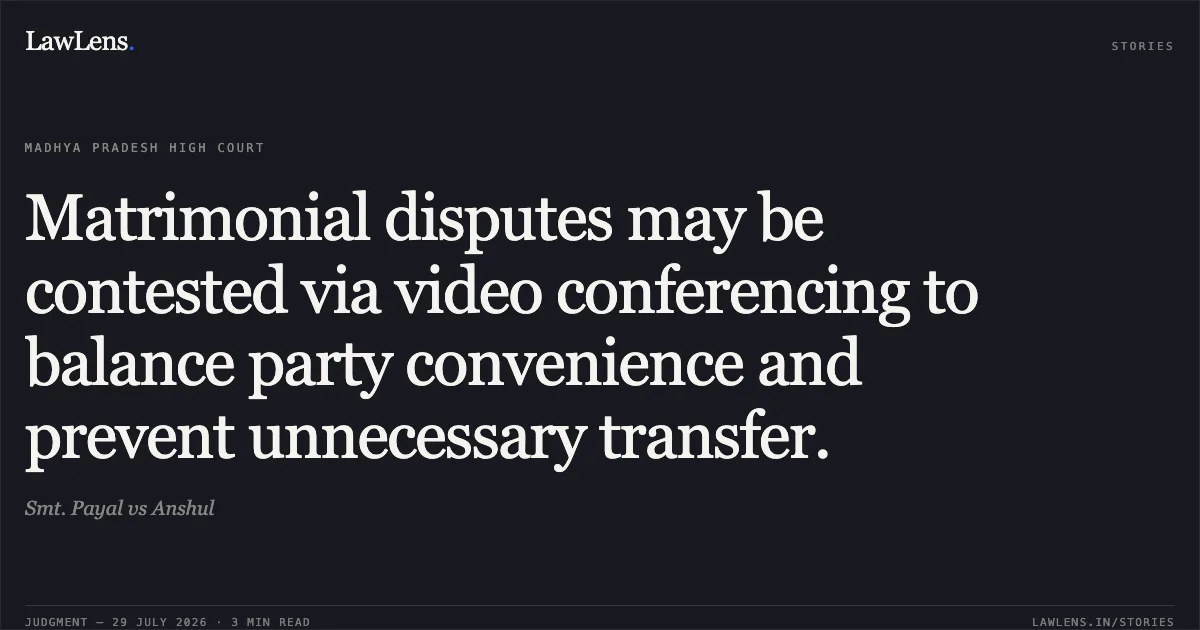
Answering the issues against transfer, the Court held that there was no need to transfer the divorce case from Jaiora to Indore
It directed that: (i) the petitioner shall contest the proceedings pending before the Family Court, Jaiora, through video conferencing and need not travel to Jaiora; (ii) it shall remain open to the Family Court, Jaiora, to direct her personal presence when required during trial, subject to the respondent paying all journey (to and fro) and residence expenses of the petitioner and her attendant; and (iii) the Family Court, Jaiora, is to proceed further in accordance with law in light of Krishna Veni Nagam (supra)
Source reference: para. 6, 7With these directions, the transfer petition stood disposed of
Source reference: para. 8Acts & Sections Cited
4 provisions across 3 statutes referred to in this judgment. Each provision opens on LawLens.
Bharatiya Nagarik Suraksha Sanhita, 20231
Code of Civil Procedure, 19081
Hindu Marriage Act, 19552
Original Court PDF
Smt. PayalvsAnshul
Click to open original judgment
Original judgment, available to read, download and summarize on LawLens.in


