Facts
The de facto complainant married original accused No. 1, Nitinkumar Kanubhai Rabari, on 29 January 2015 at Borsad.
Source reference: p.2She alleged that, shortly after the marriage, certain accused demanded ₹10 lakh for the marriage of the husband’s brother and that, after she went to the USA, the husband and his relatives demanded a further ₹25 lakh for a hotel business.
Source reference: pp.2–3On her refusal, she allegedly suffered physical and mental cruelty, including assault, and was sent back to India after signing certain documents and paying ₹75,000 towards air tickets.
Source reference: pp.2–3The applicants contended that the parties lived together in India only briefly, that the complainant travelled to the USA in March 2016, and that the marriage was dissolved by mutual consent in the USA on 15 April 2016.
Source reference: pp.3–5They relied on her statement to the Boone Police Department referring to a pre-marital affair and her intention to return to India to live with her original lover, as well as her divorce-petition statement that financial and alimony matters had been resolved.
Source reference: pp.3–5The complainant returned to India on or about 18 April 2016 and lodged FIR C.R. No. I-42 of 2016 at Borsad Town Police Station on 20 April 2016 for offences under Sections 498A, 406, 420, 323, 506(2) and 114 IPC and Sections 3 and 7 of the Dowry Prohibition Act.
Source reference: pp.1–2, 14–15The applicants sought quashing of the FIR and consequential proceedings under Section 482 CrPC.
Source reference: no citationIssues
Whether the allegations in the FIR, taken at their face value, disclosed the ingredients of the offences alleged against the applicants, particularly cruelty under Section 498A IPC and the related dowry and other offences.
Source reference: pp.5–7, 14–16Whether the allegations against the applicants were vague, omnibus and unsupported by specific attributed acts, particularly insofar as the applicants were relatives of the husband.
Source reference: p.14Whether the FIR and consequential proceedings were manifestly mala fide and constituted an abuse of the process of law so as to justify exercise of the High Court’s inherent jurisdiction under Section 482 CrPC.
Source reference: pp.6–7, 14–16Law Applied
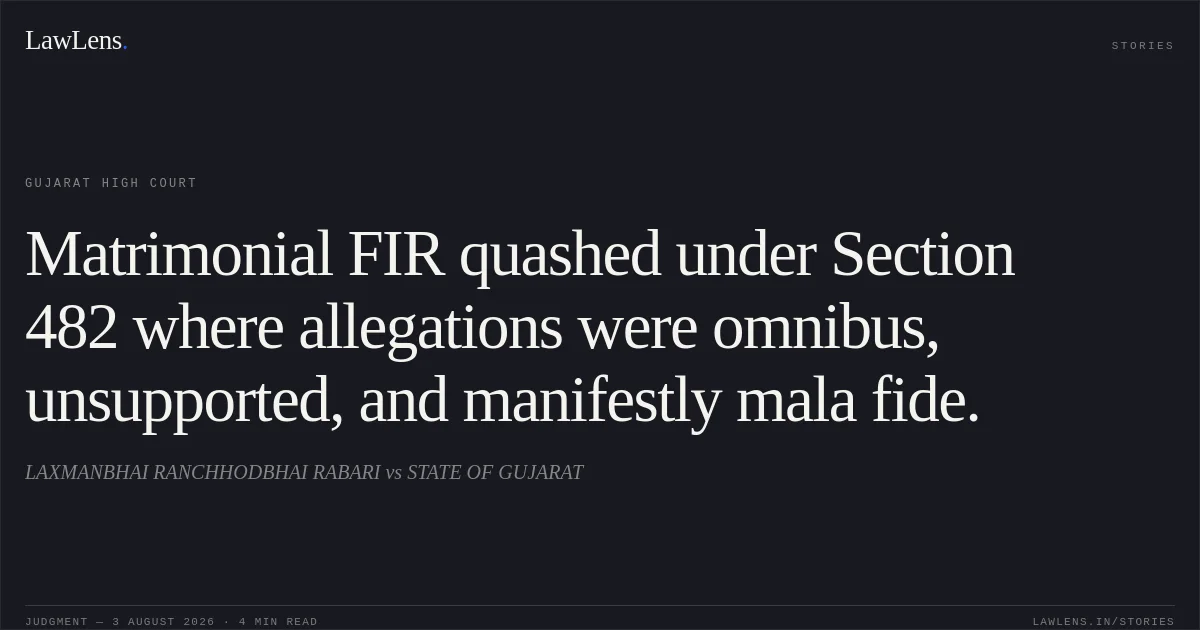
The Court applied Section 482 CrPC, which permits the High Court to quash criminal proceedings to prevent abuse of process and secure the ends of justice.
Source reference: pp.6–7It relied principally on State of Haryana v. Bhajan Lal, AIR 1992 SC 604, including the categories where the allegations do not constitute an offence, are inherently improbable, or where the proceedings are manifestly attended with mala fides and instituted for an ulterior purpose.
Source reference: pp.6–7The Court considered Section 498A IPC, under which cruelty includes wilful conduct likely to cause grave injury or harassment intended to coerce fulfilment of an unlawful demand for property or valuable security.
Source reference: pp.8–9It also relied on Preeti Gupta v. State of Jharkhand, 2010 (0) AIJEL-SC 48656, concerning exaggerated and omnibus allegations in matrimonial prosecutions.
Source reference: pp.8–10It also relied on Kahkashan Kausar @ Sonam v. State of Bihar, 2022 (0) AIJEL-SC 68351, concerning misuse of Section 498A and the need for specific allegations against relatives.
Source reference: pp.11–13The Court relied on K. Subba Rao v. State of Telangana, (2018) 14 SCC 452, holding that distant relatives should not be implicated on the basis of general allegations without specific instances of involvement.
Source reference: p.13The Court also referred to Arnesh Kumar, Geeta Mehrotra and G.V. Rao on cautious scrutiny of matrimonial prosecutions and the danger of indiscriminate implication of family members.
Source reference: pp.11–13Reasoning
Applying the Bhajan Lal principles, the Court found that the allegations against the applicants were vague and omnibus, with no specific or distinct role attributed to each applicant.
Source reference: p.14The allegations of harassment and dowry demand were stated generally and lacked specific incidents sufficient to establish the ingredients of Section 498A IPC or the connected offences.
Source reference: no citationThe Court also noted that the alleged ₹10 lakh payment was described in the FIR as a loan for the brother-in-law’s marriage, and that the marriage lasted approximately one year and three months, during which the spouses spent limited periods together because of their residence in different countries.
Source reference: p.14The timing of the proceedings was considered significant: the complainant obtained a mutual-consent divorce in the USA on 15 April 2016, stated in the divorce proceedings that financial and support claims had been settled, returned to India shortly thereafter, and lodged the FIR on 20 April 2016.
Source reference: pp.14–15Her statement to the Boone Police Department concerning her prior relationship and intention to live with her original lover, together with her subsequent remarriage and residence in Australia, was treated by the Court as supporting the applicants’ contention that the FIR was an afterthought motivated by mala fides.
Source reference: p.15On the totality of these circumstances, the Court held that the case fell within categories (1), (3), (5) and (7) of Bhajan Lal: the allegations did not prima facie establish the offences, were inherently improbable or insufficient, and the proceedings appeared manifestly mala fide.
Source reference: p.16Holding
The Court answered the issues in favour of the applicants.
It held that the FIR did not disclose the requisite ingredients of the offences against the applicants and that the proceedings were frivolous, mala fide and an abuse of the process of law.
Source reference: p.16Exercising its inherent jurisdiction under Section 482 CrPC, the Court quashed and set aside FIR C.R. No. I-42 of 2016 dated 20 April 2016, registered at Borsad Town Police Station, Anand, along with all consequential proceedings, qua the present applicants.
Source reference: p.17Both applications were allowed, the rule was made absolute, and direct service was permitted.
Source reference: p.17Acts & Sections Cited
10 provisions across 3 statutes referred to in this judgment. Each provision opens on LawLens.
Code of Criminal Procedure, 19733
Indian Penal Code, 18605
Original Court PDF
LAXMANBHAI RANCHHODBHAI RABARIvsSTATE OF GUJARAT
Click to open original judgment
Original judgment, available to read, download and summarize on LawLens.in