Facts
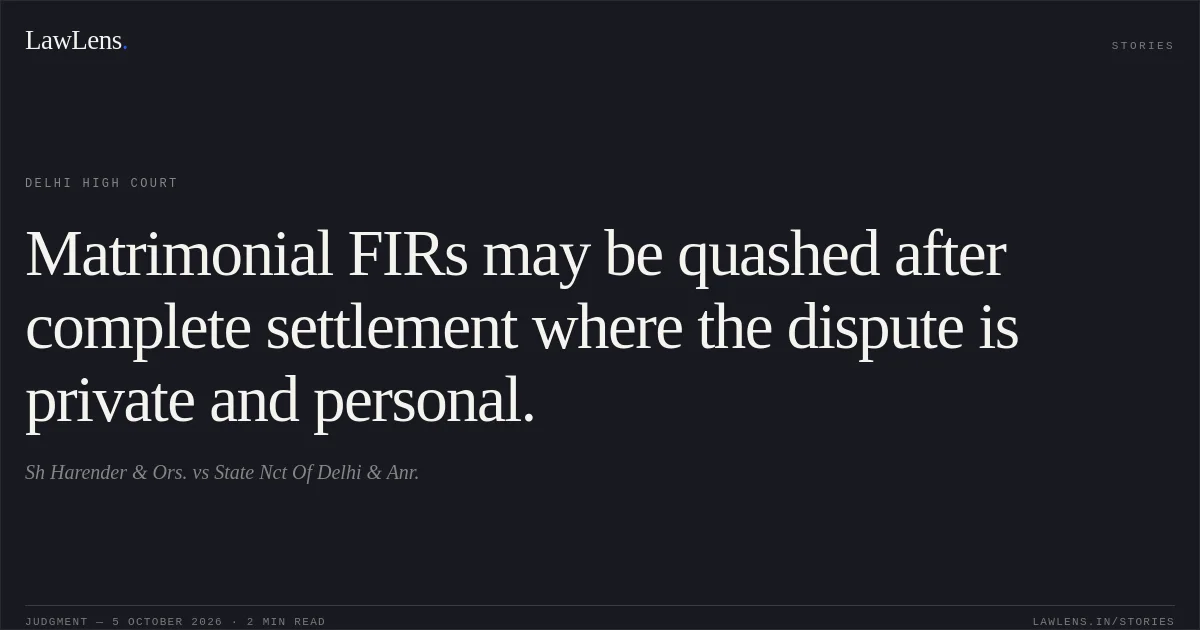
The petitioners sought quashing under Section 528 of the Bharatiya Nagarik Suraksha Sanhita, 2023, of FIR No. 580/2020, registered under Sections 498A, 406, 506 and 34 of the Indian Penal Code, 1860, and Section 4 of the Dowry Prohibition Act, 1961.
Source reference: p.1Petitioner no. 1 and respondent no. 2 married in 2015, had a daughter, and had lived separately since February 2019.
Source reference: pp.1–2The parties settled their matrimonial disputes through mediation; their mutual-consent divorce was granted on 27 January 2025, and the remaining settlement payment of Rs. 1,00,000 was paid to respondent no. 2 during the proceedings.
Source reference: pp.2, 4–5Respondent no. 2 confirmed the settlement and filed an affidavit stating that she had no objection to quashing the FIR.
Source reference: p.6Issues
1. Whether the High Court should exercise its inherent jurisdiction under Section 528 BNSS to quash the FIR and related proceedings arising from a matrimonial dispute that the parties have settled.
Source reference: pp.1, 5–62. Whether the settlement was sufficient, in the circumstances, to warrant quashing of the proceedings.
Source reference: pp.6–7Law Applied
Section 528 BNSS preserves the High Court’s inherent power to make orders necessary to secure the ends of justice or prevent abuse of the process of any court.
Source reference: p.1Applying *Gian Singh v. State of Punjab*, (2012) 10 SCC 303, the Court noted that criminal proceedings involving predominantly private or personal disputes—including matrimonial and dowry-related disputes—may be quashed where the parties have fully settled their dispute, the possibility of conviction is remote, and continuation of the proceedings would cause oppression or injustice; the nature and gravity of the offence must be considered, and serious offences affecting society are not ordinarily quashed merely on settlement.
Source reference: pp.5–6Reasoning
The FIR arose from the matrimonial relationship between petitioner no. 1 and respondent no. 2. The parties had resolved their disputes through a mediated settlement, completed the mutual-consent divorce, and recorded that respondent no. 2’s custody of the minor daughter would continue.
Source reference: pp.2, 4–5Respondent no. 2 confirmed that the settlement was voluntary and stated that she had no objection to quashing; the balance settlement amount was also paid.
Source reference: pp.5–6Given the private matrimonial nature of the dispute and its resolution, the Court considered quashing appropriate under the principles in *Gian Singh*.
Source reference: pp.5–7Holding
The Court allowed the petition and quashed FIR No. 580/2020 and all proceedings emanating from it.
The pending application was also disposed of.
Source reference: p.7Acts & Sections Cited
6 provisions across 4 statutes referred to in this judgment. Each provision opens on LawLens.
Bharatiya Nagarik Suraksha Sanhita, 20231
Indian Penal Code, 18603
Dowry Prohibition Act, 19611
Code of Criminal Procedure, 19731
Original Court PDF
Sh Harender & Ors.vsState Nct Of Delhi & Anr.
Click to open original judgment
Original judgment, available to read, download and summarize on LawLens.in