01Facts
The petitioner, Deepak S., sought quashing of C.C. No. 48500/2025 pending before the XXXVII Additional Chief Metropolitan Magistrate, Bengaluru.
The case arises from Crime No. 109/2025 registered by the South Women Police Station and concerns offences under Sections 85 and 115(2) of the Bharatiya Nyaya Sanhita, 2023 (BNS) and Section 3 of the Dowry Prohibition Act, 1961.
pp. 2–3 · ¶ 1The parties were litigating matrimonial proceedings in M.C. No. 5940/2025 before the VI Additional Principal Family Judge, Bengaluru.
¶ 3 · p. 3They resolved their dispute through mediation and executed a settlement agreement on 27-06-2026.
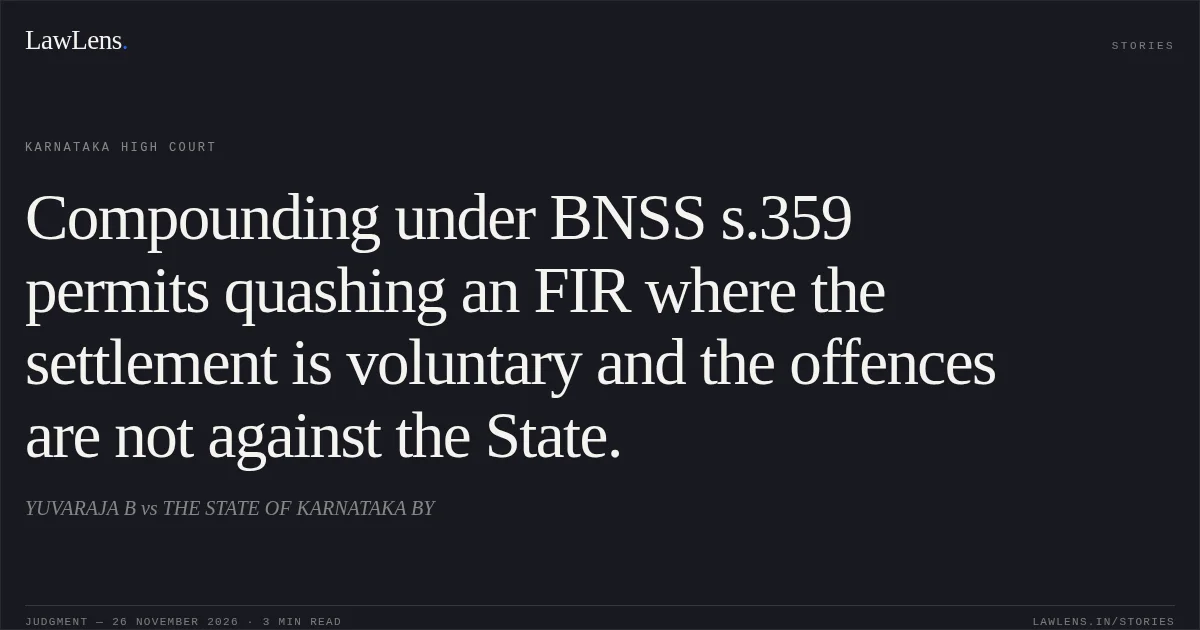
¶ 3 · p. 3 · ¶ 4 · p. 5Both parties then filed an application under Section 359(6) BNSS seeking compounding of the offences, supported by affidavits.
¶ 4 · pp. 3–4The petitioner's affidavit describes the dispute as private and arising from marital discord.
pp. 4–5The second respondent's affidavit records that she has "no objection" to quashing the proceedings.
pp. 6–7The State (Respondent No. 1) was represented by the High Court Government Pleader.
¶ 2 · p. 302Issues
i.1. Whether the offences under Sections 85 and 115(2) BNS and Section 3 of the Dowry Prohibition Act, 1961, arising from a matrimonial dispute, can be compounded on the basis of a mediated settlement and a Section 359(6) BNSS application.
¶ 4 · pp. 3–4 · ¶ 5 · pp. 6–7ii.2. Whether the criminal proceedings in C.C. No. 48500/2025 should be quashed in the exercise of the High Court's powers under Section 528 BNSS (Section 482 CrPC) in view of the parties' settlement.
¶ 5 · p. 7 · ¶ 6(ii) · p. 703Law Applied
Section 359 BNSS, which governs compounding of offences, and specifically sub-section (6), under which compounding may be permitted by the High Court.
¶ 4 · p. 3Section 528 BNSS (corresponding to Section 482 CrPC), which preserves the High Court's inherent power to quash proceedings to prevent abuse of process or secure the ends of justice.
p. 2Section 89 of the Code of Civil Procedure, 1908, read with Rules 24 and 25 of the Karnataka Civil Procedure (Mediation) Rules, 2005, under which the parties' settlement was recorded.
¶ 4 · p. 4The court's ultimate determination was that the offences are not against the State and that compounding may be accepted where affidavits of the parties support the settlement.
¶ 5 · pp. 6–7The order cites no judicial precedent.
Provisions in the judgment · 7 · Linked ones open on LawLens
Code of Criminal Procedure, 1973 Section 482
Bharatiya Nagarik Suraksha Sanhita, 2023 Section 528Section 359
Bharatiya Nyaya Sanhita, 2023 Section 85Section 115
Dowry Prohibition Act, 1961 Section 3
Code of Civil Procedure, 1908 Section 89
04Reasoning
The court considered three factors: the compounding application was jointly filed, it was supported by affidavits from both the petitioner and the second respondent confirming that the dispute was private and matrimonial, and the offences were not against the State.
¶ 5 · pp. 6–7On these grounds, the court accepted the application and terminated the proceedings against the petitioner.
¶ 5 · p. 7The order does not separately analyse whether each provision (BNS Sections 85 and 115(2) and Section 3 of the Dowry Prohibition Act) is compoundable under the applicable table to Section 359 BNSS, nor does it address the State's position on compounding, which is recorded only as the appearance of the HCGP.
¶ 2 · p. 3The decision therefore rests on the parties' consensual settlement and the characterisation of the offences as private, rather than on an express statutory-compoundability analysis.
05Holding
The High Court held that the compounding application under Section 359(6) BNSS was accepted because the offences are not against the State and the parties' settlement is supported by affidavits.
¶ 5 · p. 7The petition was disposed of, and the impugned proceedings in C.C. No. 48500/2025 were quashed as against the petitioner.
¶ 6(i)–(ii) · p. 7Original Court PDF
DEEPAK. SvsTHE STATE BY THE
Click to open original judgment
Original judgment, available to read, download and summarize on LawLens.in