Facts
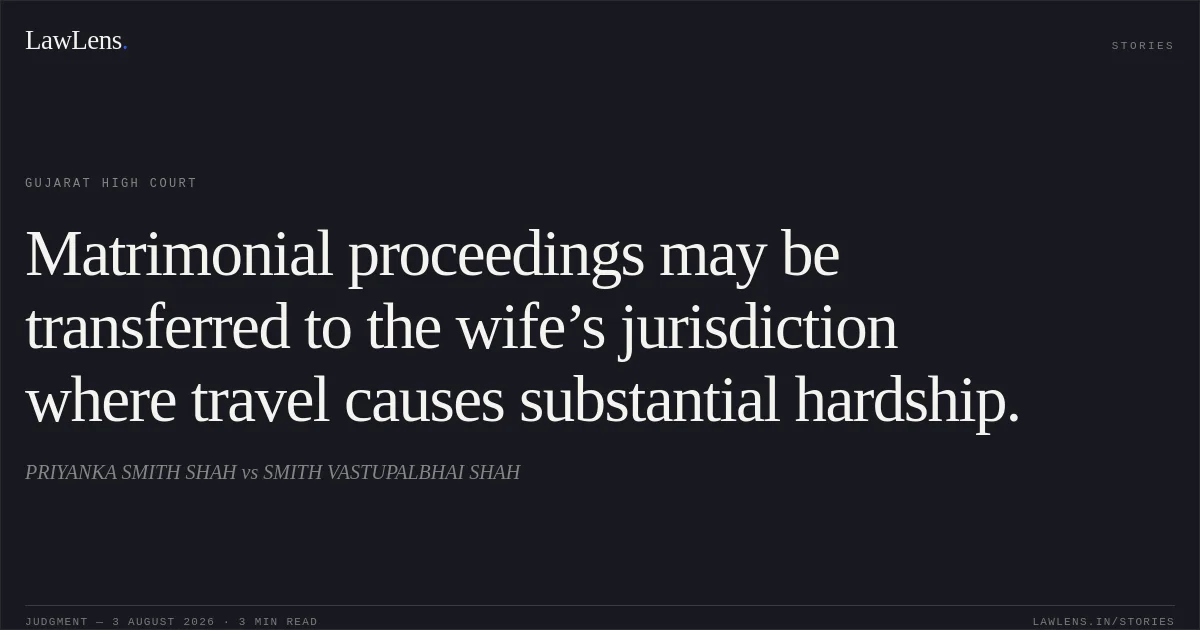
The applicant-wife filed an application under Section 24 of the Code of Civil Procedure, 1908, seeking transfer of Family Suit No. 279 of 2026, instituted by the respondent-husband and pending before the Family Court at Vadodara, to the Family Court at Sabarkantha.
Source reference: para. 4The applicant contended that she had instituted a maintenance proceeding under the Protection of Women from Domestic Violence Act, 2005, before the Court at Vadali on 4 October 2025 and that the respondent thereafter filed the Family Suit at Vadodara on 12 January 2026 as a counter-blast.
Source reference: para. 5The parties have an approximately eight-year-old daughter residing with and cared for by the applicant.
Source reference: para. 5.1The applicant further asserted that the distance between her residence and the Family Court at Vadodara was approximately 223 kilometres, causing substantial hardship and inconvenience.
Source reference: para. 5.2; para. 7Although notice of Rule was served on the respondent on 3 July 2026, he did not appear or contest the application.
Source reference: para. 3Issues
Whether Family Suit No. 279 of 2026 should be transferred from the Family Court at Vadodara to the Family Court at Sabarkantha under Section 24 of the CPC on account of the applicant-wife’s hardship and inconvenience?
Source reference: paras. 4, 7–9Whether, in balancing the inconvenience of the parties, the Court should exercise its discretion in favour of the applicant-wife where the respondent-husband has not appeared to contest the transfer application?
Source reference: paras. 3, 7–8Law Applied
The Court applied Section 24 of the Code of Civil Procedure, 1908, which empowers the High Court to transfer or withdraw a suit, appeal, or proceeding where such transfer is necessary in the interests of justice.
Source reference: no citationThe Court relied on Smita Singh v. Kumar Sanjay, AIR 2002 SC 396, and N.C.V. Aishwarya v. A.S. Saravana Karthik Sha, 2022 SCC OnLine SC 1199, for the principle that, in matrimonial transfer matters, the Court must consider the comparative hardship and inconvenience of the parties, particularly the wife’s practical difficulties in attending proceedings.
Source reference: para. 6The Court also treated the respondent’s failure to appear despite service as leaving the applicant’s averments uncontroverted.
Source reference: para. 7Reasoning
The Court found that requiring the applicant, who was residing with and caring for the parties’ minor daughter, to travel approximately 223 kilometres to Vadodara would cause significant hardship and inconvenience.
Source reference: paras. 5.1–5.2, 7Applying the principle of comparative inconvenience under Section 24 CPC and the cited Supreme Court decisions, the Court concluded that the hardship to the applicant was greater than the inconvenience likely to be caused to the respondent.
Source reference: para. 8The respondent had been duly served but neither appeared nor controverted the applicant’s assertions, further supporting the exercise of discretion in her favour.
Source reference: paras. 3, 7The Court also preserved the respondent’s ability to seek participation through video conferencing, subject to the Family Court’s assessment of whether physical presence was necessary at any particular stage.
Source reference: para. 10Holding
The High Court allowed the transfer application and ordered that Family Suit No. 279 of 2026 be transferred from the Family Court at Vadodara to the Family Court at Sabarkantha.
The Rule was made absolute.
Source reference: para. 11The respondent was permitted to request participation through video conferencing or online mode, which the Family Court could consider unless his physical presence was required for a particular proceeding.
Source reference: para. 10Acts & Sections Cited
1 provisions across 1 statute referred to in this judgment. Each provision opens on LawLens.
Code of Civil Procedure, 19081
Original Court PDF
PRIYANKA SMITH SHAHvsSMITH VASTUPALBHAI SHAH
Click to open original judgment
Original judgment, available to read, download and summarize on LawLens.in