Facts
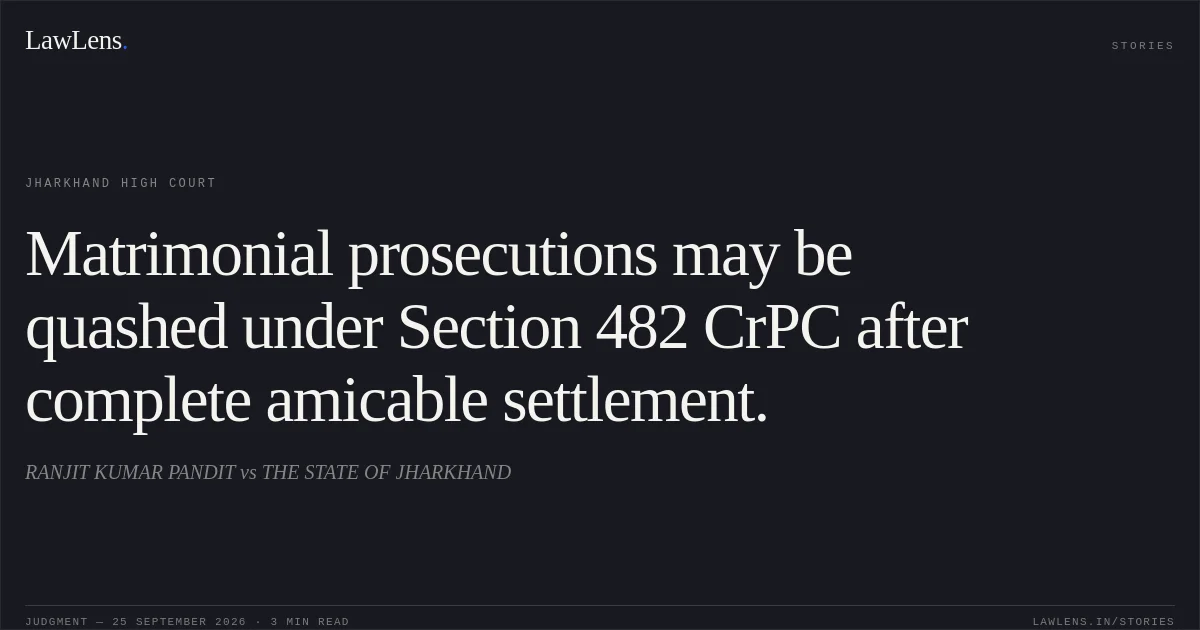
The petitioners invoked the High Court’s inherent jurisdiction under Section 482 CrPC seeking quashing of the criminal proceeding arising from C.P. Case No. 1955 of 2021 and the order dated 14 March 2022 passed by the Judicial Magistrate, 1st Class, Dhanbad, whereby cognizance/material was found sufficient to proceed against them for offences under Sections 498A/34 IPC and Section 4 of the Dowry Prohibition Act.
Source reference: p.2, para. 2The case arose out of a matrimonial dispute between the parties.
Source reference: no citationDuring the pendency of the petition, the accused and complainant entered into an amicable settlement with the intervention of common friends and well-wishers, supported by affidavits and a memorandum of settlement.
Source reference: pp.2–3, para. 4The State did not seriously oppose the petition in view of the compromise.
Source reference: p.3, para. 5The case was still at the pre-charge stage.
Source reference: p.2, para. 3Issues
Whether the High Court could exercise its inherent jurisdiction under Section 482 CrPC to quash the criminal proceeding and the order taking cognizance/material to proceed for offences under Sections 498A/34 IPC and Section 4 of the Dowry Prohibition Act on the basis of an amicable settlement between the parties?
Source reference: pp.2–3, paras. 2–5Whether continuation of the matrimonial criminal proceeding, despite the parties’ full settlement, would amount to an abuse of the process of law when the possibility of conviction had become remote and bleak?
Source reference: pp.3, 5–6, paras. 4, 6–8Law Applied
Section 482 CrPC preserves the High Court’s inherent power to make orders necessary to prevent abuse of the process of any court or to secure the ends of justice.
Source reference: p.4, para. 6Relying on Parbatbhai Aahir @ Parbatbhai Bhimsinhbhai Karmur v. State of Gujarat, (2017) 9 SCC 641, and the principles drawn from Gian Singh v. State of Punjab, (2012) 10 SCC 303, the Court held that the power to quash criminal proceedings is distinct from statutory compounding under Section 320 CrPC and may be exercised where the dispute is predominantly private or civil in nature, including matrimonial and dowry-related disputes, the parties have genuinely resolved the entire dispute, and continuation of the prosecution would be oppressive, unjust, or an abuse of process.
Source reference: pp.4–5, para. 6However, heinous offences, offences involving serious mental depravity, offences having a serious societal impact, and offences under special statutes such as corruption laws ordinarily cannot be quashed merely on the basis of compromise.
Source reference: pp.4–5, para. 6Reasoning
The Court found that the allegations arose from a matrimonial dispute and did not involve a heinous offence or serious mental depravity.
Source reference: p.6, para. 7The parties had entered into a final and amicable settlement, supported by affidavits and a memorandum of settlement, and the complainant consented to termination of the proceedings.
Source reference: pp.2–3, para. 4Applying the principles in Parbatbhai Aahir and Gian Singh, the Court treated the dispute as private and personal rather than one involving overriding public interest.
Source reference: no citationIn view of the settlement, the likelihood of conviction was considered remote and bleak, while continuation of the prosecution would cause hardship to the petitioners and amount to an abuse of the process of law.
Source reference: pp.3, 5–6, paras. 4, 7–8Holding
The High Court answered the issues in favour of the petitioners and held that the case was a fit one for exercise of inherent jurisdiction under Section 482 CrPC.
It quashed and set aside the entire criminal proceeding arising out of C.P. Case No. 1955 of 2021 and the order dated 14 March 2022, insofar as the petitioners were concerned.
Source reference: pp.6–7, paras. 8–9The criminal miscellaneous petition was accordingly allowed, and Interlocutory Application No. 13634 of 2026 was disposed of.
Source reference: p.7, paras. 10–11Acts & Sections Cited
4 provisions across 3 statutes referred to in this judgment. Each provision opens on LawLens.
Code of Criminal Procedure, 19732
Indian Penal Code, 18601
Dowry Prohibition Act, 19611
Original Court PDF
RANJIT KUMAR PANDITvsTHE STATE OF JHARKHAND
Click to open original judgment
Original judgment, available to read, download and summarize on LawLens.in