Facts
The respondent no. 2, Mr. Gulshan Pahuja ("contemnor"), was found guilty of criminal contempt of Court via judgment dated 21.04.2026 for scandalizing the court through videos uploaded online.
Source reference: p. 1-2The Court issued notice under Rule 13(1) of the Contempt of Courts (Delhi High Court) Rules, 2025, to hear him on the quantum of punishment.
Source reference: p. 2The contemnor filed an application (Crl. M.A. 15810/2026) to recall the conviction, alleging procedural irregularities, violation of constitutional rights (Articles 14, 20(3), and 21), and lack of opportunity to cross-examine judicial officers named in his videos.
Source reference: p. 2-3During the hearing on sentencing, the contemnor made further scandalous remarks, stating he expected no justice from the "dictatorial" Indian judicial system.
Source reference: p. 4Issues
1. Whether the judgment of conviction dated 21.04.2026 should be recalled or set aside based on alleged procedural irregularities and constitutional violations.
Source reference: p. 22. What is the appropriate quantum of punishment to be awarded under Section 12 of the Contempt of Courts Act, 1971, given the contemnor's conduct and lack of remorse.
Source reference: p. 2, 5Law Applied
The Court applied Section 2(c) of the Contempt of Courts Act, 1971, which defines criminal contempt as acts that scandalize or lower the authority of the court.
Source reference: p. 1-2Punishment was determined under Section 12 of the Act, which provides for simple imprisonment and fine.
Source reference: p. 2, 6Procedurally, the Court adhered to Rule 13(1) of the Contempt of Courts (Delhi High Court) Rules, 2025.
Source reference: p. 2Regarding the stay of execution, the Court invoked Section 19(3) of the Act, which allows for the suspension of a sentence to permit the contemnor to file an appeal.
Source reference: p. 5, 6Reasoning
The Court rejected the contemnor’s plea to recall the conviction, noting that it cannot sit in review of its own judgment and that the contemnor’s remedy lies in a legal challenge/appeal.
Source reference: p. 6In analyzing the quantum of punishment, the Court observed that the contemnor displayed no remorse or regret; instead, he compounded the contempt by making fresh scandalous remarks in open court, such as equating judicial discretion with "tyranny".
Source reference: p. 4-5The Court noted that the contemnor had brazenly violated a previous interim order (dated 14.05.2025) which prohibited him from uploading further defamatory videos.
Source reference: p. 5The Court reasoned that a mere fine would be insufficient, as the contemnor's defiant stance suggested he would repeat the offenses unless an adequate deterrent was imposed.
Source reference: p. 5, 6Holding
The Court held that the contemnor did not deserve mercy due to his unrepentant conduct and persistent scandalization of the judiciary.
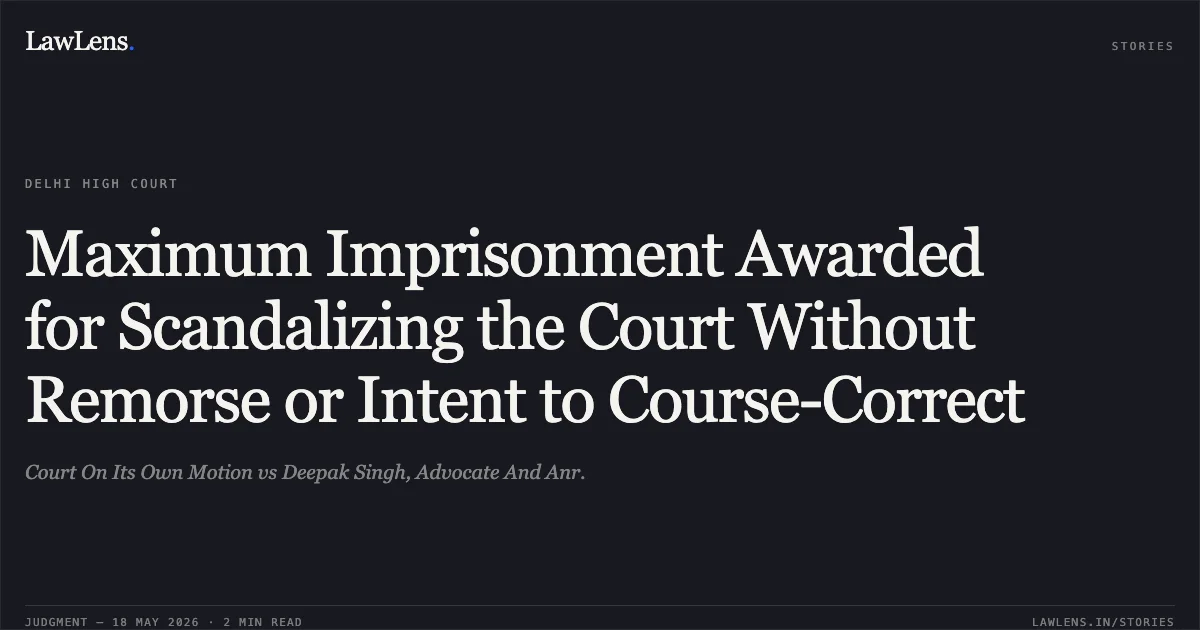
The Court sentenced Mr. Gulshan Pahuja to six months of simple imprisonment and a fine of Rs. 2,000 in each of the two matters, with the sentences to run concurrently. Failure to pay the fine results in an additional month of simple imprisonment. However, exercising power under Section 19(3) of the Act, the Court suspended the sentence for 60 days to allow the contemnor to appeal to the Supreme Court, subject to his surrender before the Registrar General if no stay is granted.
Source reference: p. 6-7Acts & Sections Cited
3 provisions across 1 statute referred to in this judgment. Each provision opens on LawLens.
Contempt of Courts Act, 19713
Original Court PDF
Court On Its Own MotionvsDeepak Singh, Advocate And Anr.
Click to open original judgment
Original judgment, available to read, download and summarize on LawLens.in