Facts
FIR No. 165/2024 was registered by Police Station Crime Branch on 28.08.2024 under Sections 3 and 4 of the Maharashtra Control of Organised Crime Act, 1999 (“MCOCA”), as extended to Delhi, against Kapil Sangwan @ Nandu and members or associates of his alleged organised crime syndicate.
Source reference: paras. 1, 9–13The prosecution alleged that the syndicate engaged in extortion, threats, shootouts, land-grabbing and other unlawful activities for pecuniary benefit, and relied upon several earlier FIRs in which cognizance had been taken.
Source reference: paras. 10–13, 72The appellant, Naresh Balyan, was arrested in the present case on 04.12.2024 after obtaining bail in another case, FIR No. 191/2023, in which he was alleged to have mediated a ransom demand made by Kapil Sangwan.
Source reference: paras. 15–17A chargesheet and supplementary chargesheets were filed, and the appellant was ultimately sent up for trial through the second supplementary chargesheet.
Source reference: paras. 18–22The prosecution relied upon voice recordings, forensic voice matching, protected-witness statements, statements and confessions of co-accused under Section 18 of MCOCA, alleged property transactions, technical connectivity with the syndicate, and alleged investment of unaccounted money.
Source reference: para. 23The appellant’s bail applications were rejected by the Trial Court on 15.01.2025 and 27.05.2025. The present proceedings arose from the latter order. At the time of the High Court’s consideration, charges had not yet been framed and arguments on charge were pending.
Source reference: paras. 3–7Issues
Whether the statutory preconditions for invoking MCOCA, particularly “continuing unlawful activity” and the requirement of more than one chargesheet in the preceding ten years, were satisfied even though the appellant was not named in all previous cases and the prosecution allegedly failed to identify a fresh act attributable to him.
Source reference: paras. 43–50Whether registration of a separate FIR under MCOCA, based substantially on the organised crime syndicate’s earlier activities, amounted to double jeopardy or was otherwise legally impermissible.
Source reference: paras. 43–44, 58–62Whether the material collected by the prosecution established sufficient grounds to attract the bar to bail under Section 21(4) of MCOCA.
Source reference: paras. 32–38, 68–78Whether the alleged retracted confessions, audio recordings, protected-witness statements and property-related evidence could be considered at the bail stage.
Source reference: paras. 70–77Whether the appellant’s prolonged pre-trial custody and the pendency of arguments on charge justified bail on the ground of violation of the right to speedy trial under Article 21 of the Constitution.
Source reference: para. 79Law Applied
The Court applied Sections 2(1)(d), 2(1)(e) and 2(1)(f) of MCOCA, defining an organised crime syndicate, organised crime and continuing unlawful activity; Sections 3 and 4, which penalise organised crime and possession of unaccountable wealth; Section 21(4), which requires reasonable grounds for believing that the accused is not guilty and is unlikely to commit an offence while on bail; Section 22, concerning statutory presumptions; and Section 23, prescribing the approval and sanction requirements for prosecution under MCOCA.
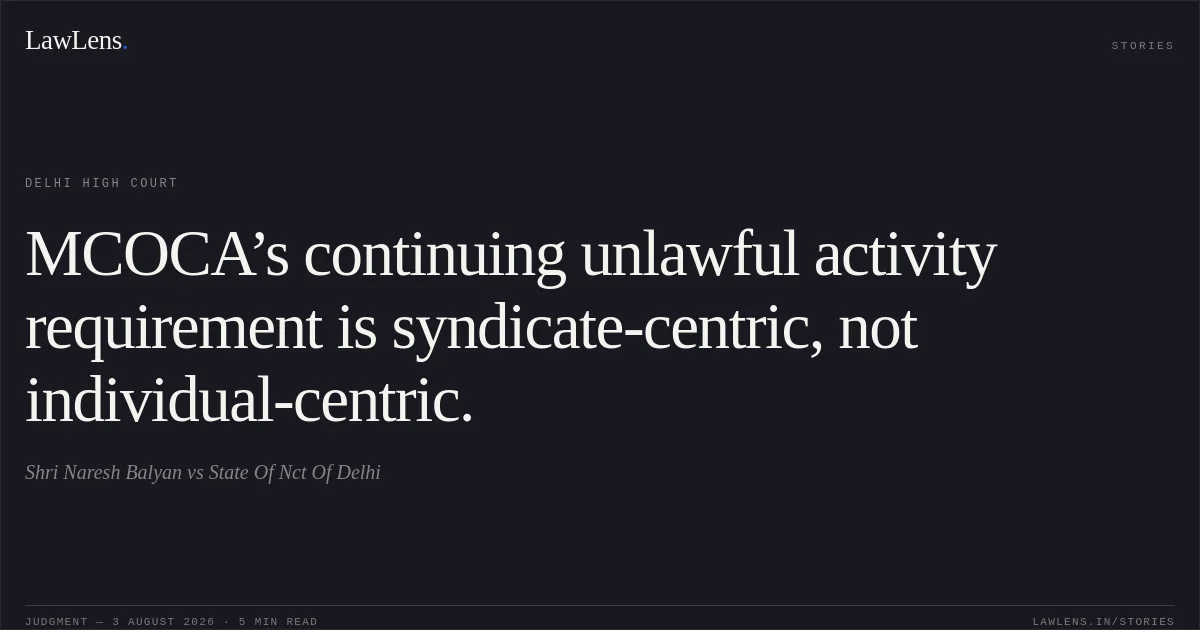
Source reference: paras. 45–55The Court held that the requirement of more than one chargesheet is syndicate-centric rather than individual-centric, and that a person may attract MCOCA as a member, facilitator or abettor even if not named in every earlier chargesheet.
Source reference: paras. 46–49It further held that the prosecution may either apply MCOCA to an existing FIR or register a separate FIR, and that a separate FIR does not, by itself, constitute double jeopardy.
Source reference: paras. 58–62At the bail stage, the Court must conduct a broad or surface-level assessment rather than a meticulous appreciation of evidence, while nevertheless satisfying itself that the statutory threshold for MCOCA is prima facie met.
Source reference: paras. 33–38Relying upon Ranjitsing Bharamjeetsing Sharma v. State of Maharashtra, the Court stated that Section 21(4) must be applied reasonably and not as if the Court were determining guilt after trial.
Source reference: para. 36Relying upon State of Maharashtra v. Bharat Shantilal Shah and Abhishek v. State of Maharashtra, it reiterated that MCOCA is to be strictly construed but not in a manner that defeats its legislative purpose.
Source reference: paras. 39, 45The Court also held that questions concerning the validity of approval, the evidentiary value of confessions and retractions, and the ultimate reliability of the prosecution material are ordinarily matters for trial.
Source reference: paras. 66, 70Reasoning
The Court found that the prosecution had prima facie demonstrated the existence of an organised crime syndicate headed by Kapil Sangwan and a continuing pattern of unlawful activities involving threats, extortion, violence and property-related coercion for pecuniary gain.
Source reference: paras. 68–78The statutory requirement of previous chargesheets was held to be satisfied by reference to the activities of the syndicate; the appellant could not defeat MCOCA merely by asserting that he was not individually named in the earlier chargesheets.
Source reference: paras. 46–49, 72The Court also rejected the contention that a fresh FIR was barred, holding that the MCOCA offence arises from the continuing and syndicate-based nature of the unlawful activity and that no double jeopardy was established.
Source reference: paras. 58–62, 80The evidence matrix disclosed a prima facie nexus between the appellant and the syndicate.
Source reference: no citationThe alleged confessions of co-accused referred to his assistance in extortion, settlement of disputes and investment of syndicate funds; their alleged retractions could not be conclusively assessed at the bail stage.
Source reference: para. 70The audio recording, supported by a forensic voice match, allegedly indicated communication between the appellant and the syndicate head and involvement in threatening businessmen and extorting money.
Source reference: para. 74Protected-witness statements, property transactions, alleged use of proxy mobile numbers and VPN/IP-hider applications, and the alleged acquisition of properties through coercive tactics further supported the prosecution’s case at the prima facie level.
Source reference: paras. 71, 75–78Consequently, the appellant failed to satisfy the twin requirements under Section 21(4) that there were reasonable grounds to believe he was not guilty and that he was unlikely to commit an offence while on bail.
Source reference: paras. 35, 78, 81The Court acknowledged the importance of speedy trial but held that, given the seriousness and complexity of the organised crime prosecution and the fact that arguments on charge were underway, custody alone did not justify bail.
Source reference: para. 79Holding
The High Court held that the invocation of MCOCA was prima facie justified, the requirement of continuing unlawful activity was satisfied on a syndicate-centric assessment, and the separate registration of FIR No. 165/2024 did not amount to double jeopardy.
The prosecution material was sufficient at the bail stage to attract the restrictions under Section 21(4) of MCOCA, and the appellant failed to meet its twin conditions.
Source reference: no citationThe appeal was dismissed, the order dated 27.05.2025 refusing bail was upheld, and the application for bail was rejected.
Source reference: para. 81The Court clarified that its observations were tentative and would not prejudice the Trial Court while considering charge or conducting the subsequent trial.
Source reference: para. 82Original Court PDF
Shri Naresh BalyanvsState Of Nct Of Delhi
Click to open original judgment
Original judgment, available to read, download and summarize on LawLens.in