Facts
The appellants, Chandrapal Yadav and Azad Singh, along with co-accused Sheo Dutt, were arrested in October 1987 by a police party acting on an informant's tip regarding a planned dacoity.
Source reference: para. 3The prosecution alleged that illegal firearms and cartridges were recovered from their possession.
Source reference: para. 11The trial court acquitted the accused of charges under Sections 399/402 of the IPC (preparation for dacoity) due to a lack of independent corroboration, but convicted them under Section 25 of the Arms Act and sentenced them to one year of rigorous imprisonment.
Source reference: paras. 1, 9, 26During the pendency of this appeal, appellant Chandrapal Yadav died, leading to the abatement of his appeal.
Source reference: para. 2Appellant Azad Singh challenged the conviction on the grounds of false implication, procedural lapses in recovery, and defective prosecution sanction.
Source reference: para. 17Issues
1. Whether the conviction under Section 25 of the Arms Act is sustainable when founded on the same evidence that led to the acquittal under Sections 399/402 of the IPC.
Source reference: para. 202. Whether the prosecution proved that the sanction for prosecution under Section 39 of the Arms Act was granted after due application of mind.
Source reference: para. 283. Whether the failure to produce a ballistic expert's report or proof of proper sealing of the recovered items vitiates the trial.
Source reference: paras. 21, 35Law Applied
The court applied Section 39 of the Arms Act, 1959, which mandates prior sanction from the District Magistrate for prosecution, emphasizing that such sanction must reflect a "quasi-judicial" application of mind rather than a mechanical administrative act.
Source reference: paras. 28-31It relied on Section 3(4) of the Cr.P.C. regarding the nature of executive vs. judicial functions.
Source reference: para. 30The court cited State of Rajasthan v. Daulat Ram (AIR 1980 SC 1314) to establish that failure to prove proper sealing and safe custody of seized items is fatal to the prosecution.
Source reference: para. 36The court applied the principle from Buta Singh v. State of Punjab (1997 SCC (Cri.) 1217) that conviction for possession of arms cannot be sustained without expert evidence (ballistic/armourer report) proving the objects meet the statutory definition of "arms".
Source reference: para. 41Reasoning
The court found the prosecution's case fundamentally flawed due to several procedural and evidentiary lapses. First, the trial court's selective acceptance of evidence—disbelieving the police and independent witness (PW-4) regarding the dacoity planning but believing them regarding the arms recovery—was deemed legally inconsistent.
Source reference: para. 26The court noted that the "Rawangi GD" (dispatch diary) and the ballistic expert's report were never produced, leaving no proof that the seized items were functional firearms.
Source reference: paras. 21, 39The court held the sanction under Section 39 of the Arms Act to be invalid because the order did not describe the weapons or the circumstances of the arrest, indicating a lack of "due application of mind" by the District Magistrate.
Source reference: paras. 29, 38The absence of the seal used during recovery and the failure to prove the weapons were produced in a sealed state before the sanctioning authority created a "shadow of doubt" regarding potential tampering.
Source reference: paras. 33-37Holding
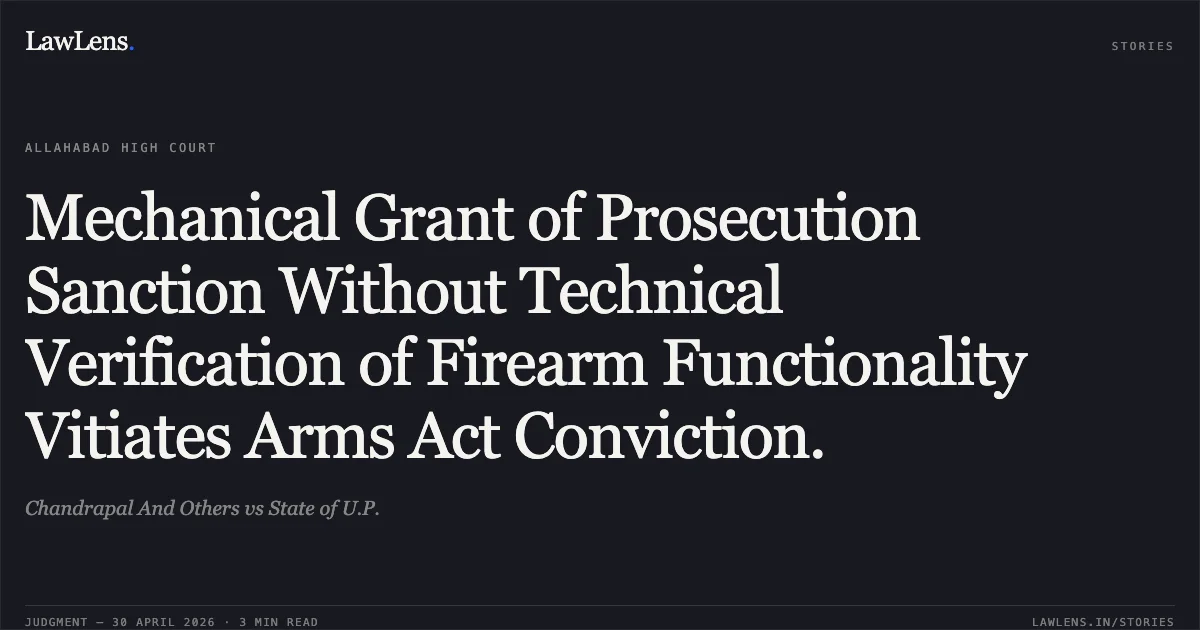
The court held that the conviction under Section 25 of the Arms Act could not be sustained because the prosecution failed to provide technical evidence (ballistic report), the sanction was mechanical and defective, and the recovery process lacked procedural safeguards like proper sealing and independent verification.
The High Court allowed the appeal, set aside the conviction of Azad Singh, acquitted him, cancelled his bail bonds, and discharged his sureties.
Source reference: paras. 40, 48Acts & Sections Cited
9 provisions across 3 statutes referred to in this judgment. Each provision opens on LawLens.
Code of Criminal Procedure, 19734
Arms Act, 19593
Indian Penal Code, 18602
Original Court PDF
Chandrapal And OthersvsState of U.P.
Click to open original judgment
Original judgment, available to read, download and summarize on LawLens.in


