01Facts
The Petitioner (Accused) entered into an Agreement to Sell dated 20.06.2019 with Respondent No. 2 for a property in Noida for Rs. 7.85 Crores, receiving an advance of Rs. 2 Crores
p. 3The Respondent alleged that the Petitioner failed to hand over possession or refund the money, despite the property being auctioned by a bank due to an existing mortgage
pp. 3-4A Magistrate directed the registration of an FIR under Section 156(3) Cr.P.C., which was upheld by the Revisional Court
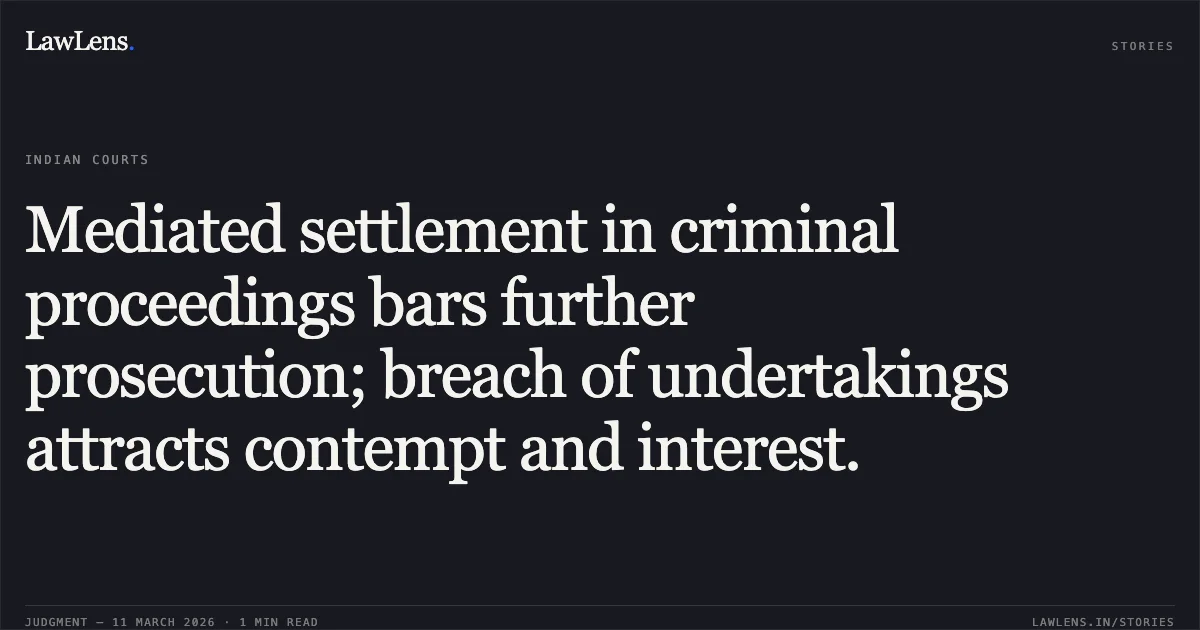
pp. 3-4While the quashing petition was pending, the parties entered into a Mediated Settlement on 17.05.2022, where the Petitioner agreed to pay Rs. 2.80 Crores in installments
pp. 6-7Although the principal was largely paid, delays in interest payments led the Respondent to file Contempt Petitions alleging breach of court-recorded undertakings
p. 8, 1102Issues
i.1. Whether criminal proceedings and the order for registration of an FIR should be quashed following a voluntary mediated settlement between the parties.
p. 8 / para. 21ii.2. Whether the repeated failure to adhere to payment timelines stipulated in a court-recorded settlement constitutes "wilful disobedience" under the Contempt of Courts Act, 1971.
p. 11 / para. 3703Law Applied
The Court applied the principle from *Gimpex Private Limited v. Manoj Goel (2022)*, which holds that once a compromise is reached, the original complaint should be quashed, leaving parties to remedies under the settlement
p. 9It relied on the Division Bench ruling in *Dayawanti v. Yogesh Kumar Gosain (2017)*, establishing that mediated settlements in compoundable offences are legally binding and enforceable through execution under Section 421/431 Cr.P.C. or contempt proceedings
pp. 9-11Regarding contempt, the Court invoked Section 2(b) of the Contempt of Courts Act, 1971, noting per *Kanwar Singh Saini v. High Court of Delhi (2012)* and *Viterra B.V. vs. Sharp Corp Limited (2024)*, that "intent" is the essence of contempt and disobedience must be "wilful and deliberate"
pp. 12-1304Reasoning
The Court reasoned that since the parties voluntarily entered a Mediated Settlement and the Petitioner had already paid the principal amount, the criminal proceedings for cheating had lost their purpose; continuing them would constitute an abuse of process
p. 8, 10The Court noted that the agreement itself provided a mechanism for defaults (12% interest), which the parties later enhanced to 18% during court proceedings
pp. 8-9However, regarding the Contempt Petitions, the Court found the Petitioner’s conduct—making payments only when the matter was listed for hearing—to be "contemptuous"
pp. 13-14It determined that while the criminal FIR deserved quashing to give effect to the settlement, the Petitioner remained liable for the "wilful" delay in fulfilling undertakings given directly to the Court
p. 1405Holding
The Court allowed the main petition (CRL.M.C. 3209/2021) and quashed the orders of the MM and ASJ directing the registration of an FIR
p. 11On the Contempt Petitions, the Court held that the Petitioner's conduct was prima facie contemptuous
p. 14It issued a Show Cause Notice to the Petitioner to either clear the balance amount within six weeks or explain why he should not be punished under the Contempt of Courts Act, 1971
p. 14The contempt matters were listed for further hearing on 30.04.2026
p. 14Original Court PDF
Shailendra Bhadauria v. The State NCT of Delhi & Anr. CRL.M.C. 3209/2021, CONT.CAS(C) 809/2024, and CONT.CAS(C) 696/2025.
Click to open original judgment
Original judgment, available to read, download and summarize on LawLens.in