Facts
The appellant was tried under Section 376 of the Indian Penal Code, 1860, for allegedly sexually assaulting the informant’s approximately four-and-a-half-year-old daughter on 28 June 2009.
Source reference: p.2The prosecution alleged that the child returned home with bloodstains on her clothes and disclosed that the appellant had assaulted her. The clothes were washed before being handed over to the police, and the FIR was lodged at 5:45 p.m. on the same day.
Source reference: p.2; p.6The trial court considered the evidence of the child, her mother and the prosecution witnesses unreliable due to material discrepancies and acquitted the appellant on 12 January 2010.
Source reference: p.2–3The Himachal Pradesh High Court reversed the acquittal, convicted the appellant under Section 376 IPC, and sentenced him to ten years’ rigorous imprisonment and a fine of ₹50,000 on 3 June 2016.
Source reference: p.1–2Before the Supreme Court, the appellant relied on the absence of injuries, the medical opinion that there was no evidence of penetration, and the FSL report showing no blood or semen on the victim’s clothes or the alleged place of occurrence.
Source reference: p.3–4; p.6–8Issues
Whether the High Court was justified in reversing the trial court’s acquittal and convicting the appellant under Section 376 IPC despite the material discrepancies in the prosecution evidence.
Source reference: p.3–5; p.11–12Whether the medical evidence and FSL report, which disclosed no injury or penetration and no blood or semen on the victim’s clothes or the alleged scene of occurrence, created a reasonable doubt regarding the prosecution case.
Source reference: p.6–11Whether the prosecution proved the appellant’s guilt beyond reasonable doubt on the basis of the testimony of the victim and other prosecution witnesses.
Source reference: p.11–13Law Applied
The Court applied Section 376 of the Indian Penal Code, 1860, and the fundamental criminal-law requirement that the prosecution must establish guilt beyond reasonable doubt.
Source reference: p.1; p.12–13In an appeal against acquittal, the appellate court must consider the entire evidentiary record and should not interfere merely by substituting its view for that of the trial court; interference is warranted only where the acquittal is shown to be unsustainable or perverse.
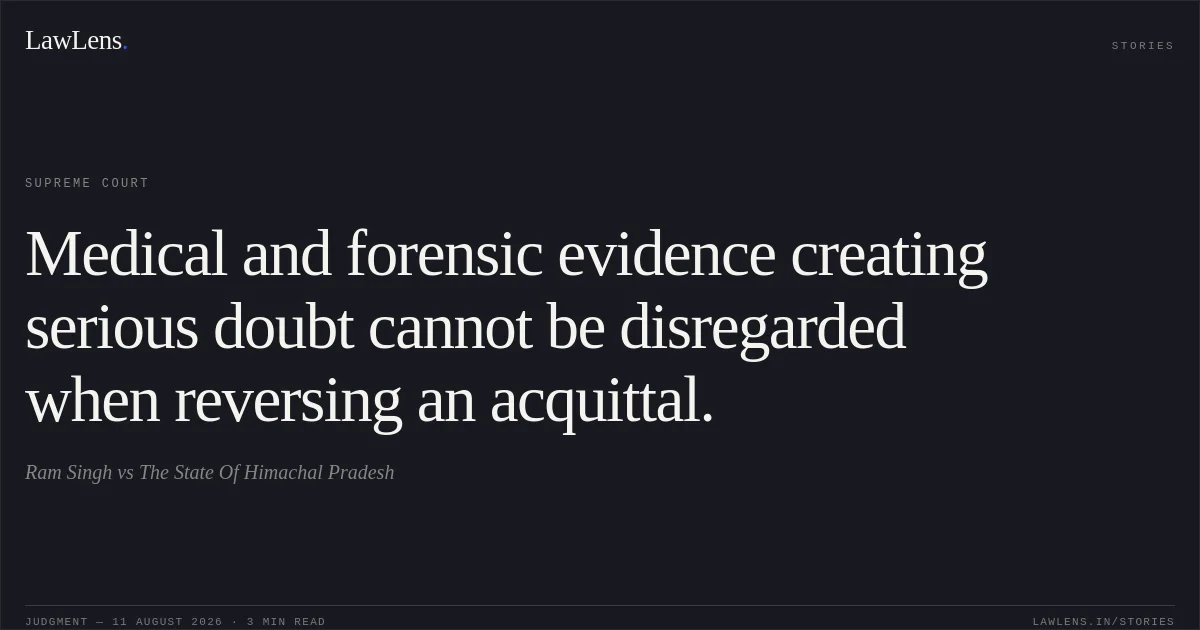
Source reference: p.3–5; p.11–12Medical and forensic evidence must be assessed alongside ocular testimony. Although such evidence does not automatically override direct testimony, the absence of injuries, blood and semen may assume significance where it materially contradicts the prosecution’s specific version of the occurrence.
Source reference: p.6–10A conviction cannot be sustained where the cumulative evidence gives rise to a serious or reasonable doubt.
Source reference: p.12–13Reasoning
The Court found material inconsistencies in the testimonies of the mother and the victim, particularly concerning the alleged bloodstains and the place of occurrence.
Source reference: p.6–7The medical examination conducted within approximately twelve hours revealed no injury, inflammation, bruising, laceration, blood or seminal stain, and the final medical opinion found no evidence of penetration.
Source reference: p.6–7The FSL report likewise detected neither blood nor semen on the victim’s clothes, and neither blood nor semen on the seized chatai and baithak allegedly connected with the incident.
Source reference: p.7–8; p.10The alleged occurrence was said to have taken place on a cot, whereas the investigating officer stated that it occurred in the kitchen, where there was no cot or bed.
Source reference: p.10–11Although semen was detected on the appellant’s underwear, the Court held that this circumstance, by itself, was not relevant in view of the other deficiencies in the prosecution case.
Source reference: p.12The High Court failed to consider the final medical opinion and FSL report while reversing the acquittal, whereas the trial court had assessed the evidence cumulatively and identified material discrepancies.
Source reference: p.11–12These circumstances created a serious doubt that the prosecution had not overcome.
Source reference: p.12–13Holding
The Supreme Court held that the prosecution failed to prove the charge under Section 376 IPC beyond reasonable doubt.
It found that the trial court had rightly acquitted the appellant and that the High Court had erred in reversing that acquittal without properly considering the medical and forensic evidence.
Source reference: p.12–13The High Court’s judgment dated 3 June 2016 was set aside, the appellant was acquitted, and his bail bonds were cancelled.
Source reference: p.13The criminal appeal was allowed.
Source reference: p.13Acts & Sections Cited
1 provisions across 1 statute referred to in this judgment. Each provision opens on LawLens.
Indian Penal Code, 18601
Original Court PDF
Ram SinghvsThe State Of Himachal Pradesh
Click to open original judgment
Original judgment, available to read, download and summarize on LawLens.in