Facts
The deceased was taken from his house by the appellants on 17 July 2006, allegedly to go to Ankleshwar to play volleyball. He did not return that evening. His clothes and belongings were later found on the bank of a river, and his body was recovered the following morning.
Source reference: pp. 5–6, paras. 7–10The post-mortem attributed death to cardio-respiratory arrest caused by asphyxia due to drowning and recorded three minor injuries, which the doctor stated could have resulted from contact with stones while bathing or being carried by the river current.
Source reference: pp. 5–6, paras. 7–10The appellants admitted that they had accompanied the deceased to the river, but maintained that he had accidentally drowned and that they had fled in panic.
Source reference: pp. 2–3, para. 2An FIR alleging murder and motive was registered approximately four months after the incident, on 3 November 2006.
Source reference: pp. 7–8, para. 12The Trial Court convicted the appellants under Sections 302, 34, 201 and 120-B of the Indian Penal Code and imposed life imprisonment for murder, along with additional sentences. The High Court affirmed the conviction. The appellants challenged those findings before the Supreme Court.
Source reference: p. 3, para. 3Issues
1. Whether the prosecution established beyond reasonable doubt that the deceased’s drowning was homicidal and that the appellants had intentionally caused his death under Sections 302 and 34 IPC.
Source reference: pp. 5–7, paras. 8–10, 21–232. Whether the circumstances relied upon by the prosecution—including motive, last-seen evidence, alleged false statements, post-occurrence conduct, and alleged admissions—were sufficient to sustain the convictions under Sections 302, 120-B and 201 IPC.
Source reference: pp. 7–14, paras. 12–233. Whether the appellants’ conduct in fleeing the riverbank and failing to report the drowning constituted incriminating conduct proving murder or concealment of evidence.
Source reference: pp. 12–14, paras. 21–23Law Applied
The Court considered the offences charged under Sections 302, 34, 201 and 120-B of the Indian Penal Code: Section 302 requires proof of murder; Section 34 requires a shared common intention; Section 201 requires causing disappearance of evidence or giving false information to screen an offender; and Section 120-B requires proof of criminal conspiracy.
Source reference: pp. 5–7, paras. 8–10In a case resting on circumstantial evidence, the prosecution must establish each incriminating circumstance and a complete chain pointing to guilt, while excluding a reasonably probable hypothesis of innocence.
Source reference: pp. 5–7, paras. 8–10Medical evidence must support, rather than merely permit, a finding of homicidal death.
Source reference: pp. 5–7, paras. 8–10Subsequent conduct, silence, or an alleged false explanation cannot independently establish guilt where the foundational circumstances—particularly homicidal death and the accused’s intentional participation—remain unproved.
Source reference: pp. 12–14, paras. 21–23Reasoning
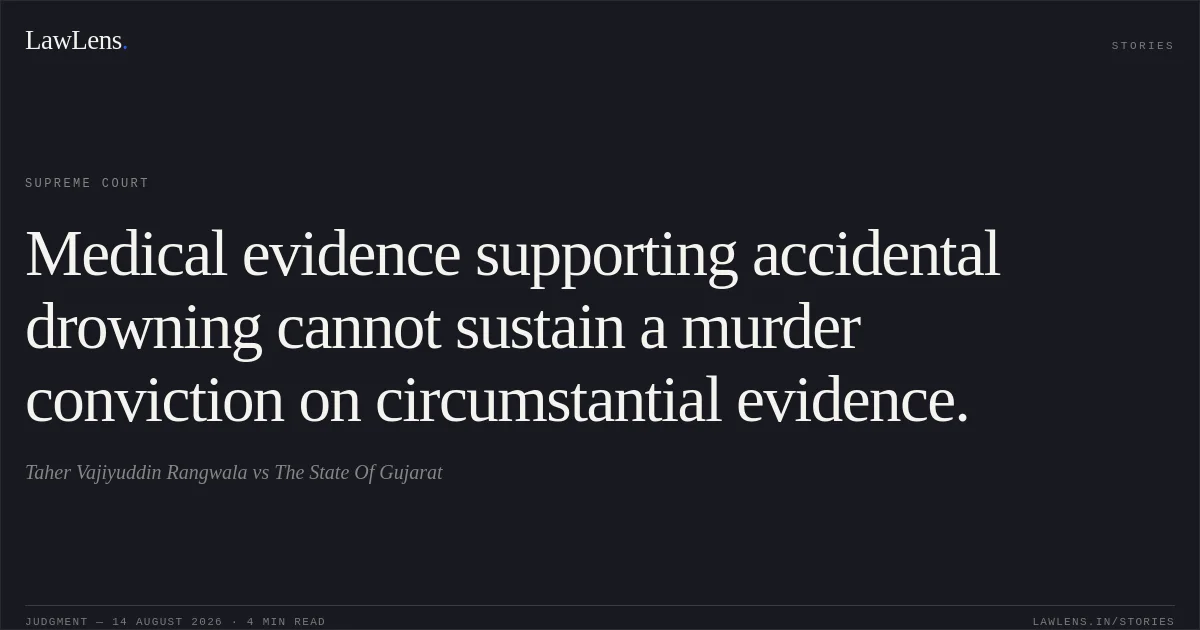
The Supreme Court held that the medical evidence did not establish homicide. The post-mortem showed drowning as the cause of death, while the recorded injuries were minor and could have been caused during bathing or by the body coming into contact with stones in the river.
Source reference: pp. 5–6, paras. 8–10Although the prosecution suggested that the deceased had been struck with a broken soda bottle, no broken bottle or blood-stained fragments were seized or sent for forensic examination.
Source reference: pp. 6–7, paras. 9–10The last-seen circumstance and the appellants’ presence at the river were accepted, but were equally consistent with the defence version that the deceased accidentally drowned while bathing.
Source reference: pp. 8–10, paras. 12–15The alleged motive was weakened by the deceased’s family having permitted him to leave with the appellants and by the apparently friendly relationship between them; the motive was also raised only after a substantial delay.
Source reference: pp. 8–10, paras. 12–15The evidence of the shop and pan-parlour witnesses merely suggested that the appellants had consumed alcohol and returned only three of four soda bottles; their in-court identification was of limited value because no test identification parade had been conducted.
Source reference: pp. 10–11, paras. 16–17The Court further held that fleeing in panic, failing to raise an alarm, going to a movie, or initially giving an incorrect account of the deceased’s whereabouts did not prove murder or concealment of evidence, since such conduct was also compatible with an accidental drowning.
Source reference: pp. 12–14, paras. 21–22As the prosecution failed to establish homicidal death or a complete chain of circumstances inconsistent with innocence, the convictions could not be sustained.
Source reference: pp. 14–15, paras. 23–24Holding
The Supreme Court answered the issues in favour of the appellants. It held that the evidence indicated accidental drowning rather than premeditated murder and that none of the prosecution’s circumstances proved the appellants’ guilt beyond reasonable doubt.
The judgments of the Trial Court and the High Court were reversed, and both appellants were acquitted.
Source reference: p. 15, paras. 24–27They were directed to be released forthwith if not required in any other case; if already released on bail, their bail bonds were ordered to stand cancelled. The appeal was allowed.
Source reference: p. 15, paras. 24–27Acts & Sections Cited
3 provisions across 1 statute referred to in this judgment. Each provision opens on LawLens.
Indian Penal Code, 18603
Original Court PDF
Taher Vajiyuddin RangwalavsThe State Of Gujarat
Click to open original judgment
Original judgment, available to read, download and summarize on LawLens.in