Facts
Meena Pal, aged approximately 20 years and carrying pregnancy, was admitted to Paramhansay Hospital, Budhar, on 3 June 2015 for delivery. A Caesarean operation was performed by the petitioners and the child was delivered at approximately 8:30 a.m. The prosecution alleged that Meena thereafter suffered postpartum haemorrhage and died at about midnight.
Source reference: para. 3An inquiry under Section 174 Cr.P.C. was initially conducted, followed by collection of witness statements, the post-mortem report, inquest material, inspection reports and other documents.
Source reference: para. 3The prosecution further alleged that the hospital had previously been directed to close because of statutory deficiencies and inadequate facilities, particularly in the operation theatre, but that the petitioners continued to conduct surgical procedures there.
Source reference: para. 4FIR No. 442/2015 was subsequently registered at Police Station Budhar for offences under Section 304 Part-II read with Section 34 IPC and Section 8 of the Madhya Pradesh Upcharyagriha Tatha Rujopchar Sambandhi Sthapnaye (Registrikaran Tatha Anugyapan) Adhiniyam, 1973.
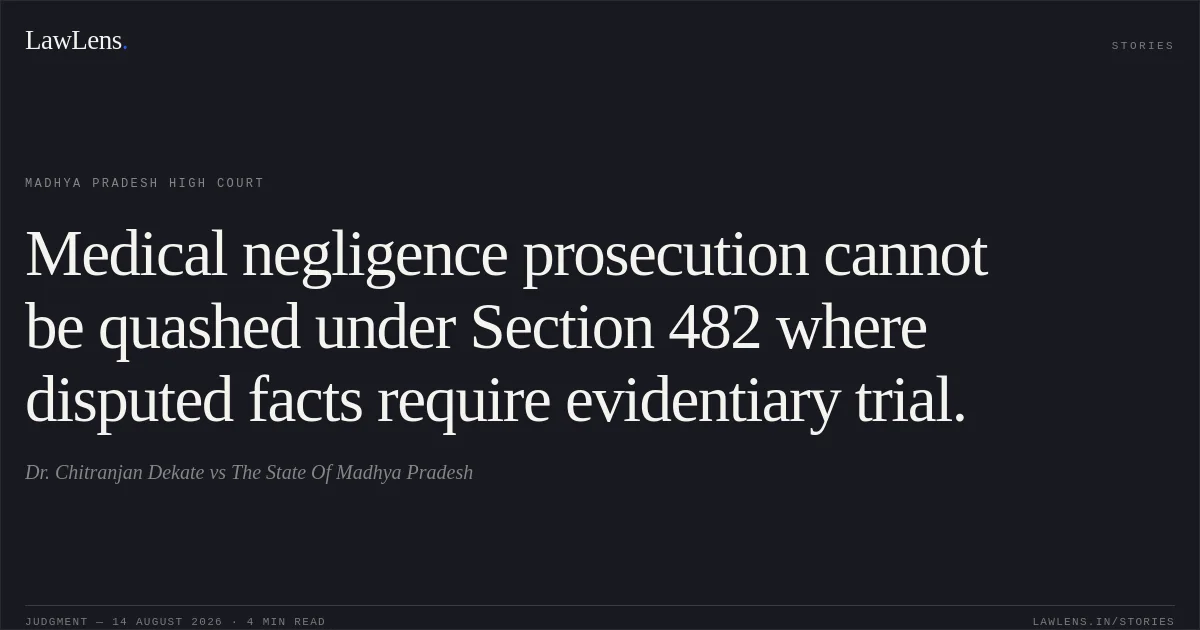
Source reference: para. 2The petitioners sought quashing of the FIR and consequential proceedings under Section 482 Cr.P.C.
Source reference: paras. 6–8Issues
Whether the FIR and material collected during investigation disclosed sufficient grounds to proceed against the petitioners under Section 304 Part-II read with Section 34 IPC, or whether the allegations could only constitute medical negligence under Section 304-A IPC?
Source reference: paras. 6, 11, 18, 21Whether the absence of a conclusive medical opinion attributing the death to negligence justified quashing the FIR under Section 482 Cr.P.C.?
Source reference: paras. 7, 11–13, 17, 19Whether the disputed facts concerning the treatment administered after delivery, the missing medical case sheet, the alleged closure order and the hospital’s facilities could be conclusively determined in proceedings under Section 482 Cr.P.C.?
Source reference: paras. 14–18, 20, 23Law Applied
The Court applied Section 482 Cr.P.C., under which the High Court’s inherent jurisdiction to prevent abuse of process or secure the ends of justice must be exercised sparingly and cannot be used to conduct a mini-trial.
Source reference: paras. 18, 21Section 304 Part-II IPC requires proof of culpable homicide involving the requisite knowledge, while Section 304-A IPC concerns death caused by rash or negligent acts not amounting to culpable homicide; the Court held that the precise offence cannot ordinarily be conclusively determined at the FIR-quashing stage.
Source reference: paras. 18, 21Section 34 IPC and Section 8 of the 1973 Adhiniyam formed part of the offences alleged.
Source reference: para. 2Relying on Jacob Mathew v. State of Punjab, (2005) 6 SCC 1, along with Martin F. D’Souza v. Mohd. Ishfaq, (2009) 3 SCC 1 and Ins. Malhotra (Ms.) v. Dr. A. Kriplani, (2009) 4 SCC 705, the Court recognized that criminal medical negligence requires a degree of negligence substantially higher than ordinary civil negligence and that medical professionals should not be prosecuted merely because treatment was unsuccessful or a patient died.
Source reference: paras. 6, 11–13, 19However, Central Bureau of Investigation v. Aryan Singh, (2023) 2 SCC 297 was applied for the principle that the High Court cannot weigh evidence, assess credibility or conduct a mini-trial while deciding a petition under Section 482 Cr.P.C.
Source reference: paras. 10, 18, 23Reasoning
The Court held that the case was not based merely on the fact that the deceased died following a Caesarean operation.
Source reference: paras. 14–15The several-hour interval between delivery and death raised triable questions concerning the deceased’s condition, the treatment administered, management of the postpartum haemorrhage, availability of blood and other facilities, and the doctors’ decisions during the intervening period.
Source reference: paras. 14–15The competing versions regarding the medical case sheet, including whether it had been removed by the deceased’s family or was retained by the hospital, could not be resolved on affidavits or by examining investigation papers.
Source reference: para. 14Similarly, the validity, communication and operative effect of the alleged closure order, the petitioners’ knowledge of it, and the adequacy of the operation-theatre facilities required documentary, oral and expert evidence.
Source reference: paras. 16–17Although Jacob Mathew protected doctors from frivolous prosecution, it did not require quashing where the investigation disclosed serious and bona fide circumstances requiring adjudication.
Source reference: paras. 13, 19Determining whether those circumstances established the mental element under Section 304 Part-II IPC, or only a lesser offence under Section 304-A IPC, would require evaluation of evidence and could not be undertaken under Section 482 Cr.P.C.
Source reference: para. 21Holding
The Court held that sufficient material existed to require the petitioners to face criminal proceedings and that the case did not fall within the narrow category warranting quashing at the threshold.
Accordingly, M.Cr.C. Nos. 319 of 2016 and 14886 of 2025 were dismissed, and any interim protection operating in favour of the petitioners was vacated.
Source reference: para. 24The Court clarified that its observations were confined to the Section 482 proceedings, did not constitute a finding of guilt or negligence, and would not prejudice the petitioners’ right to establish their defence at trial.
Source reference: para. 24Acts & Sections Cited
4 provisions across 2 statutes referred to in this judgment. Each provision opens on LawLens.
Indian Penal Code, 18602
Code of Criminal Procedure, 19732
Original Court PDF
Dr. Chitranjan DekatevsThe State Of Madhya Pradesh
Click to open original judgment
Original judgment, available to read, download and summarize on LawLens.in