Facts
The applicant, a 61-year-old retired railway employee with a 65% physical disability, underwent emergency medical treatment in November 2017
Source reference: p. 2, para 2He incurred a total expenditure of ₹3,17,939 and submitted a claim for reimbursement. The respondents sanctioned and paid only ₹1,27,800, withholding the balance of approximately ₹1,90,000 without providing a reasoned order for the deduction
Source reference: p. 2, para 2The respondents contended that the applicant failed to promptly intimate the medical authorities about his admission (delaying intimation until March 2018) and that the reimbursement was calculated strictly according to Railway Board guidelines
Source reference: p. 2, para 3The applicant challenged this as arbitrary and violative of Article 14
Source reference: p. 3, para 6Issues
1. Whether the respondents are legally obligated to reimburse the full medical expenditure incurred during a life-saving emergency when the treatment and expenditure are undisputed
Source reference: p. 6, para 122. Whether the technical ground of delayed intimation and unspecified "guidelines" justifies the partial withholding of a legitimate medical claim
Source reference: p. 5, para 10Law Applied
The court primarily applied the principles of administrative fairness under Article 14 of the Constitution of India, which prohibits arbitrary state action
Source reference: p. 3, para 6It relied on the precedent set in Union of India v. Ayodhya Prasad (WP (C) No. 13418 of 2025), which established that in emergency situations, a patient cannot be denied full reimbursement due to a hospital's alleged overcharging or procedural technicalities; such disputes are between the authorities and the hospital, not the patient
Source reference: p. 6, para 11-12The court also emphasized the requirement for government authorities to pass "reasoned and speaking orders" when denying or reducing claims to satisfy the principles of natural justice
Source reference: p. 3, para 6; p. 5, para 10Reasoning
The Tribunal observed that while the respondents claimed the deduction was based on Railway Board guidelines, they failed to place any specific rule or provision on record to justify the substantial reduction
Source reference: p. 5, para 10The court reasoned that in a medical emergency—a fact not disputed by the respondents—procedural delays in intimation (technicalities) cannot override the state's obligation to provide medical relief
Source reference: p. 6, para 12Applying the Ayodhya Prasad ruling, the Tribunal held that once the treatment and expenditure are established, any discrepancy in rates is a matter for the respondents to resolve with the hospital
Source reference: p. 6, para 12The Tribunal found the respondents' action of restricting reimbursement without providing cogent, written reasons to be a violation of natural justice and administrative transparency
Source reference: p. 6, para 13; p. 7, para 14Holding
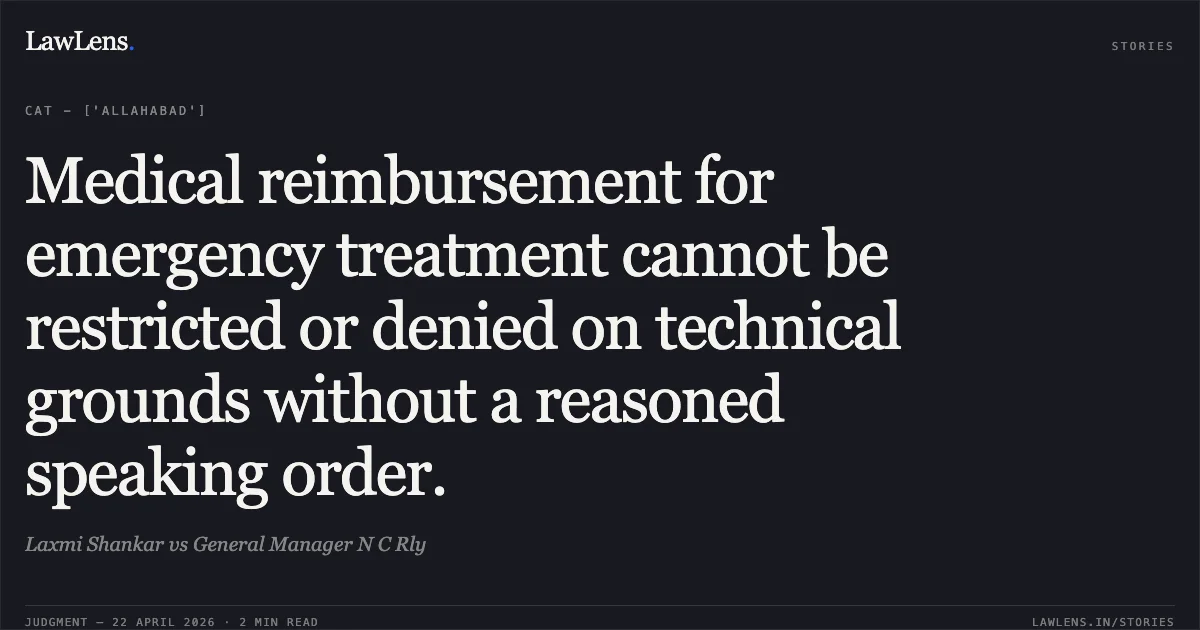
The Tribunal allowed the Original Application, answering that the respondents cannot withhold the balance amount on vague or technical grounds
The court held that the applicant, as a retired and disabled employee, is entitled to full reimbursement. The respondents were directed to pay the remaining medical reimbursement amount to the applicant along with 6% simple interest within three months
Source reference: p. 7, para 15Acts & Sections Cited
1 provisions across 1 statute referred to in this judgment. Each provision opens on LawLens.
Administrative Tribunals Act, 19851
Original Court PDF
Laxmi ShankarvsGeneral Manager N C Rly
Click to open original judgment
Original judgment, available to read, download and summarize on LawLens.in


![Authorities must decide pensionary and retiral-benefit claims through a reasoned order within eight weeks.. Habibullah khan vs HOME DEPARTMENT. CAT - ['Srinagar']. LawLens](/stories/thumbnails/authorities-must-decide-pensionary-and-retiral-benefit-claims-through-a-reasoned-order-wit-d0cbe8a8119c48fbabe7df9f2d353488.webp)