Facts
The petitioner, a hotel worker engaged in arduous manual labor, sought the implementation of the Menstrual Leave Policy across all establishments, including small commercial units in the unorganized sector
Source reference: para 1, 2.1In 2024, the State of Karnataka constituted a committee to examine the formulation of a Menstrual Leave Policy, which culminated in a Law Commission report and subsequent Government Orders dated 20.11.2025 and 02.12.2025
Source reference: para 2.3, 9These orders granted one day of paid leave per month to women workers in registered factories and establishments
Source reference: para 9A formal Bill titled the “Karnataka Menstrual Leave and Hygiene Bill, 2025” was also tabled before the Legislature
Source reference: para 9The petitioner filed this writ seeking a mandamus to enforce these policies uniformly, particularly for vulnerable workers in the unorganized sector
Source reference: para 2.4Issues
1. Whether the right to menstrual health and leave is a facet of the right to life with dignity under Article 21 of the Constitution
Source reference: para 112. Whether the State is constitutionally empowered and obligated to make special provisions for women regarding menstrual hygiene and workplace conditions under Articles 15(3) and 42
Source reference: para 123. Whether the current Menstrual Leave Policy should be extended and enforced within the unorganized sector
Source reference: para 19, 22Law Applied
Article 21 of the Constitution, interpreting the right to life to include the right to live with dignity and access to menstrual health
Source reference: para 11Article 15(3) (special provisions for women), Article 39(e) (protecting the health and strength of workers), and Article 42 (securing just and humane conditions of work)
Source reference: para 12Jaya Thakur (Dr.) v. Union of India, which recognized menstrual hygiene as an integral part of substantive dignity
Source reference: para 11Municipal Corporation of Delhi v. Female Workers (Muster Roll), which emphasized that benefits must extend to workers regardless of the nature of their employment
Source reference: para 19.1Executive power of the State under Article 162 to formulate policy measures
Source reference: para 12Reasoning
The Court reasoned that menstruation is a natural biological reality, often accompanied by debilitating physical and psychological challenges such as dysmenorrhea and PMDD, which affect workplace productivity and dignity
Source reference: para 13, 14Applying Jaya Thakur, the Court held that failing to provide menstrual management measures subjects women to stigma and humiliation, violating their bodily autonomy
Source reference: para 11The Court observed that "substantive equality" requires the law to acknowledge biological differences and provide accommodations rather than maintaining formal, blind equality
Source reference: para 13, 23While the State’s current orders were largely confined to the organized sector, the Court analyzed the "coalesced vulnerability" of women in the unorganized sector (e.g., daily wage laborers and domestic workers), noting they lack the same legal protections and facilities
Source reference: para 19, 22The State's duty to improve public health under Article 47 and provide humane work conditions under Article 42 necessitates a more inclusive approach that taps into the unorganized sector through sensitization and facilitative mechanisms
Source reference: para 20-22Holding
The Court disposed of the petition by directing the State to strictly and faithfully implement the existing Menstrual Leave Policy pending the formal enactment of the 2025 Bill
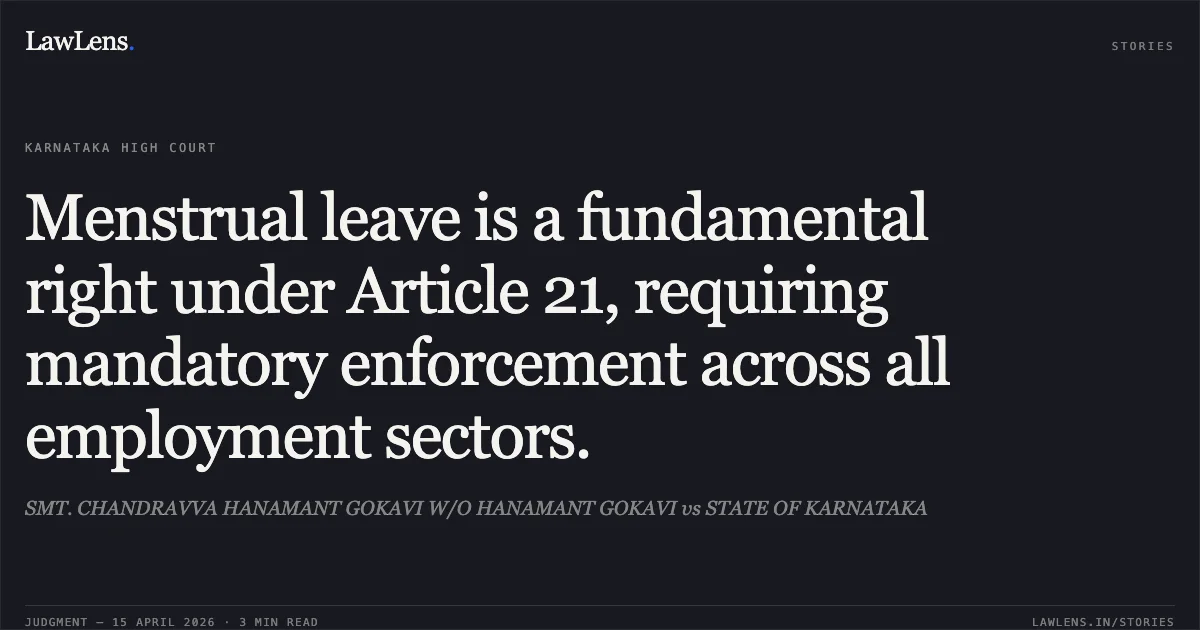
The Court held that menstrual dignity is a fundamental right and ordered that upon the Bill's enactment, the State must frame Rules to give it meaningful effect
Source reference: para 23In the interregnum, the State was directed to issue guidelines and administrative instructions to ensure uniform and rigorous implementation across all sectors, including the unorganized labor sector
Source reference: para 23The Court clarified that such special provisions do not violate Article 14 but rather provide substantive meaning to the guarantee of equality
Source reference: para 23Acts & Sections Cited
2 provisions across 2 statutes referred to in this judgment. Each provision opens on LawLens.
Code on Social Security, 20201
South Asian University Act, 20081
Original Court PDF
SMT. CHANDRAVVA HANAMANT GOKAVI W/O HANAMANT GOKAVIvsSTATE OF KARNATAKA
Click to open original judgment
Original judgment, available to read, download and summarize on LawLens.in


