Facts
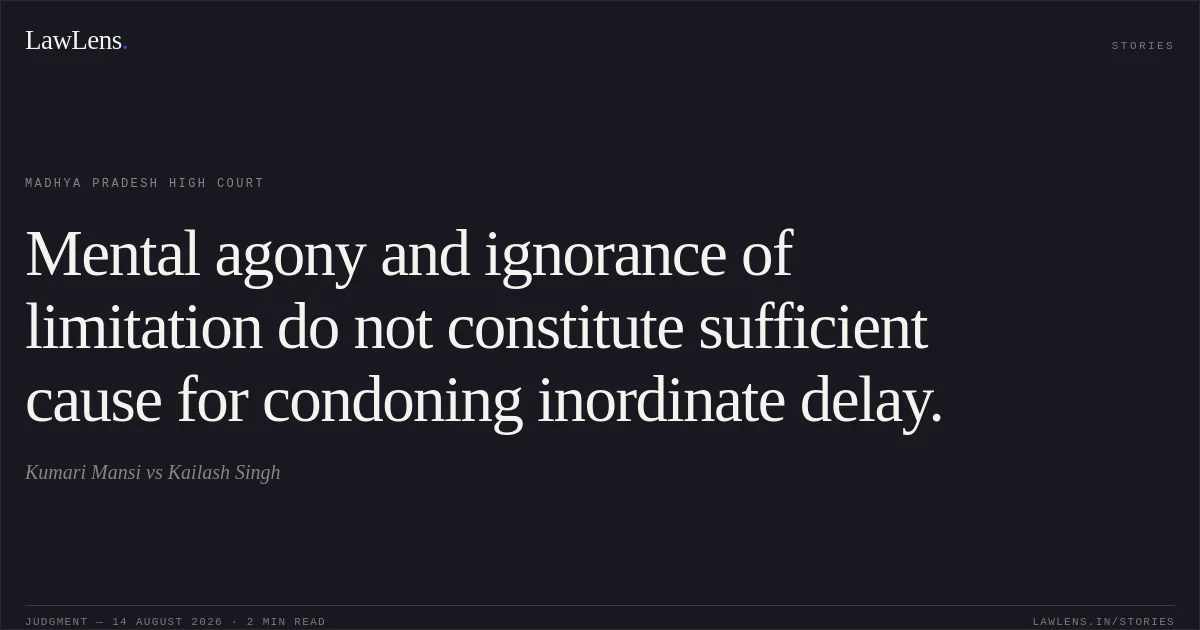
The appellants challenged the Claims Tribunal’s award dated 15 May 2024 and filed the miscellaneous appeal with an application for condonation of approximately 716 days’ delay.
Source reference: para. 1They contended that, following the deceased’s death, they were under mental agony, were rustic villagers unaware of the limitation period, and that appellant No. 4 could approach counsel only after arranging court fees and other expenses.
Source reference: para. 2The relevant papers were allegedly handed over to counsel on 28 July 2026.
Source reference: para. 2The High Court examined the record and found that the explanation did not satisfactorily account for the entire delay.
Source reference: para. 3Issues
Whether the appellants established sufficient and satisfactory cause for condoning the delay of approximately 716 days in filing the miscellaneous appeal?
Source reference: paras. 1–4, 7Whether mental agony, rustic-villager status, and alleged lack of knowledge of limitation constituted sufficient grounds for condonation when the appellants had already pursued a claim petition before the Claims Tribunal?
Source reference: para. 4Law Applied
The Court applied the principle that delay may be condoned only when the applicant demonstrates a sufficient, bona fide, and satisfactory explanation for the entire period of delay.
Source reference: no citationIt considered the liberal approach advocated in Collector, Land Acquisition, Anantnag v. Mst. Katiji, (1987) 2 SCC 107, and State of Bihar v. Kameshwar Prasad, (2000) 9 SCC 94, but relied on the countervailing principle in Pundlik Jalam Patil v. Executive Engineer, Jalgaon Medium Project, (2008) 17 SCC 448, that courts do not assist belated and stale claims merely on equitable grounds; “delay defeats equity” and the law favours vigilant litigants.
Source reference: para. 4The Court also relied on Majji Sannemma @ Sanyasirao v. Reddy Sridevi, AIR 2022 SC 332, and the observations in Shivamma (dead) by LRs v. Karnataka Housing Board, Civil Appeal No. 11794 of 2025, that delay cannot be condoned on frivolous, superficial, or inadequate grounds and that litigants must not be permitted to misuse the process of law.
Source reference: paras. 4–6Reasoning
The Court held that the appellants’ prior institution of a claim petition demonstrated that they had already invoked a legal remedy and therefore could not credibly claim complete ignorance of the applicable law or limitation period.
Source reference: para. 4Their assertion of mental agony was also found insufficient, particularly because it did not explain why the appeal was not filed within the prescribed period.
Source reference: no citationThe Court treated the pleas of rustic-villager status, lack of legal knowledge, and subsequent arrangements for litigation expenses as general justifications rather than a specific and satisfactory explanation for the 716-day delay.
Source reference: paras. 2–4Applying the principle that equitable considerations cannot revive stale claims without sufficient cause, the Court concluded that the delay was neither adequately explained nor shown to be bona fide.
Source reference: paras. 4, 7Holding
The High Court answered both issues against the appellants.
It dismissed I.A. No. 16829 of 2026, holding that no reasonable or proper explanation had been furnished for the 716-day delay.
Source reference: para. 7Consequently, the miscellaneous appeal challenging the Claims Tribunal’s award was also dismissed.
Source reference: para. 8Acts & Sections Cited
1 provisions across 1 statute referred to in this judgment. Each provision opens on LawLens.
Code of Civil Procedure, 19081
Original Court PDF
Kumari MansivsKailash Singh
Click to open original judgment
Original judgment, available to read, download and summarize on LawLens.in