Facts
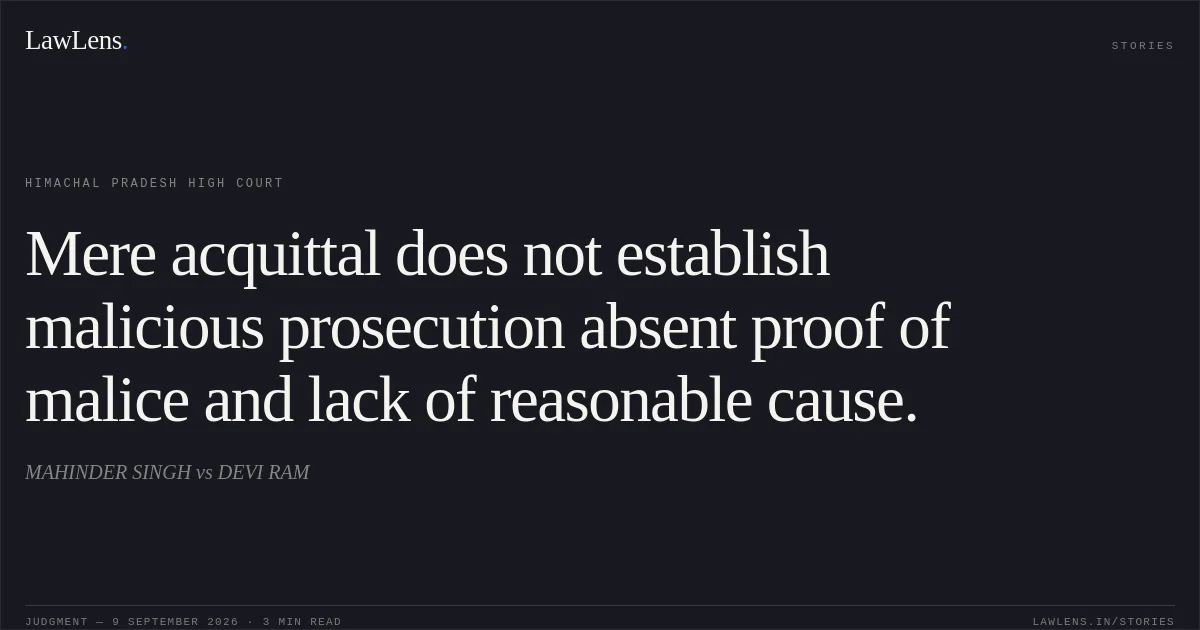
The appellants, along with two pro forma plaintiffs, instituted a suit for recovery of ₹10,10,000 as damages for malicious prosecution against respondent Devi Ram.
Source reference: para. 2The respondent, who had acquired proprietary rights and was in possession of land adjoining the plaintiffs’ land, lodged FIR No. 15/2007 under Sections 447 and 506/34 IPC and Section 3 of the Scheduled Castes and Scheduled Tribes (Prevention of Atrocities) Act, 1989, alleging that the plaintiffs had trespassed upon and attempted to take forcible possession of his land.
Source reference: paras. 2–3The police investigated the matter, found a prima facie case, and filed a challan against the plaintiffs.
Source reference: paras. 2, 10, 15The plaintiffs were subsequently acquitted by the Special Judge on 08.12.2008.
Source reference: paras. 2, 10, 15They claimed that the criminal proceedings had been instituted falsely, maliciously, and without reasonable or probable cause, causing them humiliation and litigation expenses.
Source reference: para. 2The learned District Judge dismissed the suit on 08.05.2013, leading to the present appeal under Section 96 CPC.
Source reference: para. 1Issues
Whether the criminal proceedings instituted against the plaintiffs were initiated and continued without reasonable and probable cause.
Source reference: para. 4Whether the proceedings were instituted maliciously and, consequently, whether the plaintiffs were entitled to damages for malicious prosecution.
Source reference: paras. 11–17Whether the plaintiffs’ acquittal in the criminal case, by itself, established a cause of action for malicious prosecution.
Source reference: paras. 15, 17Law Applied
The Court applied Section 96 of the Code of Civil Procedure, 1908, governing appeals from original decrees.
Source reference: para. 1It applied the established principles governing the tort of malicious prosecution, under which the plaintiff must prove: (i) institution or continuation of criminal proceedings by the defendant; (ii) absence of reasonable and probable cause; (iii) malice; and (iv) termination of the proceedings in the plaintiff’s favour.
Source reference: paras. 11–14The Court held that malice and absence of reasonable and probable cause are distinct requirements, and that absence of reasonable cause does not automatically establish malice.
Source reference: para. 11Relying on West Bengal State Electricity Board v. Dilip Kumar Ray, (2007) 14 SCC 568, the Court explained that malice means an intentional wrongful act done without just cause or excuse, or for want of reasonable or probable cause.
Source reference: para. 13Mere acquittal in a criminal case does not, by itself, establish that the prosecution was false or malicious, particularly because the criminal prosecution must prove its case beyond reasonable doubt.
Source reference: paras. 15, 17Reasoning
Although the first and fourth elements of malicious prosecution were established—the FIR was lodged by the respondent and the criminal proceedings ended in the plaintiffs’ acquittal—the plaintiffs failed to prove the essential elements of absence of reasonable and probable cause and malice.
Source reference: paras. 14–17The plaintiffs’ own evidence showed that the parties’ lands were adjacent and that the dispute arose in 2007; PW-1 also admitted that nine biswas of land was in the respondent’s possession.
Source reference: para. 15The investigating police officer testified that demarcation revealed that seven biswas of land ploughed by plaintiff Mahinder Singh was in the respondent’s possession, and the police thereafter filed a charge-sheet.
Source reference: para. 10These circumstances demonstrated a factual basis for the complaint and negated the allegation that it had been lodged without reasonable cause.
Source reference: paras. 10, 15The plaintiffs’ acquittal did not retrospectively render the complaint false or malicious, as acquittal only meant that the prosecution had not proved the case beyond reasonable doubt.
Source reference: para. 15The Court also declined to draw an adverse inference from the respondent’s failure to testify personally because his wife and attorney explained that he was elderly, weak, and had lost his power of hearing, and she entered the witness-box on his behalf.
Source reference: para. 16Holding
The Court held that the plaintiffs failed to prove that the criminal proceedings were instituted without reasonable and probable cause or that they were motivated by malice.
Their acquittal alone did not establish malicious prosecution or entitle them to damages.
Source reference: paras. 15–17The Trial Court’s dismissal of the suit was therefore upheld, and the appeal was dismissed as meritless.
Source reference: para. 18Pending applications, if any, were also disposed of.
Source reference: para. 18Acts & Sections Cited
5 provisions across 3 statutes referred to in this judgment. Each provision opens on LawLens.
Code of Civil Procedure, 19081
Indian Penal Code, 18603
Scheduled Castes and the Scheduled Tribes (Prevention of Atrocities) Act, 19891
Original Court PDF
MAHINDER SINGHvsDEVI RAM
Click to open original judgment
Original judgment, available to read, download and summarize on LawLens.in
![Similarly situated employees cannot be denied TBP financial upgradation solely because their promotional appointments were ad hoc.. A K PATHAK vs NEW DELHI MUNICIPAL CORPORATION. CAT - ['Delhi']. LawLens](/stories/thumbnails/similarly-situated-employees-cannot-be-denied-tbp-financial-upgradation-solely-because-the-b3dc1522387f4de79b828475ad651568.webp)