Facts
The petitioner, a Sanitation Superintendent with the Ahmedabad Municipal Corporation (AMC), was booked under Sections 7, 12, 13(d), and 13(2) of the Prevention of Corruption Act, 1988, on June 4, 1998.
Source reference: para 5.1Consequently, he was suspended on July 2, 1998, and later reinstated on March 19, 2002, following a review.
Source reference: para 5.1On September 19, 2002, a Special Judge convicted him, leading to his dismissal from service on February 25, 2003.
Source reference: para 5.2During the pendency of his criminal appeal, the petitioner reached the age of superannuation on June 13, 2007.
Source reference: para 9On January 24, 2017, the High Court quashed his conviction in Criminal Appeal No. 817 of 2002.
Source reference: para 5.3Following his acquittal, the AMC issued an order on March 27, 2019, treating his suspension (1998–2002) and dismissal-to-superannuation (2003–2007) periods as "spent on duty" for continuity of service and retiral benefits, but granted these benefits only on a notional basis, denying actual arrears of pay and increments.
Source reference: para 5.3The petitioner challenged this denial of actual monetary benefits.
Source reference: para 5.4Issues
1. Whether the order dated March 27, 2019, granting only notional benefits for the periods of suspension and dismissal following the petitioner’s acquittal, is sustainable in law.
Source reference: para 8Law Applied
Rule 5(2)(a) of the Gujarat Civil Services (Discipline Appeal) Rules, 1971, which governs suspension following arrest.
Source reference: para 11The principle established in Banshidhar v. State of Rajasthan (2007) 1 SCC 324, which holds that back wages are not automatic upon acquittal and must be determined based on the facts of each case, particularly when a delinquent is legally disabled from rendering service due to conviction.
Source reference: para 10Rajnarain v. Union of India (2019) 5 SCC, stipulating that an employer cannot be saddled with back wages upon an employee's acquittal unless the prosecution was malicious or launched at the behest of the department.
Source reference: para 12.1Gurpal Singh v. High Court of Judicature of Rajasthan (2012) 13 SCC, which affirms that suspension is justified during the pendency of a criminal trial involving serious charges.
Source reference: para 12.2Reasoning
The Court reasoned that the petitioner’s suspension and subsequent dismissal were inevitable legal consequences of his arrest and conviction under the Corruption Act, rather than being dehors the rules or malicious.
Source reference: para 11The Court observed that the prosecution was not initiated by the Corporation with "vexatious intent" but arose from the petitioner's own conduct as a public servant.
Source reference: para 13Applying the "no work, no pay" logic within the context of criminal disability, the Court noted that during the period of conviction, the petitioner was "legally disabled" from rendering service to the institution.
Source reference: para 13Citing Banshidhar, the Court emphasized that grant of back wages is a discretionary exercise and not a right.
Source reference: para 10Since the Corporation had already granted continuity of service and retiral benefits (gratuity, pension) by treating the period notionally as duty, the Court found that the employer should not be further burdened with the financial liability of full back wages for a period where no service was rendered due to the petitioner's involvement in a corruption case.
Source reference: para 13, 15Holding
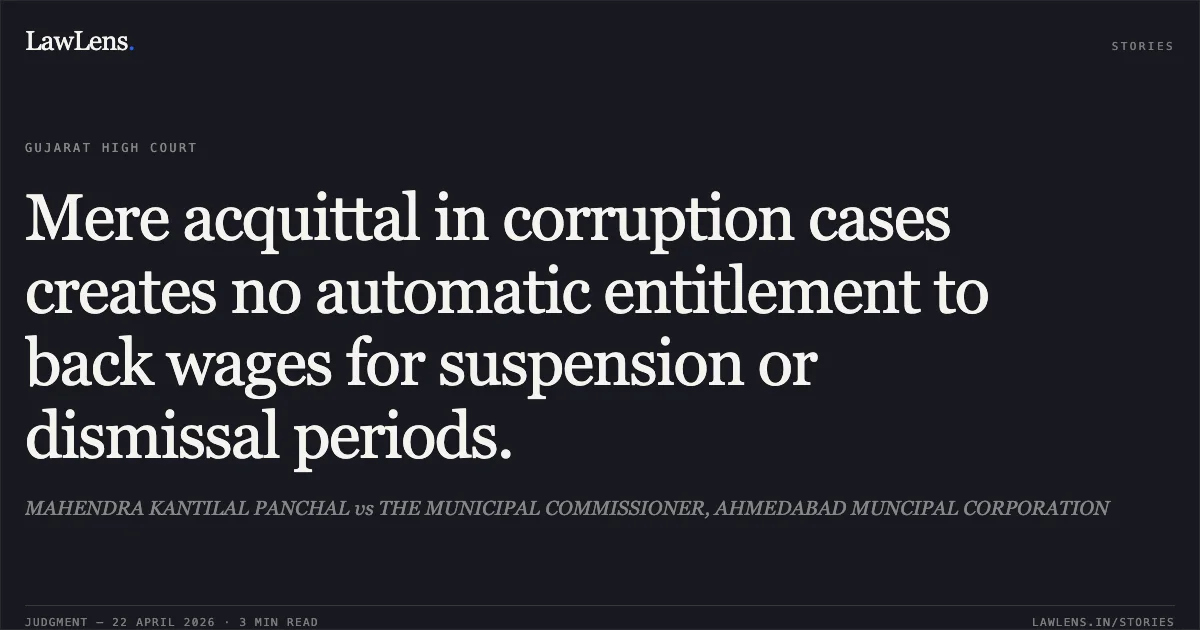
The Court held that the petitioner is not entitled to receive actual pay and allowances for the periods of suspension or dismissal until superannuation.
The High Court found no illegality in the AMC’s order dated March 27, 2019, concluding that the grant of notional benefits was just and legally sustainable under the circumstances.
Source reference: para 14The petition was dismissed, and the rule was discharged.
Source reference: para 16Acts & Sections Cited
5 provisions across 2 statutes referred to in this judgment. Each provision opens on LawLens.
Prevention of Corruption Act, 19883
Indian Penal Code, 18602
Original Court PDF
MAHENDRA KANTILAL PANCHALvsTHE MUNICIPAL COMMISSIONER, AHMEDABAD MUNCIPAL CORPORATION
Click to open original judgment
Original judgment, available to read, download and summarize on LawLens.in


![Subsequent exoneration does not retrospectively invalidate a finalized promotion select list.. UNNIKRISHNAN M vs M/o Environment And Forests. CAT - ['Ernakulam']. LawLens](/stories/thumbnails/subsequent-exoneration-does-not-retrospectively-invalidate-a-finalized-promotion-select-li-ce80a0e84f2f4887857271e8b4341c42.webp)