Facts
The Plaintiffs filed a suit in 2017 (COMS/621/2017) seeking to declare a Memorandum of Understanding (MOU) and a Share Subscription cum Shareholder Agreement ("Agreement") void and non-est on grounds of fraud and forgery
Source reference: para. 1The Plaintiffs alleged that the Agreement was signed without authority and that they were out of the country on the date the document was purportedly executed
Source reference: para. 3, 6The Defendant filed an application under Section 8 of the Arbitration and Conciliation Act, 1996, seeking to refer the dispute to arbitration per Clause 25 of the Agreement
Source reference: para. 7-8Subsequent to the 2017 Suit, the Defendant filed a separate suit in 2021 seeking specific performance of the same Agreement
Source reference: para. 14The Plaintiffs resisted the Section 8 application, arguing that allegations of fraud rendered the dispute non-arbitrable and that the Defendant waived his right to arbitrate by filing the 2021 Suit
Source reference: para. 12-14Issues
1. Whether allegations of fraud and forgery in the execution of an agreement render the underlying dispute non-arbitrable
Source reference: para. 16(i)2. Whether the act of filing a subsequent civil suit by the Defendant constitutes an abandonment or waiver of the right to seek reference to arbitration under Section 8 of the Act
Source reference: para. 16(ii)Law Applied
The Court applied Section 8 of the Arbitration and Conciliation Act, 1996 regarding the mandatory referral of parties to arbitration
Source reference: para. 1The Court relied on the "fraud exception" doctrine established in Deccan Paper Mills Co. Ltd. v. Regency Mahavir Properties, which stipulates that civil fraud (under Section 17 of the Contract Act) or fraud in the performance of a contract is arbitrable, whereas only fraud in rem (against society) is not
Source reference: para. 21The Court further applied the principle from Avitel Post Studioz Ltd. v. HSBC PI Holdings (Mauritius) Ltd., noting that criminal overtones do not oust arbitral jurisdiction
Source reference: para. 21Regarding waiver, the Court adopted the reasoning from the Delhi High Court in Ministry of Sound International Ltd. v. Indus Renaissance Partners Entertainment Pvt. Ltd., which holds that if a Section 8 application is filed first and maintained, a subsequent suit does not necessarily constitute abandonment
Source reference: para. 29Reasoning
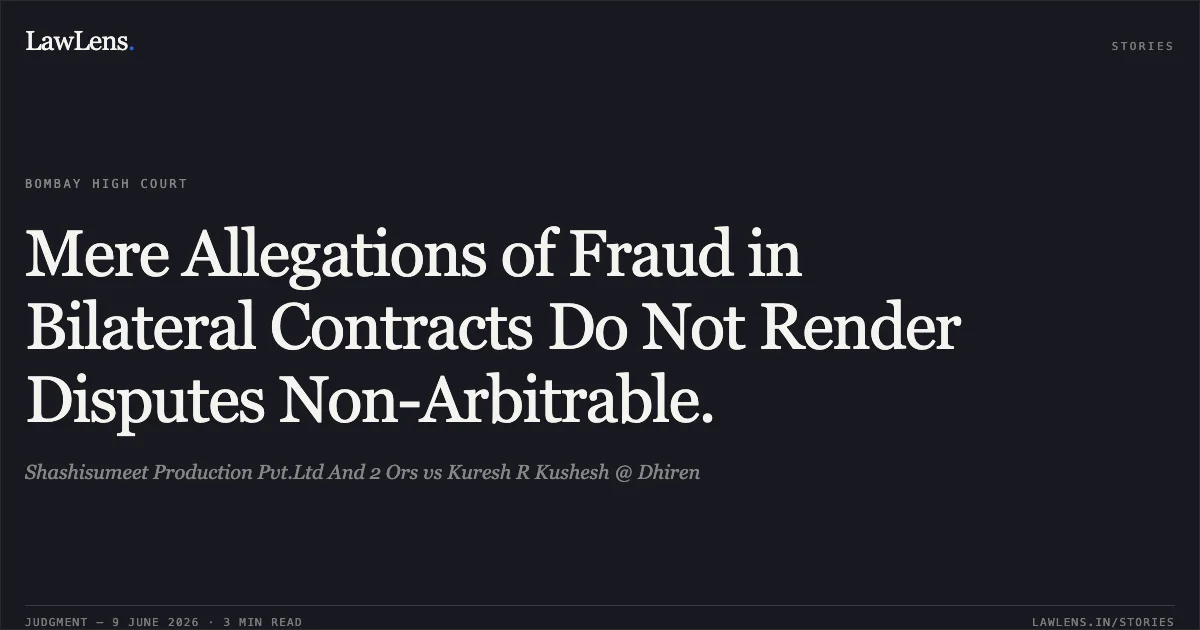
The Court reasoned that a mere allegation of fraud in a bilateral transaction is a dispute in personam and does not meet the high threshold of "serious fraud" required to bypass an arbitration clause
Source reference: para. 17-19The Court noted that the Plaintiffs’ claim regarding their absence from the country on the date of execution was an evidentiary matter for the Arbitral Tribunal to decide rather than a jurisdictional bar for the Court
Source reference: para. 26The Court observed that the Plaintiffs had admittedly received consideration (monies) under the Agreement, which contradicted their plea that no contract existed
Source reference: para. 27Regarding the 2021 Suit, the Court found no abandonment because the Defendant filed the Section 8 application in the 2017 Suit first and expressed an intent to withdraw the 2021 Suit to pursue arbitration, thereby preserving the arbitral route
Source reference: para. 30Holding
The Court allowed the Section 8 Application, holding that the disputes are arbitrable despite allegations of fraud and that the Defendant had not waived his right to arbitrate
The Court referred the parties to a Sole Arbitrator to adjudicate all disputes arising from the Agreement; the 2021 Suit was disposed of as withdrawn
Source reference: para. 31-32Acts & Sections Cited
5 provisions across 2 statutes referred to in this judgment. Each provision opens on LawLens.
Arbitration and Conciliation Act, 19964
Indian Contract Act, 18721
Original Court PDF
Shashisumeet Production Pvt.Ltd And 2 OrsvsKuresh R Kushesh @ Dhiren
Click to open original judgment
Original judgment, available to read, download and summarize on LawLens.in