Facts
The petitioner, serving as the In-charge Principal of SBSSPSJ College, engaged the complainant (Opposite Party No. 2) to perform Income Tax and EPF-related consultancy work
Source reference: para 3While payments for the Income Tax work and partial EPF work were settled, the complainant alleged that an outstanding sum of Rs. 15.90 lakhs remained unpaid
Source reference: para 3Based on the complaint and subsequent inquiry, the Judicial Magistrate 1st Class, Godda, found a prima facie case and issued a summoning order for offences punishable under Sections 406 (Criminal Breach of Trust) and 420 (Cheating) of the Indian Penal Code (IPC)
Source reference: para 2, 4The petitioner moved the High Court under Section 528 of the Bharatiya Nagarik Suraksha Sanhita (BNSS), 2023, to quash the proceedings, contending that the matter was a purely civil/contractual dispute and that the complainant had himself failed to account for advances previously received
Source reference: para 2, 9Issues
1. Whether the failure to pay outstanding dues under a service contract constitutes the offence of cheating under Section 420 IPC in the absence of fraudulent intent at the inception of the agreement
Source reference: para 112. Whether a mere breach of contract or non-payment of fees satisfies the ingredients of "entrustment" and "dishonest misappropriation" required for an offence under Section 406 IPC
Source reference: para 13-153. Whether the criminal proceeding should be quashed as an abuse of process when a civil dispute is given a criminal cloak
Source reference: para 16Law Applied
The Court primarily applied Sections 406 and 420 of the IPC.
Source reference: no citationIt relied on Delhi Race Club (1940) Ltd. v. State of U.P., establishing that Sections 406 and 420 are independent, distinct, and mutually exclusive; they cannot co-exist on the same set of facts
Source reference: para 5Regarding cheating, the court applied the principle from Uma Shankar Gopalika v. State of Bihar, holding that deception at the very inception is a condition precedent for Section 420 IPC
Source reference: para 6For criminal breach of trust, it cited Binod Kumar v. State of Bihar and Satish Chandra Ratanlal Shah v. State of Gujarat, which settled that mere breach of contract or retention of money does not constitute an offence under Section 405/406 IPC without clear evidence of entrustment and dishonest conversion
Source reference: para 7-8Reasoning
The Court observed that for an offence of cheating, the petitioner must have practiced deception since the beginning of the transaction; however, the record showed a functional professional relationship where partial payments were already made, negating initial dishonest intent
Source reference: para 11-12Regarding Section 406 IPC, the Court noted that the complainant had not "entrusted" any property to the petitioner; rather, the complainant was the one who had received advances from the college for which he failed to account
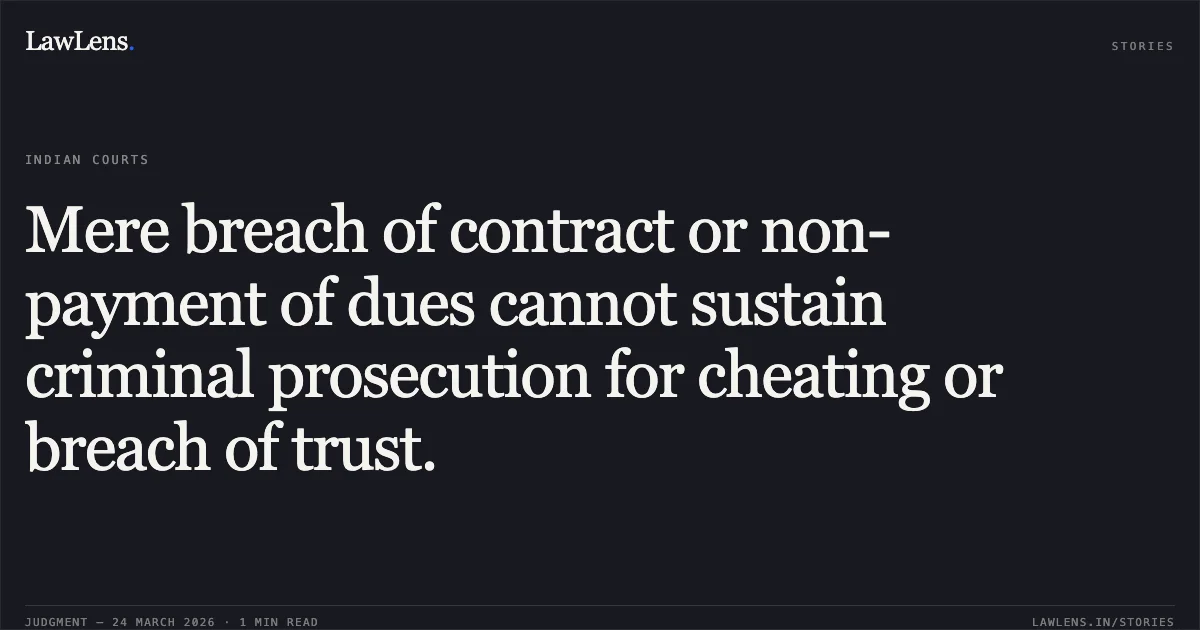
Source reference: para 14-15The Court characterized the dispute as a "mere breach of contract" regarding unpaid professional fees
Source reference: para 14It further noted that the college had already initiated a separate criminal case (Pathargama P.S. Case No. 50 of 2023) against the complainant, suggesting the present complaint was a retaliatory attempt to convert a civil liability into a criminal prosecution to "wreak vengeance"
Source reference: para 9, 14Holding
The Court held that even if all allegations in the complaint were accepted as true, they did not satisfy the legal ingredients of Sections 406 or 420 of the IPC
The Court concluded that the continuation of the criminal proceeding would constitute an abuse of the process of law
Source reference: para 16Consequently, the High Court allowed the petition and quashed the entire criminal proceeding, including the summoning order dated 20.09.2024 passed by the Judicial Magistrate 1st Class, Godda, in Complaint Case No. 164 of 2023
Source reference: para 17All interim reliefs were vacated
Source reference: para 19Acts & Sections Cited
4 provisions across 2 statutes referred to in this judgment. Each provision opens on LawLens.
Bharatiya Nagarik Suraksha Sanhita, 20231
Indian Penal Code, 18603
Original Court PDF
BASANT NARAYANvsTHE STATE OF JHARKHAND
Click to open original judgment
Original judgment, available to read, download and summarize on LawLens.in


![Subsequent exoneration does not retrospectively invalidate a finalized promotion select list.. UNNIKRISHNAN M vs M/o Environment And Forests. CAT - ['Ernakulam']. LawLens](/stories/thumbnails/subsequent-exoneration-does-not-retrospectively-invalidate-a-finalized-promotion-select-li-ce80a0e84f2f4887857271e8b4341c42.webp)