Facts
Respondent No. 2 alleged that properties originally purchased in 1999 had later been dealt with using a fabricated General Power of Attorney and subsequent sale deeds.
Source reference: paras. 2–9He stated that the original property documents had been entrusted to the petitioner for obtaining revenue entries.
Source reference: paras. 2–9The petitioner was arrayed as Accused No. 3 in Crime No. 66/2025, registered for offences under Sections 419, 420, 465, 471 and 34 of the IPC. He sought quashing of the FIR and complaint insofar as they concerned him.
Source reference: paras. 2–9The petitioner contended that the complaint and investigation disclosed no specific act connecting him to the alleged forgery, impersonation, cheating or use of forged documents.
Source reference: paras. 10.1–10.7, 10.30–10.36Issues
Whether the complaint and material collected during investigation disclosed the essential ingredients of the alleged offences against the petitioner, Accused No. 3.
Source reference: paras. 16–17, 20–24Whether continuation of the proceedings against the petitioner would amount to an abuse of process warranting the High Court’s inherent jurisdiction.
Source reference: paras. 14–16, 32–35Law Applied
The High Court considered its inherent jurisdiction under Section 482 of the Code of Criminal Procedure, referred to in the petition as corresponding to Section 528 of the Bharatiya Nagarik Suraksha Sanhita, and the offences alleged under Sections 419, 420, 465, 471 and 34 of the IPC.
Source reference: paras. 14–15, 32Under State of Haryana v. Bhajan Lal, as reiterated in Anand Kumar Mohatta v. State (NCT of Delhi), proceedings may be quashed where allegations accepted at face value do not constitute an offence, or the allegations and material collected do not disclose an offence against the accused.
Source reference: paras. 14–15, 32Cheating under Section 420 requires deception and dishonest inducement with the consequence contemplated by Section 415 IPC; Section 419 requires cheating by personation; and Sections 465 and 471 require, respectively, a connection to the making of a false document or the knowing use of a forged document as genuine.
Source reference: paras. 20–24The Court also relied on Chanchalpati Das v. State of West Bengal regarding the need for substantive material connecting an accused to alleged forgery, while clarifying that expert evidence is not invariably mandatory.
Source reference: paras. 25–27Section 34 IPC does not establish common intention merely because several persons are accused; material must support the particular accused’s participation in furtherance of that intention.
Source reference: para. 33Reasoning
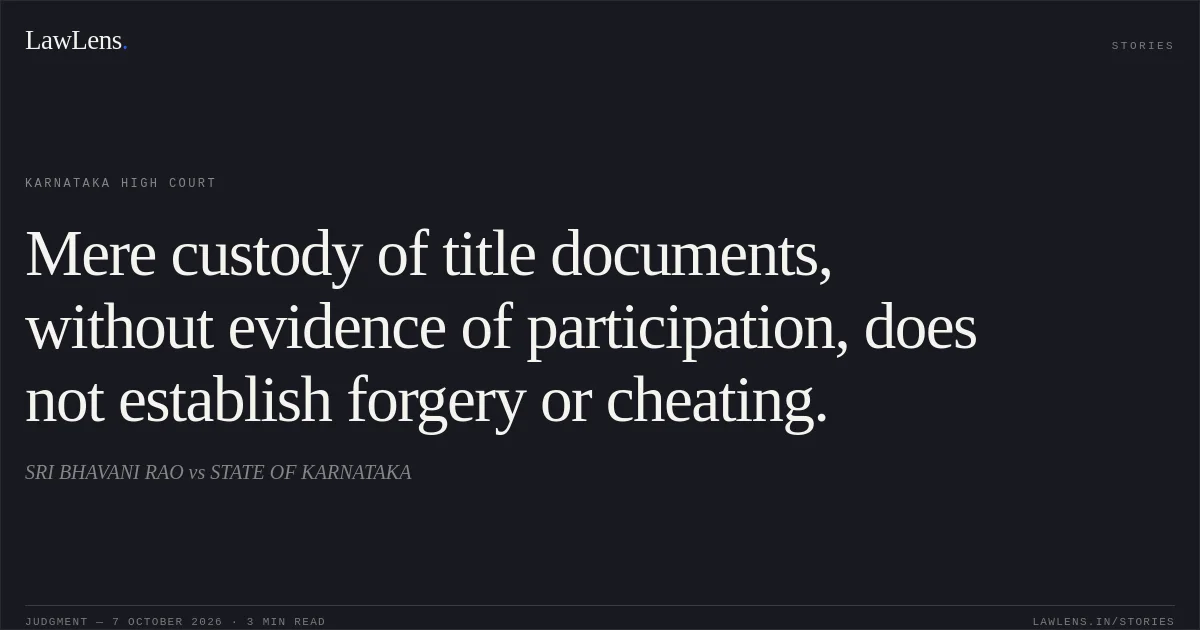
The complaint attributed to the petitioner only the earlier receipt of the original documents for the purpose of obtaining revenue entries.
Source reference: paras. 17, 19, 21–24It did not allege that he prepared or executed the GPA, impersonated anyone, induced Respondent No. 2 to part with property, participated in the sale deeds, or knowingly used a forged document.
Source reference: paras. 17, 19, 21–24Nor did the material placed before the Court identify further circumstances connecting his custody of the documents to the alleged transactions or establish participation in a common intention.
Source reference: paras. 27, 33–34The Court therefore concluded that the civil or property background was not, by itself, decisive; rather, the absence of allegations and material satisfying the offences’ ingredients justified quashing as against this petitioner.
Source reference: paras. 30–35Holding
The petition was allowed, and the FIR and complaint in Crime No. 66/2025 were quashed insofar as the petitioner/Accused No. 3 was concerned.
The investigation was permitted to continue against the other accused.
Source reference: para. 39, order clauses (iii)–(iv)The Court expressed no opinion on the genuineness of the GPA or sale deeds, or on the culpability of the other accused, and left open such further lawful steps against the petitioner if cogent and legally admissible material emerged during investigation.
Source reference: para. 39, order clauses (iii)–(iv)Acts & Sections Cited
13 provisions across 3 statutes referred to in this judgment. Each provision opens on LawLens.
Indian Penal Code, 1860
Code of Criminal Procedure, 19733
Bharatiya Nagarik Suraksha Sanhita, 20231
Original Court PDF
SRI BHAVANI RAOvsSTATE OF KARNATAKA
Click to open original judgment
Original judgment, available to read, download and summarize on LawLens.in