Facts
Respondent No. 3 alleged that N. Johnson had executed a registered General Power of Attorney dated 17 October 1994 jointly in favour of the petitioner and respondent No. 3, authorising them to sell plots situated in Sy. Nos. 88/1 and 89/1 at Serilingampally, measuring approximately 4,813.4 square yards.
Source reference: p.3–4; paras 2.1, 7Johnson allegedly cancelled the GPA on 15 December 2004. Respondent No. 3 alleged that, during the intervening period, the petitioner, without her knowledge or consent, executed eleven sale deeds on 21 February, 26 March and 17 April 2004, forged her signatures, impersonated her, affixed a false thumb impression, and received the sale consideration.
Source reference: p.7–9; paras 5.1, 8After allegedly discovering the fraud, respondent No. 3 claimed that the petitioner assured her that he would cancel the sale deeds but failed to do so.
Source reference: p.3–4; para 2.1She lodged a complaint on 13 February 2026, resulting in registration of Crime No. 11 of 2026 by the Economic Offences Wing, Cyberabad, for offences under Sections 420, 406, 419, 467, 468 and 471 IPC.
Source reference: p.3–4; para 2.1The petitioner, aged 71 years, sought quashing of the FIR and criminal proceedings under Section 528 of the BNSS, contending that the complaint was filed after an unexplained delay of approximately 22 years and that the dispute was essentially civil in nature.
Source reference: p.5–6; paras 4.1–4.3Issues
Whether the FIR and criminal proceedings against the petitioner disclosed the ingredients of cognizable offences under Sections 420, 406, 419, 467, 468 and 471 IPC so as to warrant continuation of the investigation.
Source reference: p.9–10; paras 8, 17–21Whether the alleged delay of approximately 22 years in lodging the complaint, and the availability of civil remedies, constituted sufficient grounds to quash the FIR under Section 528 of the BNSS.
Source reference: p.10–13; paras 9–16Whether the High Court could assess the reliability of the allegations or conduct a mini-trial while exercising its inherent jurisdiction at the investigation stage.
Source reference: p.14–16; paras 18–20Law Applied
The Court applied Sections 420, 406, 419, 467, 468 and 471 IPC concerning cheating, criminal breach of trust, cheating by personation, forgery of valuable security or authority, forgery for the purpose of cheating, and use of forged documents.
Source reference: p.10–11; paras 9–11It relied on Section 514 of the BNSS, corresponding to Section 468 Cr.P.C., holding that the statutory limitation under that provision applies to offences punishable with imprisonment not exceeding three years, and does not bar the present prosecution involving offences punishable with more than three years’ imprisonment.
Source reference: p.10–11; paras 9–11Under Section 528 BNSS, corresponding to Section 482 Cr.P.C., the High Court may quash proceedings only in exceptional cases where the allegations, taken at face value, do not disclose an offence, are legally barred, inherently improbable, or constitute manifest abuse of process.
Source reference: p.14–16; paras 18–20Applying State of Haryana v. Bhajan Lal, 1992 Supp (1) SCC 335, Neeharika Infrastructure (P) Ltd. v. State of Maharashtra, (2021) 19 SCC 401, State v. M. Maridoss, (2023) 4 SCC 338, and Sau. Kamala Shivaji Pokarnekar v. State of Maharashtra, (2019) 14 SCC 350, the Court held that the High Court must not conduct a mini-trial or assess evidence at the threshold.
Source reference: p.14–16; paras 18–20The Court also considered the principles in Punit Beriwala v. State of NCT of Delhi, that delay in an FIR concerning offences punishable with more than three years’ imprisonment is not, by itself, a ground to interdict investigation, and in Nazibul Rahim Khan, Bolisetti Narasimha Rao and Bimalendu Ghosh concerning abuse of criminal process where civil disputes are given a mala fide criminal colour.
Source reference: p.11–14; paras 12–17Reasoning
The Court found that the complaint contained specific allegations that the petitioner forged respondent No. 3’s signatures, impersonated her, affixed her thumb impression, and fraudulently executed eleven sale deeds while receiving consideration.
Source reference: p.9–10; paras 8, 17These allegations, if taken at face value, prima facie disclosed cognizable offences under the invoked IPC provisions.
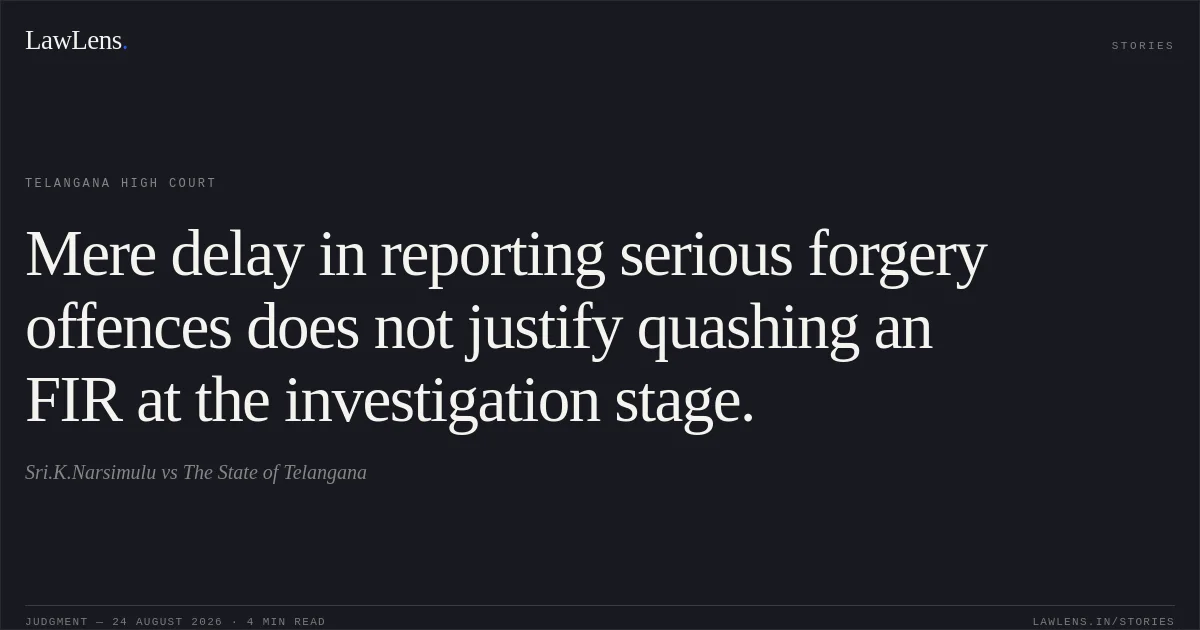
Source reference: p.9–10; paras 8, 17The Court rejected the petitioner’s reliance on the 22-year delay, holding that the alleged offences attracted punishment exceeding three years and were therefore not barred by the statutory limitation provision; moreover, mere delay in lodging the FIR could not, without more, justify quashing at the investigation stage.
Source reference: p.10–13; paras 9–12The Court further held that the existence of possible civil remedies did not automatically exclude criminal liability where the allegations independently disclosed forgery, impersonation and cheating.
Source reference: p.13–16; paras 17–21Unlike cases involving a purely civil dispute or demonstrable mala fides, the present matter raised triable factual issues requiring investigation and evidence.
Source reference: p.13–16; paras 17–21The petitioner’s contentions regarding knowledge, the cancellation of the GPA, and the absence of complaints by the original owner or purchasers could not be adjudicated through a mini-trial under Section 528 BNSS.
Source reference: p.13–16; paras 17–21Holding
The Court held that the FIR prima facie disclosed cognizable offences and that neither the delay in lodging the complaint nor the availability of civil remedies justified quashing the proceedings.
It concluded that the case did not fall within the exceptional category warranting exercise of inherent powers under Section 528 BNSS.
Source reference: p.16; paras 21–22Accordingly, Criminal Petition No. 12801 of 2026 was dismissed, and all pending miscellaneous applications were closed.
Source reference: p.17; para 23Acts & Sections Cited
12 provisions across 3 statutes referred to in this judgment. Each provision opens on LawLens.
Indian Penal Code, 18606
Bharatiya Nagarik Suraksha Sanhita, 20234
Code of Criminal Procedure, 19732
Original Court PDF
Sri.K.NarsimuluvsThe State of Telangana
Click to open original judgment
Original judgment, available to read, download and summarize on LawLens.in
![Courts will not interfere with transfers absent mala fides or violation of statutory rules.. M Ramya vs EMPLOYEES STATE INSURANCE CORPORATION (ESIC). CAT - ['Chennai']. LawLens](/stories/thumbnails/courts-will-not-interfere-with-transfers-absent-mala-fides-or-violation-of-statutory-rules-a6845e9ca6f548fca284c51c8351957f.webp)
![Courts cannot direct one-time recruitment age relaxation absent authority in the governing rules or advertisement.. UT OF PUDUCHERRY vs M ANDAL. CAT - ['Chennai']. LawLens](/stories/thumbnails/courts-cannot-direct-one-time-recruitment-age-relaxation-absent-authority-in-the-governing-895d78fde47143e2a8ed0207c4b6a44f.webp)
![A review cannot correct an allegedly erroneous decision absent an error apparent on the record.. Ajit Kumar Jha vs RAILWAY BOARD. CAT - ['Delhi']. LawLens](/stories/thumbnails/a-review-cannot-correct-an-allegedly-erroneous-decision-absent-an-error-apparent-on-the-re-8ac952fd4eba470c92f7da20af72a220.webp)