Facts
The petitioner, Sanjeeva Shukla, was impleaded as an accused in Case No. CS/104375 of 2021, instituted under Sections 138 and 141 of the Negotiable Instruments Act, 1881, pending before the Metropolitan Magistrate, 11th Court, Calcutta.
Source reference: para. 2–4He was described as one of the directors of Accused No. 1, Credforce Asia Limited, and contended that he had been arraigned merely by virtue of his designation, without any allegation that he was in charge of, or responsible for, the conduct of the company’s business at the relevant time.
Source reference: para. 4The petitioner sought quashing of the complaint proceedings under Section 482 of the Code of Criminal Procedure, 1973, arguing that the complaint did not attribute to him any role in the underlying transaction, issuance of the cheque, or its dishonour.
Source reference: para. 3, 11–12The complainant/opposite party did not appear despite service, and the matter was heard in its absence.
Source reference: para. 13, 19Issues
Whether prosecution of a director under Sections 138 and 141 of the Negotiable Instruments Act can continue where the complaint merely describes him as a director or makes general allegations regarding management of the company, without specifically averring that he was in charge of and responsible to the company for the conduct of its business at the relevant time.
Source reference: para. 16–18, 22–23Whether the absence of a specific allegation identifying the person who signed or drew the dishonoured cheque renders the complaint legally deficient against the petitioner.
Source reference: para. 18–21Whether continuation of the proceedings against the petitioner would amount to an abuse of the process of law warranting exercise of the High Court’s inherent jurisdiction under Section 482 CrPC.
Source reference: para. 23–25Law Applied
The Court applied Sections 138 and 141 of the Negotiable Instruments Act, 1881, holding that vicarious criminal liability under Section 141 is exceptional and must be strictly construed.
Source reference: para. 14, 22A complaint must specifically aver that, at the time of commission of the offence, the accused was “in charge of, and responsible to, the company for the conduct of the business of the company”; the two expressions are conjunctive and cannot be read disjunctively.
Source reference: para. 14, 22Mere designation as a director, participation in the company’s day-to-day affairs, or a general assertion that the accused managed the company is insufficient.
Source reference: para. 14–15, 20–22The Court relied on Pawan Kumar Goel v. State of U.P., Ashok Shewakramani v. State of Andhra Pradesh, Sunil Todi v. State of Gujarat, Sunita Palita v. Panchami Stone Quarry, Shaleen Khemani v. State of West Bengal, and N. Harihara Krishnan v. J. Thomas.
Source reference: para. 14–15, 20–22It further applied the principle that the complaint must disclose the identity of the person who drew or signed the cheque, since an offence under Section 138 is person-specific.
Source reference: para. 14, 21Section 482 CrPC empowers the High Court to quash proceedings where continuation would constitute an abuse of the process of law.
Source reference: para. 23Reasoning
The Court examined the petition of complaint and found that the allegations against the petitioner and the other directors were general in nature.
Source reference: para. 18–19Although the complaint stated that the directors were involved in managing the company’s day-to-day business and affairs, it did not specify the petitioner’s individual role, involvement in the transaction, authority to issue the cheque, or responsibility for its dishonour.
Source reference: para. 18–19Such general statements did not satisfy the statutory requirement that the petitioner was both in charge of and responsible to the company for the conduct of its business, as required under Section 141(1).
Source reference: para. 16–18, 22The complaint also failed to identify which accused had signed or drawn the cheque, an omission relevant to the person-specific nature of an offence under Section 138.
Source reference: para. 21Applying the principles laid down by the Supreme Court, the Court held that there was no sufficient foundational averment or prima facie case against the petitioner, and that permitting the prosecution to continue would amount to an abuse of process.
Source reference: para. 20–23Holding
The High Court answered the issues in favour of the petitioner.
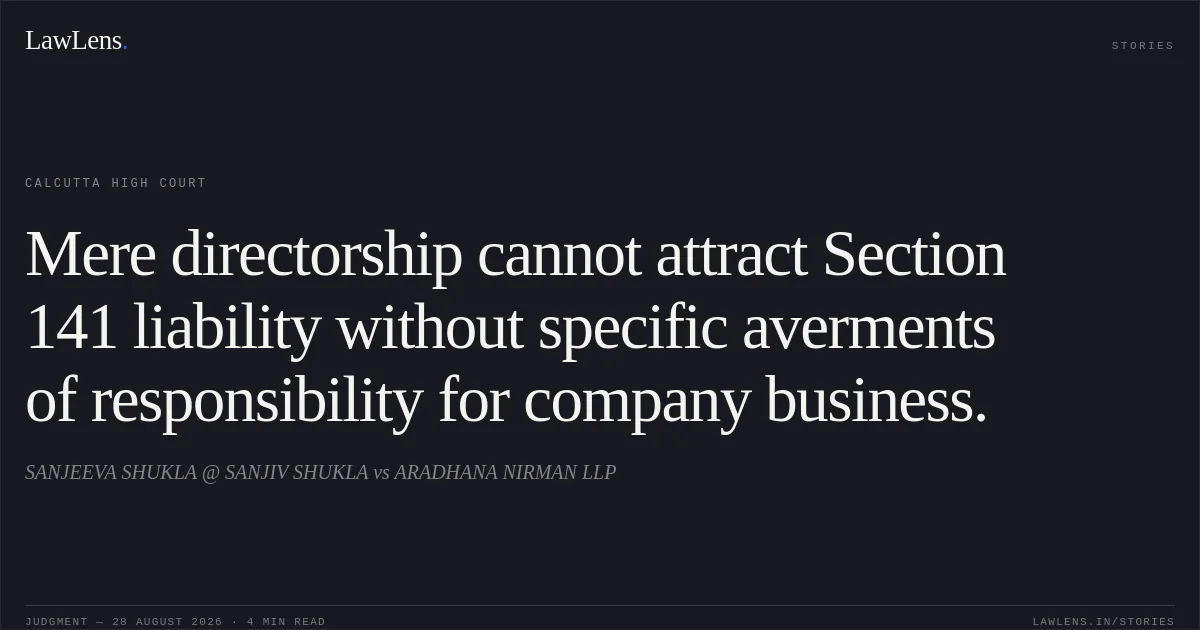
It held that mere designation as a director and general allegations concerning the company’s management do not attract vicarious liability under Section 141 of the Negotiable Instruments Act.
Source reference: para. 23–25The revisional application, CRR 2620 of 2024, was allowed, and the proceedings in Case No. CS/104375 of 2021 under Sections 138 and 141 of the Negotiable Instruments Act were quashed insofar as they concerned Sanjeeva Shukla @ Sanjiv Shukla.
Source reference: para. 23–25Connected applications were disposed of, any interim order was vacated, and a copy of the judgment was directed to be sent to the trial court for compliance.
Source reference: para. 26–29Acts & Sections Cited
5 provisions across 3 statutes referred to in this judgment. Each provision opens on LawLens.
Negotiable Instruments Act, 18813
Code of Criminal Procedure, 19731
Mines and Minerals (Development and Regulation) Act, 19571
Original Court PDF
SANJEEVA SHUKLA @ SANJIV SHUKLAvsARADHANA NIRMAN LLP
Click to open original judgment
Original judgment, available to read, download and summarize on LawLens.in
![Courts will not interfere with transfers absent mala fides or violation of statutory rules.. M Ramya vs EMPLOYEES STATE INSURANCE CORPORATION (ESIC). CAT - ['Chennai']. LawLens](/stories/thumbnails/courts-will-not-interfere-with-transfers-absent-mala-fides-or-violation-of-statutory-rules-a6845e9ca6f548fca284c51c8351957f.webp)
![Courts cannot direct one-time recruitment age relaxation absent authority in the governing rules or advertisement.. UT OF PUDUCHERRY vs M ANDAL. CAT - ['Chennai']. LawLens](/stories/thumbnails/courts-cannot-direct-one-time-recruitment-age-relaxation-absent-authority-in-the-governing-895d78fde47143e2a8ed0207c4b6a44f.webp)
![A review cannot correct an allegedly erroneous decision absent an error apparent on the record.. Ajit Kumar Jha vs RAILWAY BOARD. CAT - ['Delhi']. LawLens](/stories/thumbnails/a-review-cannot-correct-an-allegedly-erroneous-decision-absent-an-error-apparent-on-the-re-8ac952fd4eba470c92f7da20af72a220.webp)