Facts
The Appellant/Plaintiff purchased land from Defendant No. 2 via a registered sale deed dated 16.12.2005
Source reference: para. 3During subsequent land acquisition proceedings for a national highway, the Appellant discovered the land was recorded in the name of Defendant No. 1
Source reference: para. 3Defendant No. 1 had obtained title through a court-executed sale deed in 2012, following an ex-parte decree for specific performance in Civil Suit No. 21-A/2009 against Defendant No. 2
Source reference: para. 3The Appellant filed a fresh suit (Civil Suit Class-A/31/2017) seeking declaration of title and to declare the 2010 decree null and void, alleging it was obtained through fraud and collusion between the Defendants
Source reference: para. 4The Trial Court dismissed the Appellant’s suit on 25.04.2024, holding that the Appellant failed to prove title due to a lack of mutation in revenue records and failed to prove collusion
Source reference: para. 5The Appellant challenged this dismissal before the High Court
Source reference: para. 2Issues
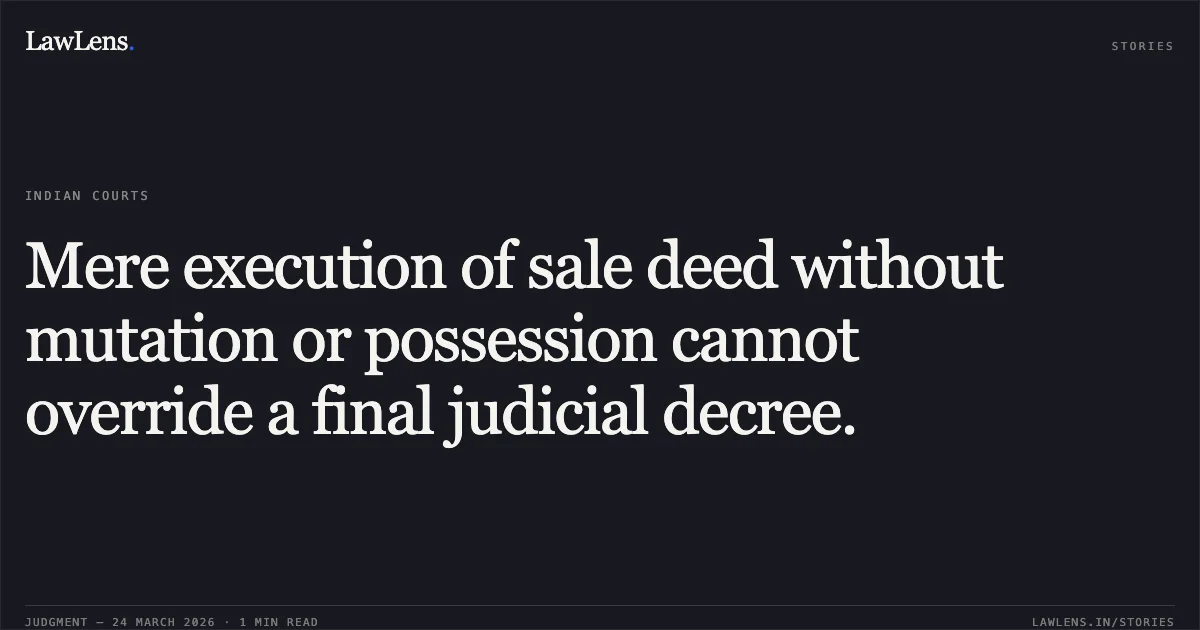
1. Whether the mere execution of a registered sale deed is sufficient to establish lawful title in the absence of mutation in revenue records and proof of continuous possession
Source reference: para. 102. Whether the judgment and decree passed in Civil Suit No. 21-A/2009 was vitiated by fraud or collusion due to the non-disclosure of the prior 2005 sale deed
Source reference: para. 113. Whether a separate civil suit for declaration is maintainable to challenge a decree that has attained finality when the statutory remedy of an appeal was not exercised
Source reference: para. 12Law Applied
The Court applied the principle that while a registered sale deed is a primary document of title, mutation entries and evidence of actual possession are essential to demonstrate the completeness of a legally enforceable title
Source reference: para. 10Regarding fraud, the Court relied on the principle established in Ram Prakash Agarwal v. Gopi Krishan (2013) 11 SCC 296, which holds that while fraud vitiates judicial acts, it must be specifically pleaded and strictly proved by cogent evidence
Source reference: para. 11the Court emphasized the doctrine of finality of judgments, noting that statutory appellate remedies cannot be bypassed through collateral civil suits in the absence of a proven nullity
Source reference: para. 12Reasoning
The Court observed that although the Appellant proved the execution of the 2005 sale deed, the failure to mutate the property in revenue records or provide evidence of continuous possession created significant doubt regarding the validity of his ownership against competing claims
Source reference: para. 10Addressing the allegation of fraud, the Court reasoned that the mere non-disclosure of a prior sale deed by Defendant No. 2 in the earlier litigation did not, by itself, constitute intentional deceit or conspiracy
Source reference: para. 11The Appellant provided only "bald and unsubstantiated" allegations of collusion, failing to meet the high threshold of proof required to overturn a judicial decree
Source reference: para. 11the Court determined that because the 2010 decree had attained finality and was not challenged through the appropriate appellate forum, the Appellant could not circumvent the legal process by instituting a separate suit for declaration
Source reference: para. 12Holding
The Court held that the Appellant failed to establish a clear title or prove that the previous decree was a nullity obtained by fraud
The suit was deemed not maintainable as it attempted to bypass statutory appellate remedies without sufficient cause
Source reference: para. 12The High Court dismissed the appeal and upheld the judgment and decree of the Trial Court dated 25.04.2024
Source reference: para. 14Original Court PDF
JITENDRA GOELvsSEWAK RAM PANDEY
Click to open original judgment
Original judgment, available to read, download and summarize on LawLens.in