01Facts
The petitioner, B. Veeraiah, was arraigned as an accused under Section 106(1) of the Bharatiya Nyaya Sanhita, 2023 (“BNS”) in GR No. 13 of 2025, arising from FIR No. 14 of 2025 dated 9 April 2025 registered at Police Station Campbell Bay, South Andaman District.
¶ 1The FIR concerned the accidental death of Samar Mondal, an employee deputed for painting an electrical pole/transformer structure.
After investigation, the police filed a charge-sheet against Muni Raj and the petitioner, alleging that the petitioner, as contractor, had failed to provide proper training and safety equipment to the deceased and other workers.
¶ 3–4The petitioner sought quashing of the proceedings under Section 528 of the Bharatiya Nagarik Suraksha Sanhita, 2023 (“BNSS”), contending that he was not present at the work site, did not supervise the work, and that the allegations did not establish a direct causal connection between any act on his part and the death.
¶ 5, 7–10The State opposed quashing, arguing that the petitioner had a duty to provide safety equipment.
¶ 1102Issues
i.Whether the allegations that the petitioner failed to provide training and safety equipment disclosed an offence under Section 106(1) BNS, which penalises causing death by a rash or negligent act.
¶ 12–13ii.Whether the charge-sheet established that any rash or negligent act of the petitioner was the direct and proximate cause (causa causans) of the deceased’s death.
¶ 14–17iii.Whether the High Court should exercise its jurisdiction under Section 528 BNSS to quash the criminal proceedings against the petitioner.
¶ 5, 23–2503Law Applied
The Court applied Section 106(1) BNS, which criminalises causing death by a rash or negligent act not amounting to culpable homicide.
¶ 12It held that the provision requires a direct and proximate causal nexus between the accused’s rash or negligent act and the death; mere responsibility, breach of a rule, or an omission unconnected with the death is insufficient.
¶ 14, 17Relying on Yuvraj Laxmilal Kanther v. State of Maharashtra, 2025 SCC OnLine SC 520, the Court recognised that an accidental death occurring during work, without material showing the accused’s culpable rashness or negligence, does not establish the offence.
¶ 13It further relied on I.B. Bhalla v. The State, 1989 SCC OnLine Cal 278, for the requirement that the alleged act must be the direct cause of death; M/S Divis Infratech Builders and Electrical Contractors v. State of Maharashtra, Criminal Application No. 218 of 2011, for the relevance of the accused’s presence and control over the work; L. Ashok Kumar v. State, 2021 SCC OnLine Mad 2772, for the requirement of recklessness and causal responsibility; and Pankaj Kumar Dhingra v. The State, CRR No. 23 of 2026, for the distinction between “causes death” and being merely “responsible for the death”.
¶ 15–17The Court also considered Clause 14 of the contract, under which safety arrangements were subject to inspection by the labour officer and the Engineer-in-Charge.
¶ 19Provisions in the judgment · 3 · Linked ones open on LawLens
Bharatiya Nyaya Sanhita, 2023 Section 106
Bharatiya Nagarik Suraksha Sanhita, 2023 Section 528
Indian Penal Code, 1860 Section 304
04Reasoning
The Court found that the petitioner was admittedly absent from the work site and that the work was not under his supervision.
¶ 18The deceased had been working from 13 March 2025, while the accident occurred on 2 April 2025; the work had also commenced earlier, without any recorded complaint or reminder from the complainant authority or its engineers that safety equipment was lacking.
¶ 18Although the petitioner may have had contractual responsibility to provide safety equipment, Section 106(1) BNS required proof that a rash or negligent act attributable to him directly caused the death.
The Court observed that the prescribed safety protocol involved ensuring that the power was switched off, proper grounding, and the use of protective equipment; the first two requirements rested on the worker and supervisor, while the third concerned the contractor.
¶ 20–21However, the police did not find that the death resulted from the deceased’s failure to wear safety equipment.
¶ 21–22The injuries were caused by the flow of electric current, and the charge-sheet did not establish that the petitioner’s alleged omission was the direct or proximate cause of that electrocution.
¶ 21–22Applying the cited authorities, the Court concluded that the materials did not disclose the essential ingredients of Section 106(1) BNS against the petitioner.
05Holding
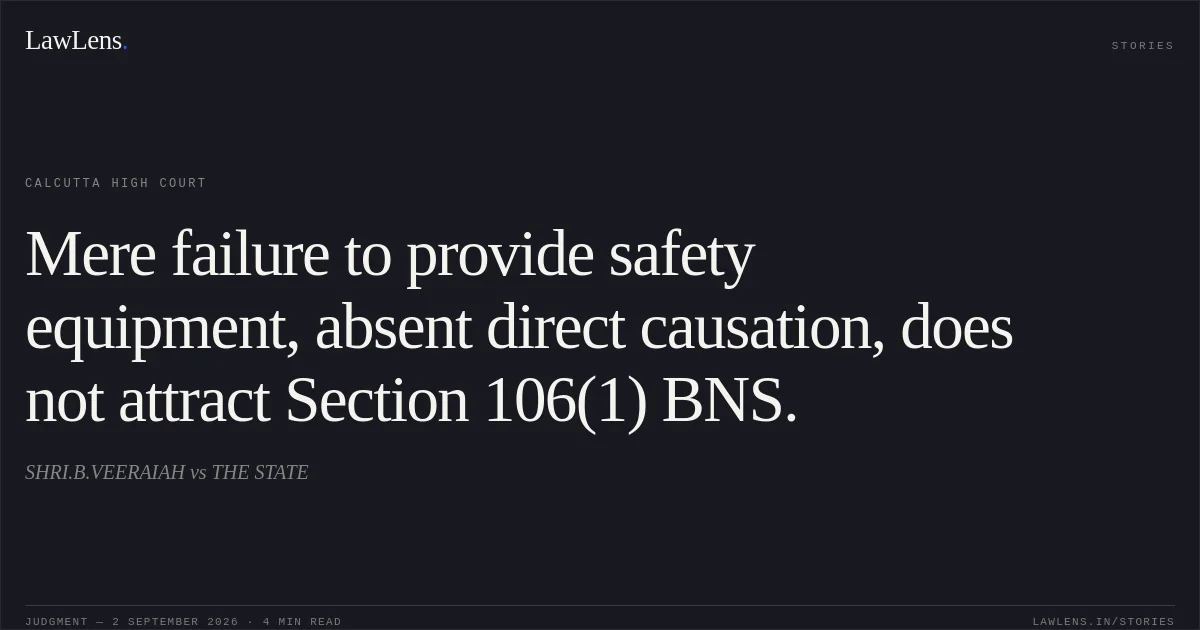
The Court held that no prima facie case under Section 106(1) BNS was made out against B. Veeraiah because the charge-sheet did not establish any direct or proximate causal connection between his conduct and the deceased’s death.
¶ 23Exercising jurisdiction under Section 528 BNSS, the Court allowed CRR No. 37 of 2026 and quashed GR No. 13 of 2025, arising from FIR No. 14 of 2025, insofar as it concerned the petitioner.
¶ 23The petitioner was discharged from the case, and the criminal revision, along with any connected application, was disposed of.
¶ 24–26Original Court PDF
SHRI.B.VEERAIAHvsTHE STATE
Click to open original judgment
Original judgment, available to read, download and summarize on LawLens.in