Facts
The respondent No. 1, a Data Entry Operator and contractual employee in the CID, West Bengal, alleged that while she was working under the respondent DSP, he repeatedly touched or stroked her back and waist inappropriately between September 2021 and July 2022.
Source reference: para. 2–4She filed a complaint on 5 January 2023, and her statement was recorded before the Internal Complaints Committee (“ICC”) on 23 February 2023.
Source reference: para. 3The ICC found the allegations proved and recommended departmental action against the DSP by its report dated 13 April 2023.
Source reference: para. 6The DSP challenged the report in O.A. No. 450 of 2023 before the West Bengal Administrative Tribunal. The Tribunal set aside the ICC report on the ground that the complaint was barred by the three-month limitation under Section 9 of the Sexual Harassment of Women at Workplace (Prevention, Prohibition and Redressal) Act, 2013 (“2013 Act”).
Source reference: para. 6, 15Issues
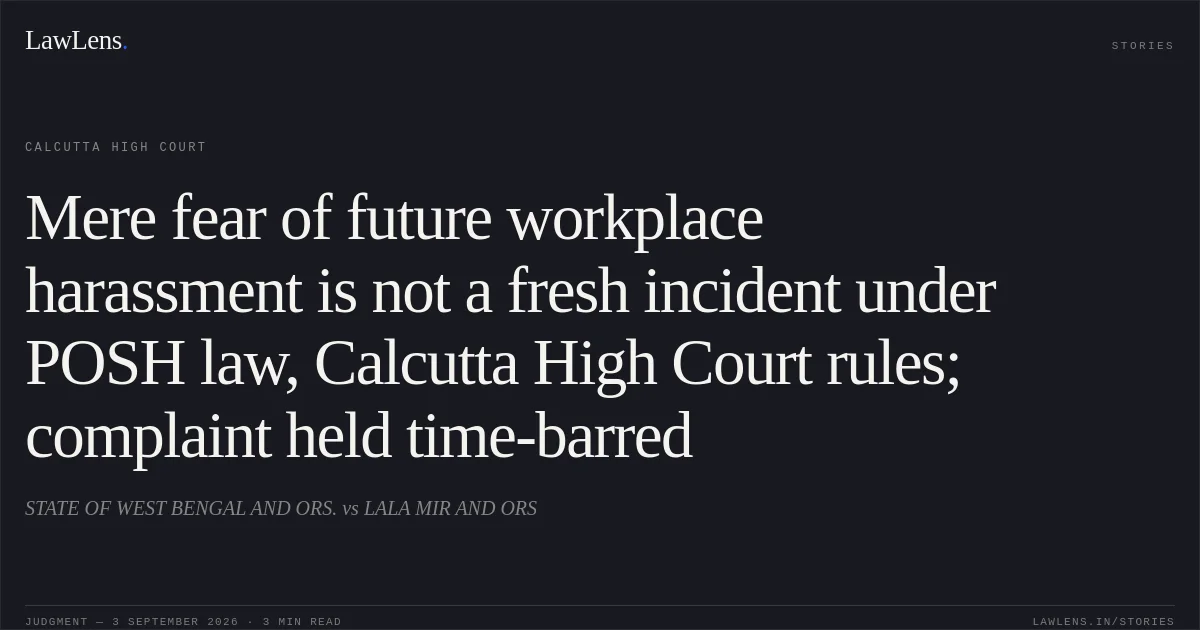
Whether the complainant’s apprehension, arising after she saw the DSP in October 2022, constituted a subsequent incident of sexual harassment so as to bring the complaint dated 5 January 2023 within the limitation period under Section 9 of the 2013 Act.
Source reference: para. 16–18Whether, in the absence of any alleged incident of sexual harassment after July 2022, the ICC could entertain the complaint and recommend departmental action.
Source reference: para. 23–26Whether the Tribunal’s order setting aside the ICC report on the ground of limitation warranted interference under Article 226 of the Constitution.
Source reference: para. 27–28Law Applied
Section 2(n) of the 2013 Act defines “sexual harassment” as including unwelcome physical contact and advances, sexually coloured remarks, showing pornography, or other unwelcome physical, verbal or non-verbal conduct of a sexual nature.
Source reference: para. 19Section 3 prohibits sexual harassment at the workplace and recognises certain connected circumstances, including threats to employment, interference with work, or creation of an intimidating, offensive or hostile work environment.
Source reference: para. 20–22Under Section 9, a complaint must ordinarily be made within three months from the date of the incident, subject to a maximum extension of three further months where the ICC is satisfied, for reasons recorded in writing, that circumstances prevented timely filing.
Source reference: para. 10, 12The Court relied on X v. Nirmal Kanti Chakrabarti, 2025 SCC OnLine SC 1964, and Dr. Nirmal Kanti Chakraborti v. Vaneeta Patnaik & Ors., 2024 SCC OnLine Cal 11896, concerning limitation under Section 9, and applied the principle that limitation provisions must be enforced with statutory rigour, as stated in Popat Bahiru Govardhane v. Land Acquisition Officer, (2013) 10 SCC 765.
Source reference: para. 13–14, 25Reasoning
The Court distinguished between an actual act or conduct constituting sexual harassment and a mere apprehension of possible future harassment.
Source reference: para. 16–17, 24Sections 2(n) and 3 of the 2013 Act require an act, behaviour, or connected circumstance amounting to sexual harassment; they do not treat a subjective apprehension of future harassment, without any accompanying act or conduct, as a fresh incident of sexual harassment.
Source reference: para. 18–23Since the last alleged incident occurred in July 2022, the complaint ought to have been filed by the end of October 2022. The complaint filed on 5 January 2023 was therefore beyond the prescribed period, and no subsequent incident was pleaded that could restart limitation.
Source reference: para. 24–26The Supreme Court decision relied upon by the State was factually distinguishable because it involved an independent act of removal following the alleged harassment, whereas the present case involved only apprehension.
Source reference: para. 25Holding
The High Court held that the complaint did not disclose any incident of sexual harassment after July 2022 and that the complainant’s subsequent apprehension did not constitute a fresh or recurring incident under the 2013 Act.
The complaint dated 5 January 2023 was consequently barred by limitation under Section 9.
Source reference: para. 23–26The Tribunal had correctly set aside the ICC report, and no ground for interference under Article 226 was established.
Source reference: para. 27The writ petition was dismissed; any connected application was disposed of and any interim order was vacated.
Source reference: para. 28Acts & Sections Cited
3 provisions across 1 statute referred to in this judgment. Each provision opens on LawLens.
Original Court PDF
STATE OF WEST BENGAL AND ORS.vsLALA MIR AND ORS
Click to open original judgment
Original judgment, available to read, download and summarize on LawLens.in