Facts
The petitioner, an Assistant Section Officer in the Urban Development and Housing Department, was implicated in Special Vigilance P.S. Case No. 56 of 2022 under Sections 7/8 of the Prevention of Corruption Act, 1988, following allegations that he had supplied departmental documents through WhatsApp in exchange for ₹15,000.
Source reference: paras. 3–4He was arrested on 21 October 2022 and subsequently granted bail on 2 December 2022.
Source reference: paras. 3–4A departmental proceeding was initiated against him on the basis of four charges concerning the registration of the vigilance case, alleged transmission of confidential departmental documents, breach of confidentiality obligations, and violation of the Bihar Government Servants’ Conduct Rules, 1976.
Source reference: paras. 4, 12The Inquiry Officer found three charges not proved and held only Charge No. 1—relating to the registration of the FIR—proved.
Source reference: paras. 4–5, 13No witness, informant, mobile phone, or other supporting evidence was produced before the Inquiry Officer to establish the factual allegations contained in the FIR.
Source reference: para. 14The Disciplinary Authority nevertheless imposed the penalties of censure and withholding of three annual increments with cumulative effect by order dated 7 November 2023.
Source reference: paras. 2, 6–7The petitioner’s service appeal was rejected by the Chairman-cum-Member, Revenue Board, Bihar, on 23 July 2024.
Source reference: paras. 2, 6–7Issues
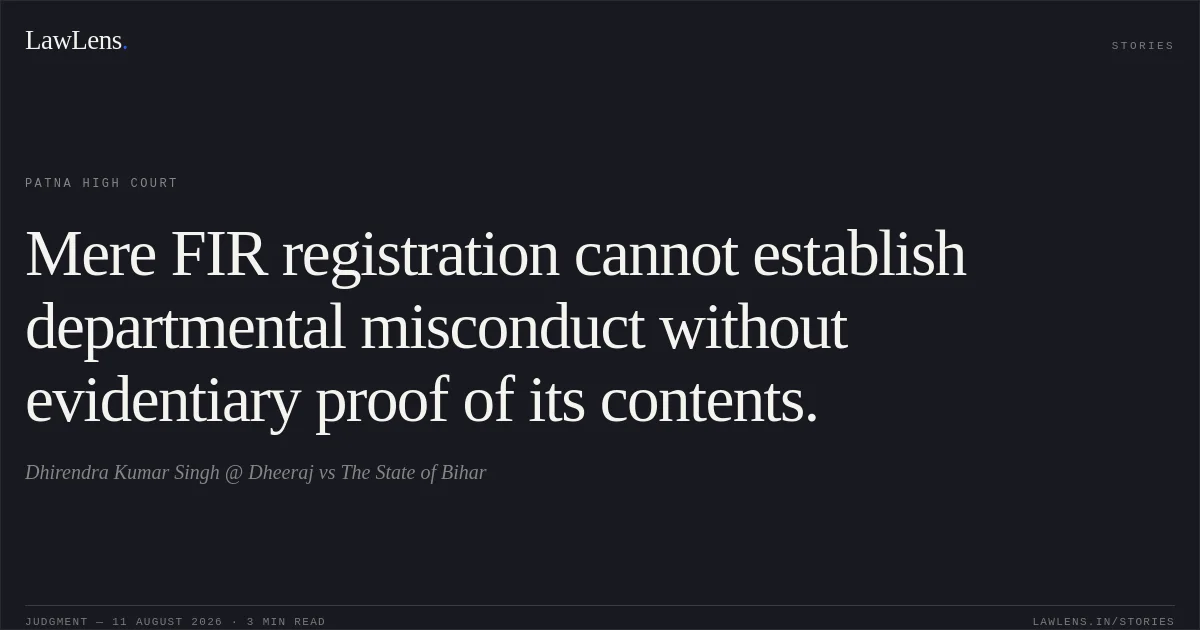
Whether a departmental charge can be treated as proved merely on the basis that an FIR was registered against the petitioner, without proving the underlying allegations through admissible evidence in the departmental inquiry?
Source reference: paras. 8–9, 13–14Whether the punishment order and appellate order were legally sustainable when three of the four charges were found not proved and the only proved charge concerned the fact of registration of the FIR?
Source reference: paras. 12–14Whether the departmental authorities acted in violation of Rule 18 of the Bihar Government Servants (Classification, Control and Appeal) Rules, 2005?
Source reference: para. 9Law Applied
The Court applied the Bihar Government Servants (Classification, Control and Appeal) Rules, 2005, particularly Rule 18, which requires disciplinary findings to be based on material and evidence establishing the charge in the departmental proceeding.
Source reference: paras. 8–9, 13Although departmental proceedings are governed by the standard of preponderance of probabilities rather than proof beyond reasonable doubt, that standard applies only where the underlying facts and evidence are properly placed before and assessed by the Inquiry Officer.
Source reference: paras. 8–9, 13The Court also distinguished criminal jurisprudence, requiring proof beyond reasonable doubt, from service jurisprudence, which applies the lower standard of preponderance of probabilities; however, mere registration of an FIR does not, by itself, establish the truth of its allegations.
Source reference: para. 13The alleged conduct was also framed with reference to the Bihar Secretariat Instructions and Rule 3(1)(i), (ii) and (iii) of the Bihar Government Servants’ Conduct Rules, 1976.
Source reference: para. 12Reasoning
The Court held that the Inquiry Officer had proved only the fact that an FIR had been registered, while the substantive allegations—that the petitioner accepted ₹15,000, transmitted confidential documents through WhatsApp, and thereby compromised the vigilance investigation—remained unproved.
Source reference: paras. 12–13The informant or person who allegedly made the accusation was not examined, and neither the mobile phone nor any witness capable of proving the alleged communication or transaction was produced in the inquiry.
Source reference: para. 14Consequently, the registration of the FIR could not be treated as conclusive proof of the allegations contained in it.
Source reference: paras. 13–14Since the preponderance-of-probabilities standard still requires some evidentiary basis for the charge, reliance solely upon the FIR amounted to a violation of Rule 18 of the Bihar CCA Rules, 2005.
Source reference: paras. 13–14The disciplinary punishment therefore lacked a legally sustainable foundation, and the appellate authority’s affirmation of that punishment could not stand.
Source reference: paras. 13–14Holding
The High Court allowed the writ petition and set aside the punishment order dated 7 November 2023, imposing censure and withholding of three annual increments with cumulative effect, as well as the appellate order dated 23 July 2024.
The Court held that mere proof of registration of the FIR was insufficient to establish the misconduct alleged against the petitioner in the departmental proceeding.
Source reference: para. 14It clarified, however, that if the petitioner is subsequently convicted in the pending criminal case, the respondent authorities would remain free to take action against him in accordance with law.
Source reference: para. 15Acts & Sections Cited
3 provisions across 1 statute referred to in this judgment. Each provision opens on LawLens.
Prevention of Corruption Act, 19883
Original Court PDF
Dhirendra Kumar Singh @ DheerajvsThe State of Bihar
Click to open original judgment
Original judgment, available to read, download and summarize on LawLens.in