Facts
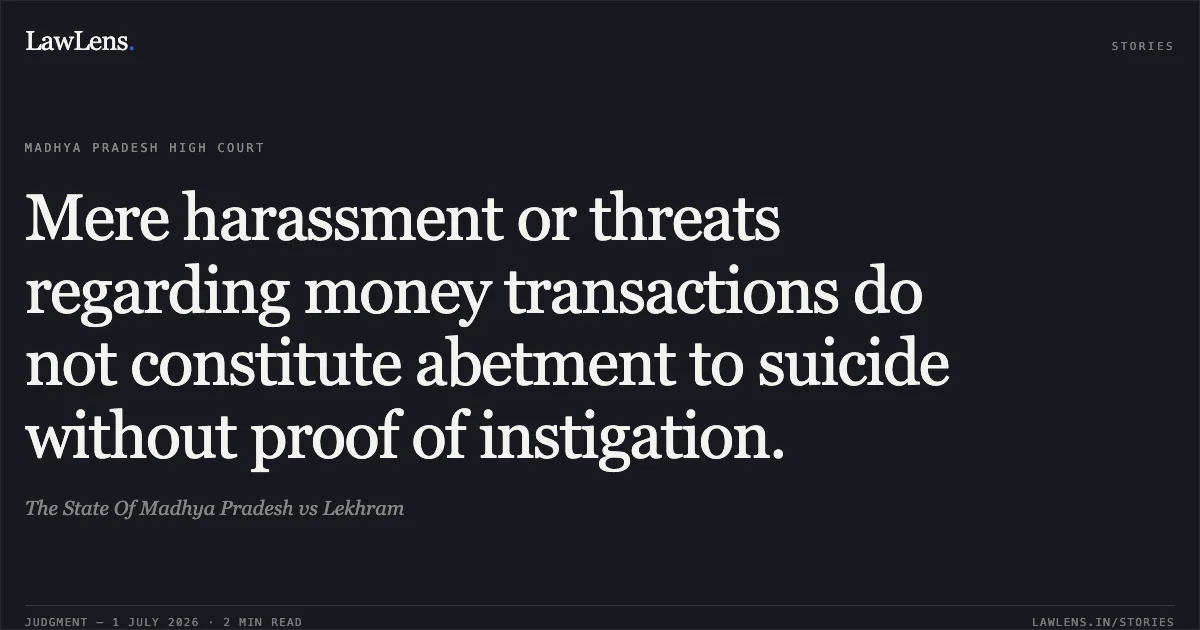
The State appealed against a judgment dated 28.03.2023 by the Sessions Judge, Khandwa, which acquitted the respondents of charges under Section 306 of the Indian Penal Code (IPC).
Source reference: para. 2The prosecution alleged that the deceased, Mokam Singh, had advanced ₹20,000 to Respondent No. 1. When repayment was demanded, the respondents allegedly harassed and threatened to kill the deceased or falsely implicate him in a rape case.
Source reference: para. 2On 07.08.2021, the deceased consumed poison and later succumbed during treatment on 09.08.2021.
Source reference: para. 2The prosecution relied on the testimony of family members (PW-1 to PW-4) and a dying declaration (Ex.P/15).
Source reference: para. 6Issues
1. Whether the alleged harassment and threats by the respondents constitute "abetment" under Section 107 of the IPC to sustain a conviction under Section 306 IPC.
Source reference: para. 9-142. Whether the trial court’s judgment of acquittal was perverse or based on a misappreciation of evidence warranting interference by the High Court.
Source reference: para. 21-23Law Applied
The court applied Section 306 of the IPC regarding abetment of suicide and Section 107 of the IPC, which defines abetment as instigation, engaging in conspiracy, or intentional aid.
Source reference: para. 9-10It relied on S.S. Cheena v. Vijay Kumar Mahajan, establishing that abetment requires a "positive act" and clear mens rea to push the deceased into a position where suicide is the only option.
Source reference: para. 12Principles from M. Mohan v. State regarding the necessity of a direct act of instigation.
Source reference: para. 13H.D. Sundara v. State of Karnataka, which dictates that an appellate court should not overturn an acquittal if the trial court’s view is a "possible view".
Source reference: para. 22Reasoning
The Court observed that the prosecution failed to establish the proximate link between the respondents' actions and the suicide.
Source reference: para. 18It noted material contradictions between the testimonies of the deceased’s mother (PW-3) and father (PW-4) regarding the timing of the alleged threats.
Source reference: para. 18Crucially, the Court found a significant time gap between the threats and the suicide, and noted that the threats were often communicated to the mother rather than the deceased directly.
Source reference: para. 19Applying the "instigation" standard, the Court held that relative to the dying declaration (Ex.P/15), mere allegations of harassment over money transactions do not satisfy the legal requirement of active incitement to commit suicide under Section 107 IPC.
Source reference: para. 20-21The Court found that the trial court's appreciation of evidence was a legally plausible view.
Source reference: para. 27Holding
The Court held that the prosecution failed to prove the essential ingredients of abetment beyond a reasonable doubt.
The High Court dismissed the application for leave to appeal and the criminal appeal, upholding the judgment of acquittal passed by the Sessions Judge, Khandwa.
Source reference: para. 28Acts & Sections Cited
4 provisions across 2 statutes referred to in this judgment. Each provision opens on LawLens.
Indian Penal Code, 18602
Code of Criminal Procedure, 19732
Original Court PDF
The State Of Madhya PradeshvsLekhram
Click to open original judgment
Original judgment, available to read, download and summarize on LawLens.in


