Facts
The State of Gujarat filed an appeal under Section 378 of the CrPC challenging the acquittal of the respondents by the Special Judge (Atrocity), Mahesana, for offences under Sections 504, 506(2), and 114 of the IPC and Section 3(1)(10) of the SC/ST (Prevention of Atrocities) Act.
Source reference: p. 1The complainant, Kantibhai Vankar, alleged that on 13.01.2011, the accused stopped, abused, and threatened him with death because he had filed an encroachment complaint against them.
Source reference: p. 2During the trial, the prosecution examined eight witnesses, including the complainant (P.W. 1) and two alleged eyewitnesses (P.W. 4 and 5).
Source reference: p. 3During the pendency of the appeal, Respondent No. 1 died, and the appeal stood abated against him.
Source reference: p. 5Issues
1. Whether the prosecution established the guilt of the accused beyond a reasonable doubt given material contradictions in the complainant's testimony.
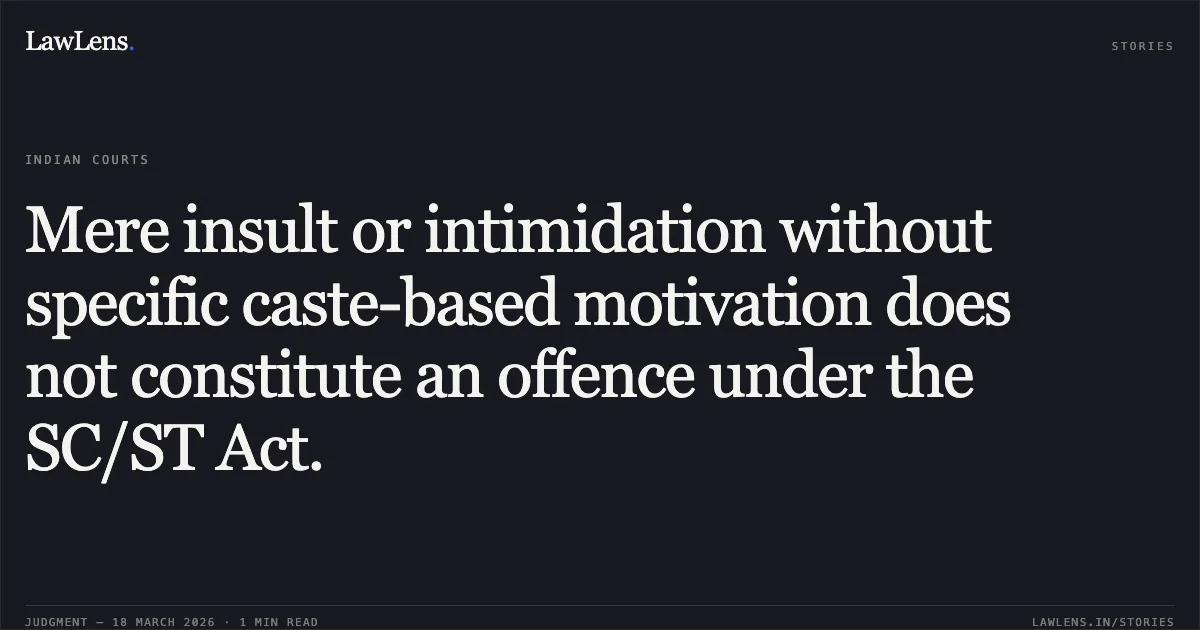
Source reference: p. 72. Whether the alleged insults and intimidation were specifically targeted at the victim due to his caste identity to attract Section 3(1)(10) of the SC/ST Act.
Source reference: p. 103. Whether the appellate court can interfere with an acquittal when the trial court’s reasoning is plausible and not perverse.
Source reference: p. 14Law Applied
The Court applied Sections 504 (intentional insult), 506(2) (criminal intimidation), and 114 (abettor present) of the IPC, alongside Section 3(1)(10) of the SC/ST (Prevention of Atrocities) Act.
Source reference: p. 1It relied on Sajan Sakhariya v. State of Kerala (AIR 2024 SC 4557), which clarifies that an offence under the SC/ST Act requires that the insult or intimidation be directed at the victim specifically because they belong to a Scheduled Caste or Tribe.
Source reference: p. 10Regarding the scope of acquittal appeals, the court applied the "double presumption of innocence" principle from Chandrappa v. State of Karnataka [(2007) 4 SCC 415] and Ram Kumar v. State of Haryana (AIR 1995 SC 280), holding that an acquittal should not be disturbed if the trial court’s view is reasonable.
Source reference: p. 13, 15Reasoning
The Court observed that the prosecution’s case rested on unstable evidence.
Source reference: p. 8The complainant (P.W. 1) admitted in cross-examination that Accused No. 1 was not present at the time of the incident, directly contradicting the complaint (Exh. 10).
Source reference: p. 8Furthermore, the complainant failed to provide the specific abusive or caste-based words allegedly used, rendering the testimony vague.
Source reference: p. 7Crucially, both independent eyewitnesses (P.W. 4 and 5) and the panch witnesses (P.W. 2 and 3) turned hostile and did not support the prosecution.
Source reference: p. 8The Court reasoned that without direct evidence or corroborated testimony, the motive and the act of intimidation were not established.
Source reference: p. 11Under the limited scope of Section 378 CrPC, the Court found no manifest illegality or perversity in the trial court’s findings, noting that the trial court correctly identified the lack of evidence connecting the accused to the crime.
Source reference: p. 11, 17Holding
The High Court dismissed the appeal and upheld the trial court's judgment of acquittal.
It held that the prosecution failed to prove the charges beyond a reasonable doubt and failed to satisfy the essential ingredients of the SC/ST Act.
Source reference: p. 10, 17The Court ordered the record and proceedings to be remitted to the concerned trial court.
Source reference: p. 17Acts & Sections Cited
6 provisions across 3 statutes referred to in this judgment. Each provision opens on LawLens.
Indian Penal Code, 18603
Code of Criminal Procedure, 19732
Scheduled Castes and the Scheduled Tribes (Prevention of Atrocities) Act, 19891
Original Court PDF
STATE OF GUJARATvsCHAUDHRY KACHRABHAI GALBABHAI
Click to open original judgment
Original judgment, available to read, download and summarize on LawLens.in


![Subsequent exoneration does not retrospectively invalidate a finalized promotion select list.. UNNIKRISHNAN M vs M/o Environment And Forests. CAT - ['Ernakulam']. LawLens](/stories/thumbnails/subsequent-exoneration-does-not-retrospectively-invalidate-a-finalized-promotion-select-li-ce80a0e84f2f4887857271e8b4341c42.webp)