Facts
The applicants are guarantors for original accused Nos. 1 to 3 (principal borrowers), who availed a term loan and overdraft facility totaling Rs. 5.15 crore from the complainant bank
Source reference: p. 1-2Allegations arose that the borrowers operated accounts in other banks in breach of contractual terms and defaulted on repayments
Source reference: p. 2An FIR was registered under Sections 467, 468, 471, 406, 420, and 120B of the IPC
Source reference: p. 2Following investigation, forgery charges were dropped, and the charge-sheet was filed only under Sections 406 (criminal breach of trust) and 420 (cheating) read with 120B
Source reference: p. 2, 4The applicants filed a discharge application (Exh. 13) before the JMFC, Patan, which was rejected on the grounds that they were partners and had supplied false documents
Source reference: p. 2The applicants challenged this rejection via the present revision application, contending they were merely passive guarantors in a civil loan dispute
Source reference: p. 2-3Issues
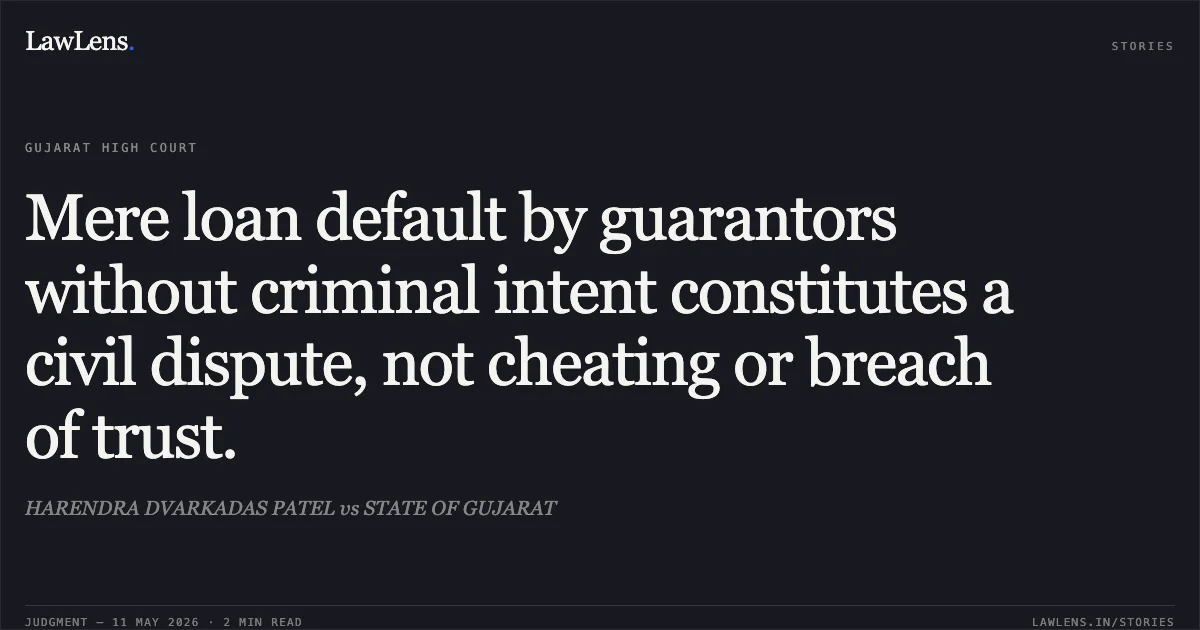
1. Whether the trial court erred in rejecting the discharge application by mischaracterizing the guarantors as partners and overlooking the civil nature of the loan default
Source reference: p. 2-32. Whether a criminal prosecution under Sections 406 and 420 IPC can be maintained against guarantors in a commercial loan default where no initial fraudulent intent is established
Source reference: p. 5Law Applied
The court applied Sections 397 and 401 of the Cr.P.C. regarding revisional jurisdiction and Section 239 of the Cr.P.C. concerning the discharge of the accused
Source reference: p. 1, 4Principle that a mere breach of contract or failure to repay a loan does not constitute cheating (Section 420 IPC) unless dishonest intention existed at the inception of the transaction
Source reference: p. 5The court further referenced Priti Saraf & Anr., Rikhab Birani & Anr. v. State of U.P. [2025 INSC 512], and Lalit Chaturvedi v. State of U.P. [2024 SCC OnLine SC 171] to emphasize that civil disputes must not be given a "criminal cloak" to exert pressure for recovery
Source reference: p. 6Reasoning
The Court observed that the principal borrower had died and the bank had already initiated recovery under the SARFAESI Act, 2002
Source reference: p. 4It noted that the Investigating Officer had already dropped forgery charges (Sec. 467, 468, 471), contradicting the trial court's finding that the applicants "supplied false documents"
Source reference: p. 2, 4The Court reasoned that the applicants were merely guarantors and not beneficiaries of the siphoned funds, and there was no evidence of mens rea or dishonest intention at the time the loan was secured
Source reference: p. 5It held that the dispute was essentially civil, arising from a default in repayment, and that criminal proceedings cannot be used as a substitute for civil recovery, especially when the bank had already auctioned mortgaged properties
Source reference: p. 4-5Holding
The High Court allowed the revision application and quashed the order dated 10.02.2010 passed by the JMFC, Patan
The Court held that the ingredients of Sections 406 and 420 IPC were not prima facie made out against the guarantors
Source reference: p. 5The applicants were discharged from the criminal case, their bail bonds were cancelled, and the court reaffirmed that the discharge mechanism serves as a vital safeguard against frivolous prosecutions that lack a legal foundation
Source reference: p. 5-7Acts & Sections Cited
9 provisions across 3 statutes referred to in this judgment. Each provision opens on LawLens.
Code of Criminal Procedure, 19733
Securitisation and Reconstruction of Financial Assets and Enforcement of Security Interest Act, 20021
Indian Penal Code, 18605
Original Court PDF
HARENDRA DVARKADAS PATELvsSTATE OF GUJARAT
Click to open original judgment
Original judgment, available to read, download and summarize on LawLens.in