Facts
The respondent filed a testamentary proceeding seeking probate of the will of late C. Shyamalavalli before the Madras High Court; the proceeding, initially registered as O.P. No. 164 of 2020, was later converted into T.O.S. No. 12 of 2021 and remained pending.
Source reference: para. 3The appellants filed their written statement, after which the respondent filed a proof affidavit along with documents.
Source reference: para. 4The appellants applied under Order XIII Rule 3 of the Code of Civil Procedure, 1908, seeking exclusion of the affidavit, allegedly irrelevant averments, and exhibited documents.
Source reference: para. 4The Single Judge rejected the application, while observing that certain xerox documents could not be marked in the absence of an explanation for non-production of the originals, but that the remaining documents could be received for determining title and rival claims concerning the will.
Source reference: para. 5The Division Bench dismissed the appellants’ appeal and imposed costs of ₹10,000, holding, inter alia, that mere filing or marking of evidence did not amount to proof and that the evidence should not be shut out at the threshold.
Source reference: para. 6The appellants thereafter approached the Supreme Court.
Source reference: no citationIssues
Whether the proof affidavit and documents filed by the respondent were liable to be eschewed at the threshold under Order XIII Rule 3 CPC as irrelevant or inadmissible in the testamentary proceedings?
Source reference: paras. 8–12Whether the documents marked or exhibited could be excluded merely on the ground that their contents had not yet been proved in accordance with law?
Source reference: paras. 9–12Whether mere marking or admission of documents dispensed with the requirement of proving their contents and truth at trial?
Source reference: para. 11Law Applied
The Court applied Order XIII Rule 3 CPC, under which a court may reject, at any stage, a document that is irrelevant or otherwise inadmissible, while recording reasons for doing so.
Source reference: para. 8It relied on Bipin Shantilal Panchal v. State of Gujarat, (2001) 3 SCC 1, which holds that, except where the objection concerns deficiency of stamp duty, objections to admissibility may ordinarily be recorded and the document marked tentatively, subject to determination at the final stage.
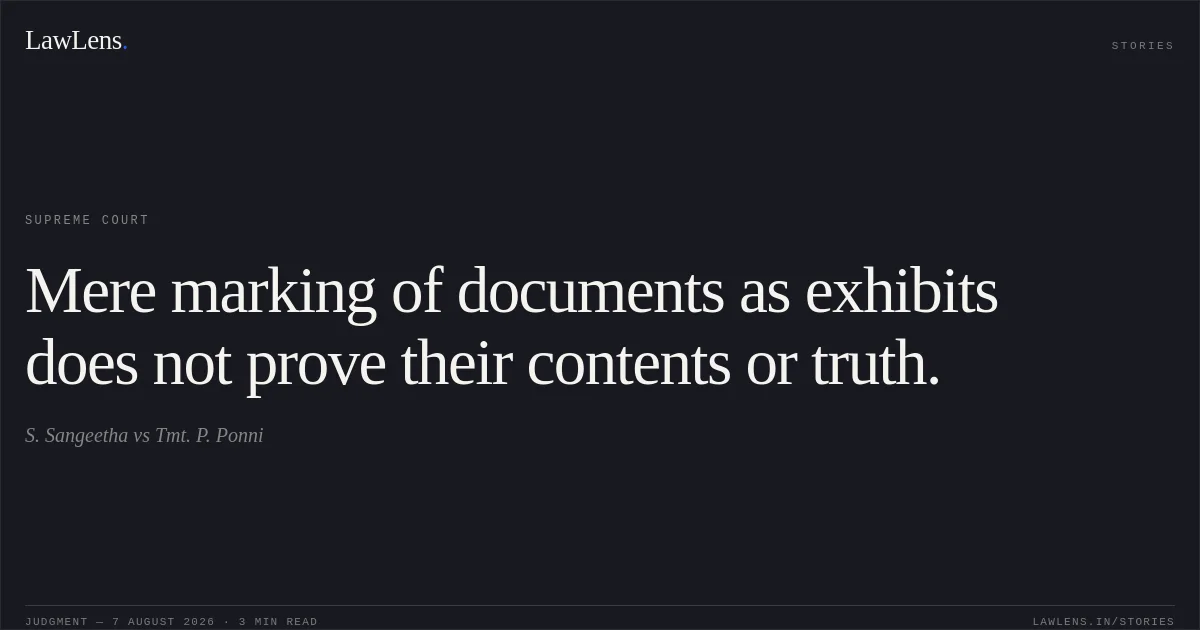
Source reference: para. 10The Court further applied the settled principle from LIC v. Ram Pal Singh Bisen, (2010) 4 SCC 491, along with Sait Tarajee Khimchand v. Yelamarti Satyam, Narbada Devi Gupta v. Birendra Kumar Jaiswal, and Vijay v. Union of India, that mere admission or marking of a document as an exhibit does not amount to proof of its contents or truth; the contents must be proved through primary or legally admissible secondary evidence.
Source reference: para. 11In testamentary proceedings, the propounder must ultimately prove the will to the satisfaction of the court.
Source reference: para. 6(c)Reasoning
The Supreme Court held that the documents challenged by the appellants, except the xerox copies already excluded by the Single Judge for want of explanation regarding the originals, were not prima facie irrelevant or inadmissible to the properties and rival claims involved in the testamentary proceeding.
Source reference: para. 9The references in the proof affidavit to other suits and transfers of properties within the same family structure could not be rejected at the threshold, since their relevance and evidentiary value were matters to be assessed during the proceedings.
Source reference: para. 10Applying Bipin Shantilal Panchal, the Court emphasized that premature exclusion of evidence could prejudice the trial and create difficulties at the appellate stage.
Source reference: para. 10At the same time, the Court clarified that the respondent would still have to prove the contents and evidentiary value of the marked documents in accordance with law; their marking did not establish their truth or dispense with formal proof.
Source reference: paras. 11–12Accordingly, there was no justification for exercising the power under Order XIII Rule 3 CPC to eschew the remaining documents or affidavit material at that stage.
Source reference: para. 12Holding
The appeal was dismissed, and the Madras High Court’s judgment dated 21 August 2024 in OSA No. 31 of 2023 was upheld.
The Court held that the challenged documents, other than the xerox copies already excluded, should not be rejected at the threshold, but their contents would have to be proved in accordance with law during the testamentary proceedings.
Source reference: paras. 9, 12The proceedings in T.O.S. No. 12 of 2021 were directed to continue uninfluenced by the Supreme Court’s observations, the stay granted on 11 November 2024 was vacated, and pending applications were disposed of.
Source reference: paras. 14–15Original Court PDF
S. SangeethavsTmt. P. Ponni
Click to open original judgment
Original judgment, available to read, download and summarize on LawLens.in