Facts
The appellants—Ram Harsh, Chhotta, Maya Ram and Prema Devi—were respectively the husband, brother-in-law, mother-in-law and father-in-law of the deceased.
Source reference: paras. 2, 4–5The prosecution alleged that the deceased was harassed for non-fulfilment of a demand for a motorcycle and was strangulated in her matrimonial home on 5 September 2010, approximately two years after her marriage.
Source reference: paras. 2, 4–5The post-mortem report recorded contusions around the neck and on the back, a fractured hyoid bone, and death due to strangulation asphyxia.
Source reference: para. 5The trial court convicted all the appellants under Sections 498-A and 304-B IPC and Section 4 of the Dowry Prohibition Act, sentencing them to ten years’ rigorous imprisonment under Section 304-B IPC, three years’ rigorous imprisonment and fine under Section 498-A IPC, and six months’ rigorous imprisonment and fine under Section 4 of the Dowry Prohibition Act.
Source reference: paras. 2–3In appeal, the deceased’s father, PW-1, who had initially supported the prosecution during examination-in-chief, denied the dowry demand and harassment during cross-examination and stated that his earlier testimony had been given on the suggestions of villagers.
Source reference: paras. 7–11The deceased’s brothers and uncle, examined as PW-4, PW-5 and PW-6, also turned hostile and did not support the prosecution case.
Source reference: para. 13Issues
Whether the prosecution proved beyond reasonable doubt that the deceased was subjected to cruelty or harassment by the appellants for, or in connection with, a dowry demand, so as to sustain convictions under Sections 498-A IPC, 304-B IPC and Section 4 of the Dowry Prohibition Act.
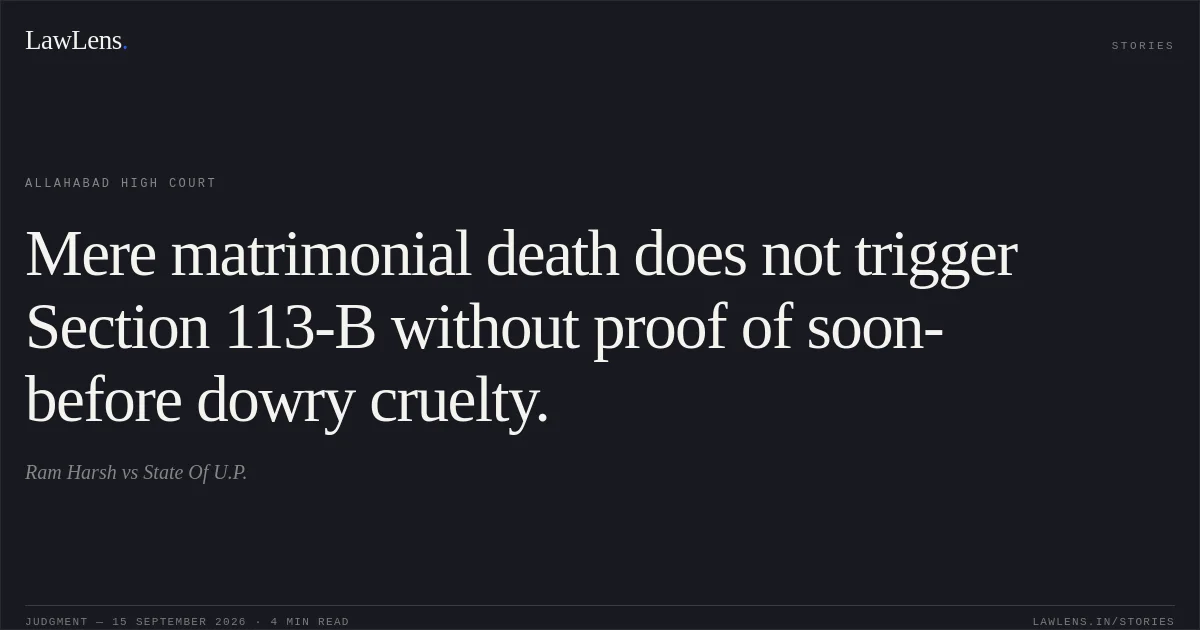
Source reference: paras. 17–20, 27–29Whether the statutory presumption of dowry death under Section 113-B of the Evidence Act could be invoked merely because the deceased died an unnatural death in her matrimonial home within seven years of marriage.
Source reference: paras. 18–20Whether the circumstances of strangulation, the appellants’ alleged absence from the matrimonial home, and their failure to establish an alternative place of presence were sufficient to connect them with the deceased’s death.
Source reference: paras. 20–24, 28Law Applied
The Court applied Sections 498-A and 304-B IPC and Section 4 of the Dowry Prohibition Act, requiring proof of cruelty or harassment connected with a dowry demand.
Source reference: no citationUnder Section 113-B of the Evidence Act, the presumption of dowry death arises only when the prosecution first establishes that, soon before her death, the woman was subjected to cruelty or harassment for, or in connection with, a dowry demand.
Source reference: para. 18The prosecution bears the burden of proving guilt beyond reasonable doubt, whereas the accused need only raise a reasonable doubt or establish a probable defence; they are not required to prove their defence beyond reasonable doubt (Anand Ramachandra Chougule v. Sidarai Laxman Chougala, (2019) 8 SCC 50).
Source reference: paras. 21–23Suspicion, however strong, cannot replace legal proof, and where two views are reasonably possible, the view favourable to the accused must be adopted (Jose v. Sub-Inspector of Police, (2016) 10 SCC 519).
Source reference: para. 24In a case based on circumstantial evidence, the circumstances must be fully established, consistent only with guilt, conclusive, exclude every reasonable hypothesis of innocence, and form a complete chain (Sharad Birdhichand Sarda v. State of Maharashtra, (1984) 4 SCC 116).
Source reference: para. 25The testimony of a hostile witness may be used not only to support a conviction where corroborated, but also to discredit the prosecution and support an acquittal where it inspires confidence (Talari Naresh v. State of Telangana, 2026 SCC OnLine SC 852).
Source reference: para. 26Reasoning
The Court held that the prosecution failed to prove the foundational facts necessary for invoking Section 113-B of the Evidence Act.
Source reference: no citationApart from the partially retracted testimony of PW-1, there was no reliable evidence that any appellant had demanded dowry or subjected the deceased to cruelty or harassment.
Source reference: paras. 19, 27, 29Even in examination-in-chief, PW-1 merely stated that the deceased had told him about the alleged demand; he did not state that any appellant had directly demanded a motorcycle from him, and he subsequently disowned the allegation during cross-examination.
Source reference: paras. 19, 27, 29PW-4, PW-5 and PW-6 denied any dowry demand and did not support the prosecution.
Source reference: paras. 13, 27Although the deceased had died by strangulation in her matrimonial home, the medical evidence established only the cause of death and did not identify the appellants as the perpetrators.
Source reference: paras. 5, 20, 28The prosecution itself relied on PW-1’s statement that the appellants had left the house two days before the incident and that the deceased was alone; the appellants were not required to prove their alibi beyond reasonable doubt when the prosecution had not established their presence at the scene.
Source reference: paras. 20–23Their failure to provide detailed particulars of their absence could create suspicion but could not substitute for proof.
Source reference: paras. 15–16, 24, 28Holding
The Court answered the issues in favour of the appellants and held that the prosecution had failed to prove the alleged dowry demand, cruelty, harassment, or the appellants’ involvement in the deceased’s strangulation beyond reasonable doubt.
All three appeals were allowed.
Source reference: para. 30The judgment of conviction dated 1 October 2011 and the sentencing order dated 10 October 2011 were set aside, and the appellants were acquitted of offences under Sections 498-A and 304-B IPC and Section 4 of the Dowry Prohibition Act by giving them the benefit of doubt.
Source reference: para. 30Any fine deposited was directed to be refunded, and the appellants were required to furnish bonds and sureties under Section 437-A CrPC for a period of six months.
Source reference: para. 31Acts & Sections Cited
4 provisions across 2 statutes referred to in this judgment. Each provision opens on LawLens.
Code of Criminal Procedure, 19732
Original Court PDF
Ram HarshvsState Of U.P.
Click to open original judgment
Original judgment, available to read, download and summarize on LawLens.in