Facts
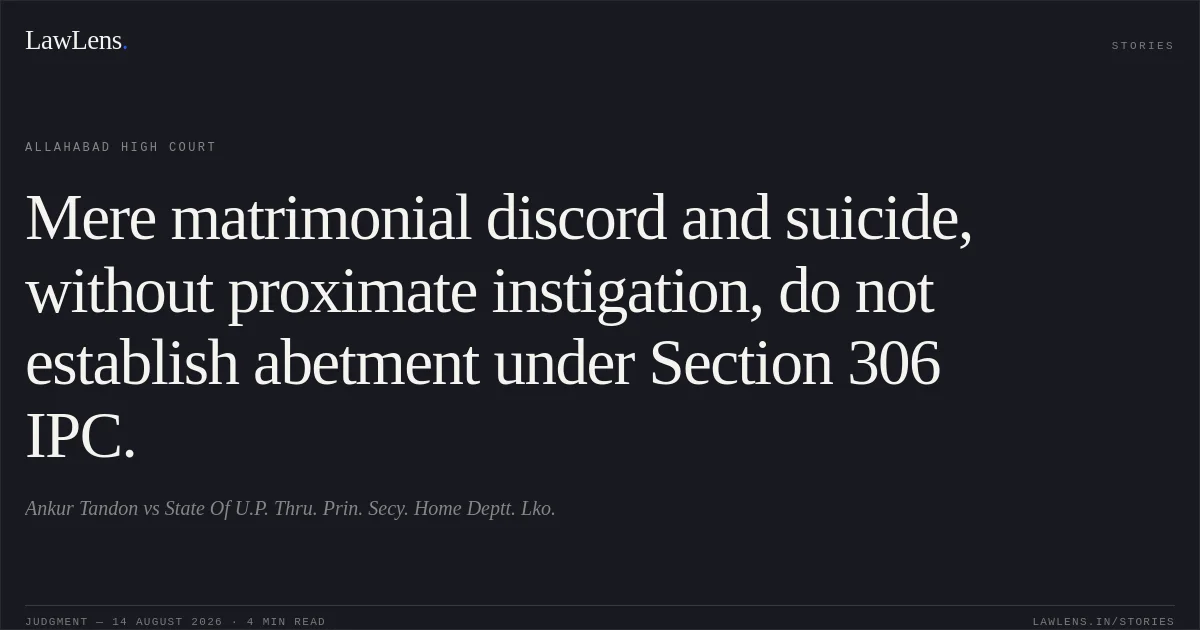
The appellant was convicted by the Special Judge, Ayurveda Scam/CBI, Lucknow, for offences under Sections 498-A and 306 IPC and Section 4 of the Dowry Prohibition Act, while being acquitted under Section 304-B IPC.
Source reference: p.1, para. 2The prosecution alleged that the deceased, Monika Tandon, married the appellant on 14 December 2004 and was harassed by him and his family for dowry, including a demand of ₹10 lakh for purchasing a flat; it was alleged that her father paid ₹6 lakh and that the deceased was thereafter harassed for the balance amount.
Source reference: p.2, para. 3The deceased committed suicide by hanging on 2 October 2010 and left two suicide notes alleging ill-treatment, misbehaviour, humiliation and responsibility for her death against the appellant and others.
Source reference: p.2, paras. 4, 6The prosecution witnesses alleged dowry-related harassment, assault and that the appellant’s divorce proceedings caused the deceased mental agony.
Source reference: pp.3–5, paras. 7–12The appellant denied the allegations and relied on documentary material showing prolonged matrimonial discord, separate residence, criminal complaints, matrimonial proceedings and allegations of cruelty by the deceased against him.
Source reference: pp.5–7, paras. 13–19The trial court held that the charge under Section 304-B IPC was not proved because the parties had not been in contact for approximately five months before the suicide, but convicted the appellant under Sections 498-A and 306 IPC and Section 4 of the Dowry Prohibition Act.
Source reference: p.8, paras. 20–23Issues
1. Whether the prosecution proved beyond reasonable doubt that the appellant subjected the deceased to cruelty or harassment in connection with an unlawful dowry demand, thereby attracting Section 498-A IPC and Section 4 of the Dowry Prohibition Act.
Source reference: pp.9–13, paras. 24–432. Whether the appellant abetted the deceased’s suicide under Sections 306 and 107 IPC, particularly when the parties had allegedly had no contact for more than five months before the suicide.
Source reference: pp.15–22, paras. 44–583. Whether the presumption under Section 113-A of the Evidence Act could be invoked in the absence of cogent proof of cruelty or proximate instigation.
Source reference: pp.20–22, paras. 52–58Law Applied
The prosecution bears the burden of proving guilt beyond reasonable doubt, whereas the accused need only establish a probable defence or raise a reasonable doubt on the basis of preponderance of probabilities, as held in Anand Ramachandra Chougule v. Sidarai Laxman Chougala and Vaibhav v. State of Maharashtra.
Source reference: p.13, paras. 40–41Section 498-A IPC criminalises wilful conduct likely to drive a woman to suicide or cause grave injury, and harassment intended to coerce fulfilment of an unlawful demand for property or valuable security.
Source reference: p.21, para. 53Section 4 of the Dowry Prohibition Act penalises demanding dowry, while Section 3 separately penalises giving or taking dowry.
Source reference: pp.13–15, paras. 42–43Under Sections 306 and 107 IPC, abetment of suicide requires proof of instigation, conspiracy or intentional aid; mere harassment or matrimonial discord is insufficient without a direct or indirect act of incitement, a clear mens rea, and proximity to the suicide.
Source reference: pp.15–20, paras. 46–50, 57Section 113-A of the Evidence Act permits—but does not mandate—a presumption of abetment by a husband or his relative where a married woman commits suicide within seven years of marriage and has first been subjected to cruelty; cogent evidence of cruelty is a condition precedent to its application.
Source reference: pp.20–22, paras. 52–56Reasoning
The Court found material inconsistencies in the allegations concerning the dowry demand.
Source reference: pp.9–13, paras. 25–30, 35–38The alleged payment of ₹6 lakh was unsupported by particulars of the plot sale, date of payment or documentary evidence, and the prosecution witnesses gave inconsistent accounts regarding earlier demands and payments.
Source reference: pp.9–13, paras. 25–30, 35–38The dowry allegation was first made in writing only in the FIR lodged on 20 April 2010, whereas the parties had already been involved in multiple disputes and proceedings since 2007; the appellant’s documentary evidence furnished a probable account of prolonged matrimonial discord and counter-allegations.
Source reference: pp.10–13, paras. 31–39, 42–43The Court therefore held that the prosecution failed to establish cruelty under Section 498-A IPC or a dowry demand under Section 4 of the Dowry Prohibition Act beyond reasonable doubt.
Source reference: p.13, para. 43As to Section 306 IPC, the Court held that the suicide notes and the fact of suicide could not, by themselves, establish legally sufficient abetment.
Source reference: pp.20–22, paras. 51, 56–58The trial court had itself found that the appellant and the deceased had not been in contact for five months and twelve days before the suicide.
Source reference: pp.20–22, paras. 51, 56–58No proximate act, direct incitement, intentional aid or positive conduct by the appellant during that period was proved.
Source reference: pp.20–22, paras. 51, 56–58In the absence of proof of cruelty, the presumption under Section 113-A could not be invoked merely because the deceased was a married woman who had committed suicide.
Source reference: pp.20–22, paras. 51, 56–58Holding
The appeal was allowed.
The High Court set aside the judgment and order dated 21 September 2024 and acquitted the appellant of the offences under Sections 498-A and 306 IPC and Sections 3/4 of the Dowry Prohibition Act.
Source reference: p.22, para. 59The appellant was directed to be released from custody upon furnishing a personal bond and two sureties under Section 437-A Cr.P.C.; the fine deposited by him was ordered to be refunded.
Source reference: p.23, para. 60Acts & Sections Cited
15 provisions across 4 statutes referred to in this judgment. Each provision opens on LawLens.
Indian Penal Code, 18607
Code of Criminal Procedure, 19734
Hindu Marriage Act, 19552
Original Court PDF
Ankur TandonvsState Of U.P. Thru. Prin. Secy. Home Deptt. Lko.
Click to open original judgment
Original judgment, available to read, download and summarize on LawLens.in