Facts
The applicant, a Constable in the Delhi Police serving as a Naib Court at Saket Court, was suspended on 14.11.2013 for alleged negligence
Source reference: p. 2The charge stated that he failed to inform the Investigating Officer (IO) regarding an anticipatory bail application filed by an accused (Ex. HC Amit Tomar), which allowed the accused to obtain interim protection
Source reference: p. 2Following a departmental inquiry, the Disciplinary Authority proved the charges and imposed a major penalty: forfeiture of two years of approved service with a reduction in pay, treatment of the suspension period as not spent on duty, and inclusion of his name in the "secret list of doubtful integrity"
Source reference: p. 2-3The applicant argued that no codified instructions assigned him the duty to inform the IO and that he followed the routine practice of placing the application on the Public Prosecutor's table
Source reference: p. 2After his appeal was rejected on 11.02.2015, he challenged the orders before the Tribunal
Source reference: p. 3Issues
1. Whether mere negligence in the performance of duty, absent any ulterior motive or codified instructions, constitutes "misconduct" under service rules
Source reference: p. 62. Whether the penalty imposed was arbitrary and subject to judicial review under the principles of proportionality
Source reference: p. 7Law Applied
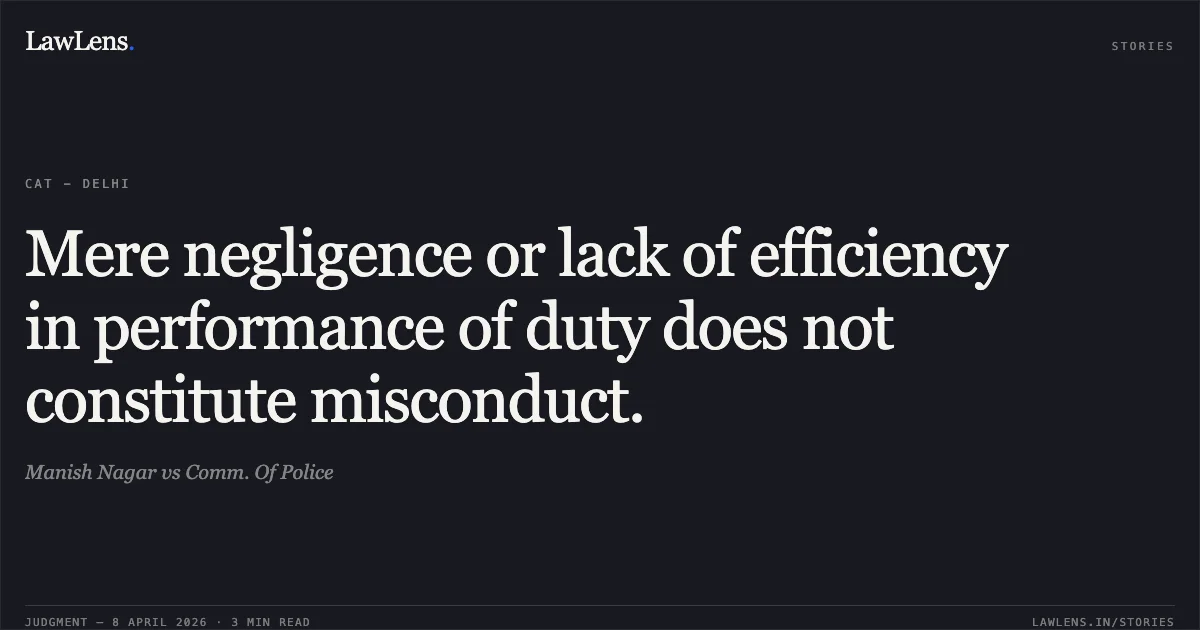
The Tribunal primarily applied the precedent set by the Hon’ble Supreme Court in Union of India & Others v. J. Ahmed (1979) 2 SCC 286, which established that lack of efficiency, failure to attain the highest standards of administrative ability, or mere negligence in the discharge of duty do not constitute "misconduct" for disciplinary proceedings
Source reference: p. 5-6It further relied on B.C. Chaturvedi v. Union of India (1995) 6 SCC 749, which affirms that while Courts/Tribunals seldom interfere in disciplinary decisions, they may exercise judicial review if there is a violation of the Principles of Natural Justice or if the punishment is so disproportionate that it "shocks the conscience of the Court"
Source reference: p. 7Reasoning
The Tribunal found that the applicant had followed the standard routine by placing the bail application on the Public Prosecutor’s table
Source reference: p. 6It noted that the respondents failed to produce any Standard Operating Procedure (SOP) or codified instructions that required the applicant to inform the IO directly or bypass the Public Prosecutor in urgent matters
Source reference: p. 6Applying the ratio from J. Ahmed, the Tribunal reasoned that even if a "whiff of negligence" existed, it did not amount to a "commission or omission" or a lack of "devotion to duty" constituting misconduct
Source reference: p. 6The Tribunal observed that the duty to coordinate between the IO and the Prosecutor likely lay with the Crime Branch's own Naib Courts, who were instead made prosecution witnesses in this case
Source reference: p. 4Consequently, the Tribunal determined that the applicant had been wrongly punished for a lapse that was not his legal responsibility
Source reference: p. 7Holding
The Tribunal allowed the O.A., holding that the applicant’s actions did not amount to misconduct
It quashed and set aside the impugned orders dated 11.02.2015, 17.10.2014, 30.08.2014, and 24.11.2014
Source reference: p. 7The Tribunal directed the respondents to grant the applicant all consequential benefits, including restoration of pay, arrears, increments, and continuity of service, within eight weeks
Source reference: p. 7The placement of the applicant's name on the secret list of doubtful integrity was also effectively nullified by the quashing of the underlying orders
Source reference: p. 7Acts & Sections Cited
1 provisions across 1 statute referred to in this judgment. Each provision opens on LawLens.
Administrative Tribunals Act, 19851
Original Court PDF
Manish NagarvsComm. Of Police
Click to open original judgment
Original judgment, available to read, download and summarize on LawLens.in