Facts
The complainant company alleged that it supplied 436.65 MT of goods between June and September 2015, invoiced at ₹58,67,307.50, of which ₹24,99,454.90 remained unpaid.
Source reference: para. 4, 11Despite demands and a legal notice, payment was allegedly not made.
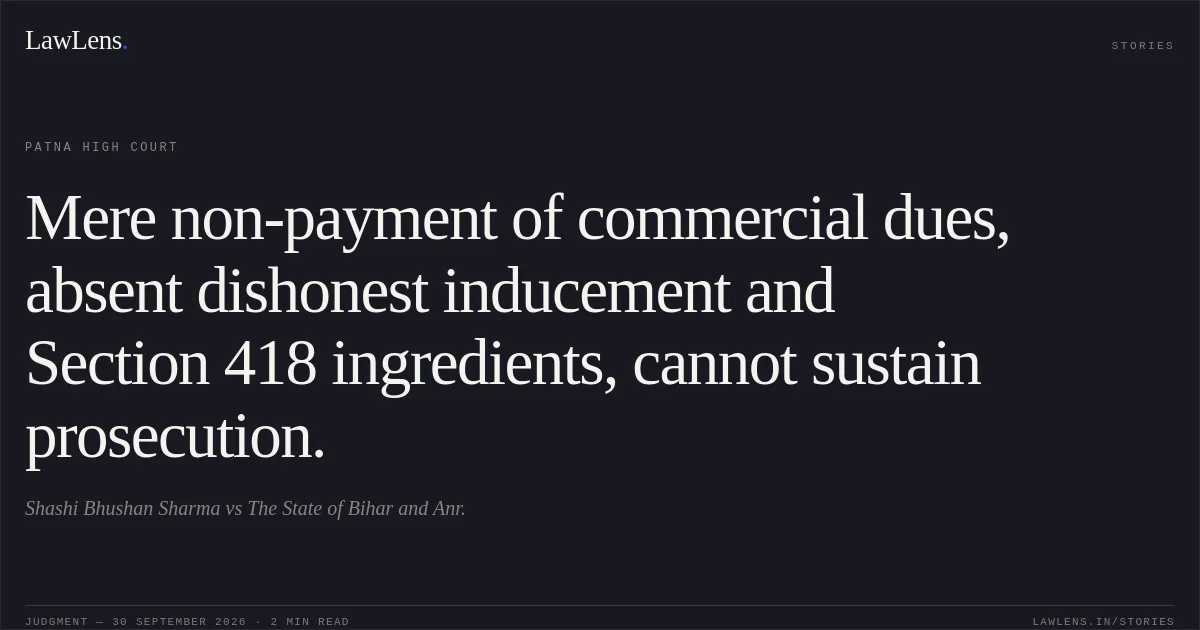
Source reference: para. 4, 11The petitioner, stated to be the company’s Regional Administrator, sought to quash the Magistrate’s order dated 24 April 2018 taking cognizance against him under Section 418 IPC in Complaint Case No. 3159(C)/2016.
Source reference: para. 2, 5–6He argued that no specific act or inducement was attributed to him and that the allegations concerned a commercial payment dispute.
Source reference: para. 2, 5–6The opposite parties opposed the petition.
Source reference: para. 7Issues
1. Whether the complaint, taken at face value, disclosed the essential ingredients of an offence under Section 418 IPC against the petitioner
Source reference: para. 9–10, 16–172. Whether continuation of the criminal proceedings against the petitioner would amount to an abuse of process where the allegations concerned non-payment of commercial dues and attributed no specific criminal act to him
Source reference: para. 14–18Law Applied
Section 418 IPC requires the ingredients of cheating under Section 415 IPC, together with material showing that the accused was bound by law or legal contract to protect the interests of the person allegedly cheated and knew that wrongful loss was likely to result.
Source reference: para. 9A subsequent failure to pay a commercial liability, without allegations showing dishonest or fraudulent intention at the inception of the transaction, does not by itself constitute cheating.
Source reference: para. 12Under Section 482 CrPC, proceedings may be quashed where allegations, accepted at face value and in their entirety, do not disclose the essential ingredients of the alleged offence; the Court need not undertake a meticulous appreciation of evidence.
Source reference: para. 15–16The Court also relied on Rikhab Birani and Another v. State of Uttar Pradesh and Another, 2025 SCC OnLine SC 823, for the principle that a commercial or contractual dispute cannot be given a criminal colour absent the essential ingredients of the offence, and criminal process cannot be used merely to recover a monetary claim.
Source reference: para. 13Reasoning
The complaint did not allege that the petitioner made any representation to the complainant, induced the supply of goods, participated in the relevant transaction, or undertook a personal or contractual obligation to protect the complainant’s interests.
Source reference: para. 10Nor did it attribute to him a specific act concerning the supply or non-payment; his designation as Regional Administrator was insufficient, by itself, to establish criminal liability.
Source reference: para. 11, 14The allegations therefore disclosed, at most, non-payment of commercial dues and did not establish either cheating or the additional requirements of Section 418 IPC.
Source reference: para. 12, 17On that basis, the Court found that continuing the proceedings would amount to an abuse of process.
Source reference: para. 16, 18Holding
The Court held that the complaint did not disclose the essential ingredients of Section 418 IPC against the petitioner.
It allowed the application and quashed the cognizance order dated 24 April 2018 and all consequential proceedings against him in Complaint Case No. 3159(C)/2016.
Source reference: para. 17–20Acts & Sections Cited
3 provisions across 2 statutes referred to in this judgment. Each provision opens on LawLens.
Indian Penal Code, 18602
Code of Criminal Procedure, 19731
Original Court PDF
Shashi Bhushan SharmavsThe State of Bihar and Anr.
Click to open original judgment
Original judgment, available to read, download and summarize on LawLens.in