01Facts
The petitioner in W.P. No. 34149 of 2025, Rangabass (party-in-person), sought removal of encroachments on a public road in S. Nos. 311/6, 311/8 and 311/18 and consideration of his representation dated 21.06.2025.
p. 4 · ¶ 1The petitioner alleged that respondents 5 to 7 had encroached on the road in S. Nos. 311/6 and 311/18.
p. 5 · ¶ 2In W.P. No. 28017 of 2026, Venkatachalam sought removal of encroachments by the fifth respondent on public pathways in S. Nos. 311/6, 311/18 and 311/19, Erumaipatti Village, and restoration of the road.
p. 4 · ¶ 2 · p. 3After several hearings, the Special Government Pleader stated that encroachments in S. Nos. 311/6 and 311/18 had been removed, and respondents 5 to 7 stated the same and did not object to removing any remaining encroachment.
p. 5 · ¶ 3The petitioner contended that he was not an encroacher but occupied Grama Natham land in S. No. 311/19, and that revenue authorities had no jurisdiction to evict occupants of such land.
p. 5 · ¶ 4The Government Pleader contended that the petitioner had encroached on the public pathway in S. No. 311/19.
p. 7 · ¶ 802Issues
i.1. Whether revenue authorities can evict a person in occupation of Grama Natham land (S. No. 311/19) and whether mere occupation confers any right on such occupant.
p. 5 · ¶ 4–5ii.2. Whether the Government is empowered to regulate Grama Natham lands under Revenue Standing Order No. 21, and whether earlier Full Bench rulings (1904 and 1923) remain binding notwithstanding the recent Full Bench decision in Kaman @ Kamatchi.
p. 5 · ¶ 5 · p. 6 · ¶ 6–7iii.3. Whether the official respondents must remove the encroachments and protect the public pathway for public use.
p. 7 · ¶ 903Law Applied
Revenue Standing Order No. 21 provides that Grama Natham lands are first to be used for public purposes and may secondarily be assigned to homeless poor persons for dwelling, up to three cents; mere occupation confers no right of ownership.
p. 5 · ¶ 5Madathapu Ramaya v. Secretary of State for India in Council, ILR 1904 (27) Mad 386, and Taluk Board, Dindigul v. Venkatarama Ayyar, (1923) 18 LW 366, both Full Bench decisions, held that the Government may regulate Grama Natham lands.
p. 6 · ¶ 6Kaman @ Kamatchi v. District Collector, W.P. (MD) No. 19720 of 2017 (dated 06.03.2026), a recent Full Bench decision in which two Judges took one view and a third dissented, and in which the Supreme Court stayed Para 153 in SLP (D) No. 36729 of 2026.
p. 6 · ¶ 7National Insurance Co. Ltd. v. Pranay Sethi, AIR 2017 SC 5157, was applied to hold that the 1923 Full Bench ruling remains binding precedent.
p. 6 · ¶ 7Article 226 of the Constitution of India, under which the Court may direct removal of encroachments on public pathways.
p. 7 · ¶ 904Reasoning
The petitioner's claim that Grama Natham occupants cannot be evicted was rejected because the Full Benches of 1904 and 1923 held that the Government may regulate such land, and RSO 21 governs its use.
p. 5 · ¶ 5 · p. 6 · ¶ 6The Court treated the 1923 ruling as binding and found the Kaman decision unsettled, given the split bench and the Supreme Court's stay of Para 153.
p. 6 · ¶ 7On the facts, the Court found that the encroachments in S. Nos. 311/6 and 311/18 had been removed, and that the petitioner was the only remaining encroacher on the pathway, which he had occupied in S. No. 311/19. The Court held that his occupation did not give him a right against eviction, and that the pathway had initially been obstructed by respondents 5 to 7 and later by the writ petitioner.
p. 7 · ¶ 805Holding
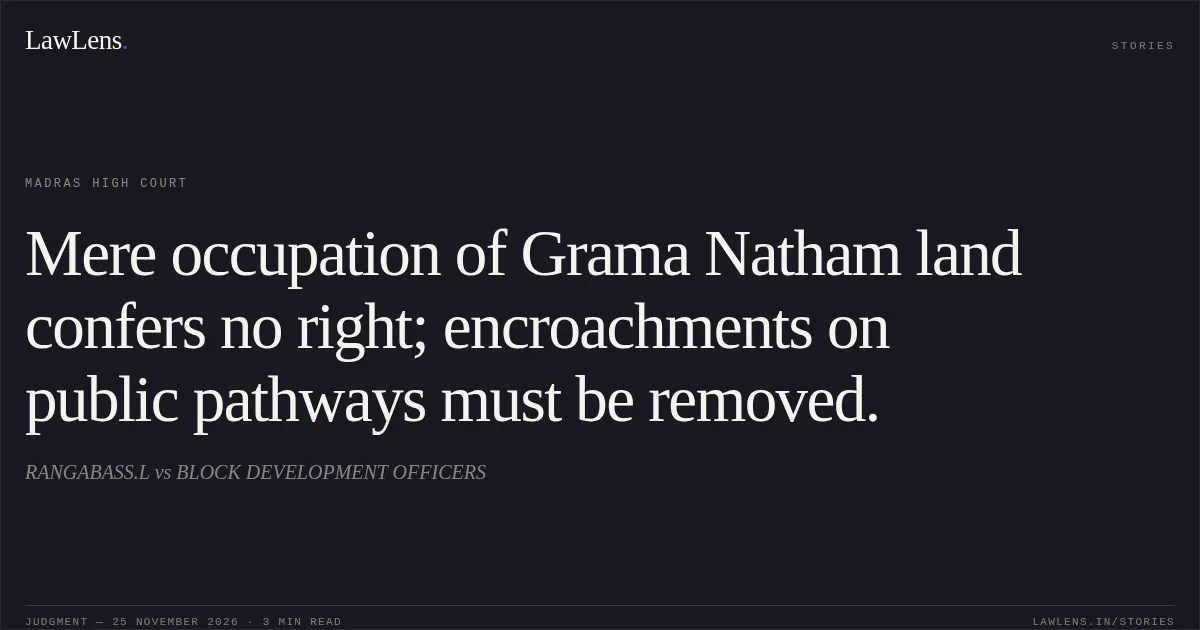
Occupation of Grama Natham land confers no right against eviction, and the Government may regulate such land under RSO 21 as settled by the 1904 and 1923 Full Benches; the public pathway must remain free for public use.
p. 6 · ¶ 6–7 · p. 7 · ¶ 8–9The official respondents (1 to 4) are directed to remove all encroachments in the public pathway in S. Nos. 311/6, 311/18 and 311/19, including the petitioner's, ensure no obstruction, and protect the pathway, to be completed within four weeks from receipt of the order. Both writ petitions are disposed of without costs.
p. 7 · ¶ 9 · p. 8 · ¶ 10Original Court PDF
RANGABASS.LvsBLOCK DEVELOPMENT OFFICERS
Click to open original judgment
Original judgment, available to read, download and summarize on LawLens.in