Facts
The plaintiffs/respondents, representing the Parakalaramanujakoodam Paghalpathu Rappathu Trust, sought recovery of possession of the suit property.
Source reference: no citationThe property was originally subject to an earlier title suit (O.S.No.749 of 1973), where the first defendant (appellant) was impleaded as the 34th defendant in 1976 via I.A.No.309 of 1976.
Source reference: para 11In that earlier suit, the plaintiff acknowledged the defendant’s claim of title via a 1964 sale deed but failed to seek recovery of possession against him, seeking it only against a different party.
Source reference: para 11-12The earlier litigation ended in 1988 with the dismissal of a Letters Patent Appeal (L.P.A.No.5 of 1984).
Source reference: para 10The current suit for recovery of possession was filed on 07.12.1992.
Source reference: para 7Both lower courts decreed the suit, holding that limitation began only after the final disposal of the LPA in 1988.
Source reference: para 4.4Issues
1. Whether the lower courts were justified in ignoring the defendants' plea of adverse possession despite established possession since 10.07.1964 and construction of a house.
Source reference: para 22. Whether the limitation for recovery of possession starts only from the disposal of earlier appellate proceedings (LPA) or if the mere pendency of proceedings fails to arrest the running of limitation under Section 9 of the Limitation Act.
Source reference: para 2Law Applied
The court applied Section 3 of the Limitation Act, 1963, which mandates the dismissal of suits filed after the prescribed period even if limitation is not pleaded.
Source reference: para 13It relied on Article 65 of the Limitation Act, which stipulates a 12-year period for recovery of possession from the date possession becomes adverse.
Source reference: para 13, 19The court invoked the principle from Nazir Mohamed v. J. Kamala, holding that a decree for possession does not automatically follow a declaration of title.
Source reference: para 13The court applied Rajender Singh v. Santa Singh, affirming that continued illegal possession matures into a right due to the owner's inaction.
Source reference: para 16It also applied Section 9 of the Limitation Act, stating that once limitation begins to run, no subsequent disability or inability stops it.
Source reference: para 2, 14Reasoning
The court found that the plaintiff had "clear and definite notice" of the defendant's adverse claim as early as 1976 when the defendant was impleaded in the previous suit.
Source reference: para 17, 19Despite being aware that the defendant claimed title through a 1964 sale deed, the plaintiff failed to seek the relief of recovery of possession in the 1973/1976 proceedings.
Source reference: para 12The court reasoned that the "limitation clock" started ticking at least in 1976.
Source reference: para 23Crucially, the court held that the pendency of the defendant’s appeal or LPA in the title suit did not "tie the hands" of the plaintiff or arrest the period of limitation for filing a fresh suit for possession.
Source reference: para 12, 14The lower courts erred in calculating the 12-year period from the 1988 LPA judgment rather than from the date the adverse interest was first established and acknowledged by the plaintiff.
Source reference: para 23Holding
The Court answered the substantial questions of law in favor of the appellants, holding that the suit was barred by limitation.
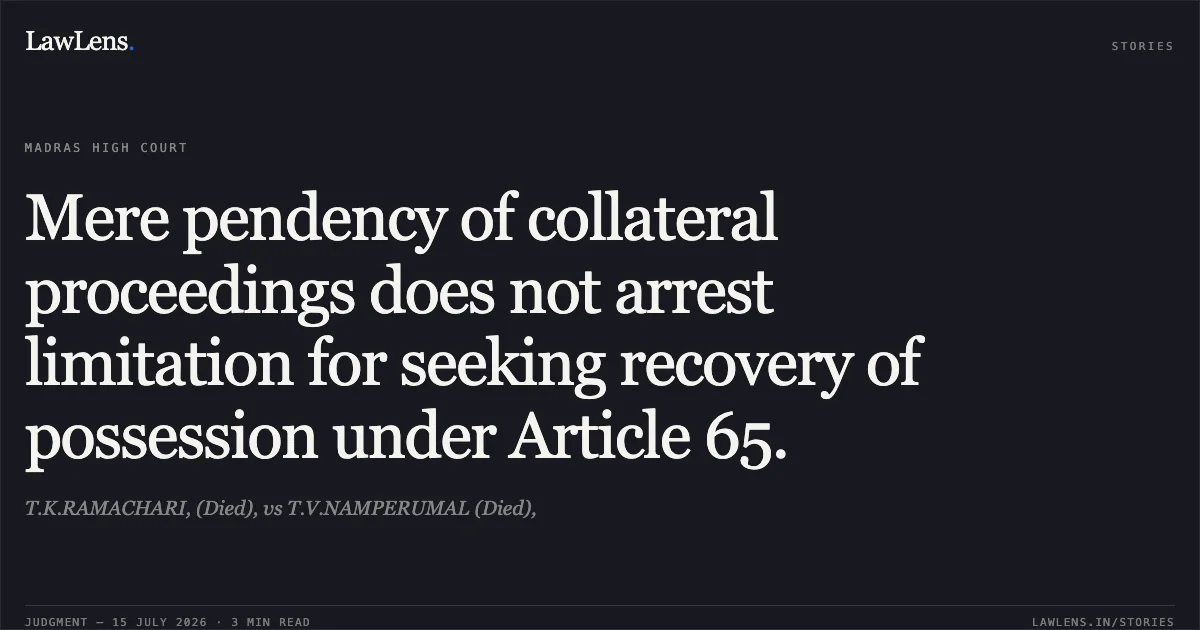
The mere pendency of earlier collateral proceedings does not stop the running of limitation for a recovery suit.
Source reference: para 23The Second Appeal was allowed, the judgments of the Trial Court and First Appellate Court were set aside, and the suit in O.S.No.2451 of 1996 was dismissed. No order as to costs was made.
Source reference: para 24Acts & Sections Cited
5 provisions across 2 statutes referred to in this judgment. Each provision opens on LawLens.
Code of Civil Procedure, 19081
Limitation Act, 19634
Original Court PDF
T.K.RAMACHARI, (Died),vsT.V.NAMPERUMAL (Died),
Click to open original judgment
Original judgment, available to read, download and summarize on LawLens.in


