Facts
On 2 October 2000, during nighttime patrolling, the officer-in-charge of Kunda Police Station received secret information that certain persons were preparing to commit dacoity near Karnijore culvert. The police reached the location and apprehended the appellant and two other persons, while others fled. Upon search, two live .315-bore cartridges were allegedly recovered from the appellant; a country-made pistol and cartridges were recovered from another accused. A seizure list was prepared in the presence of independent witnesses.
Source reference: p.2, para. 3An FIR was registered under Sections 399 and 402 of the Indian Penal Code and Sections 25(1-B)(a), 26 and 35 of the Arms Act.
Source reference: p.3, para. 4Following investigation and trial, the Additional Sessions Judge convicted the appellant under Sections 25(1-B)(a) and 26(1) of the Arms Act and sentenced him to rigorous imprisonment for one year under Section 25(1-B)(a) and two years’ rigorous imprisonment with a fine of ₹2,000 under Section 26(1), with the sentences directed to run concurrently.
Source reference: p.1, paras. 2, 9The appellant challenged both the conviction and sentence.
Source reference: no citationIssues
Whether the recovery of two live cartridges from the appellant was sufficient to sustain his conviction under Section 25(1-B)(a) of the Arms Act, despite the non-examination of the Sergeant Major and the alleged absence of sealing at the place of seizure?
Source reference: p.6, para. 10; p.7, para. 12Whether the appellant’s conduct amounted to a secret contravention of the Arms Act so as to attract Section 26(1), merely because the cartridges were recovered during a police search?
Source reference: p.6, para. 10; p.7, para. 13Whether, considering the appellant’s custody of approximately four months, the age of the occurrence, and the prolonged trial, the sentence under Section 25(1-B)(a) should be reduced to the period already undergone?
Source reference: p.7, para. 14; p.8, paras. 15–16Law Applied
The Court applied Section 25(1-B)(a) of the Arms Act, which criminalises unauthorised possession or carrying of arms or ammunition; the recovery of live cartridges from the appellant was treated as sufficient to sustain the conviction.
Source reference: p.7, para. 12Section 26(1) of the Arms Act applies where there is a secret contravention of specified provisions, including Section 3, carried out in a manner indicating an intention that the act should not be known to a public servant or other persons legally entitled to know.
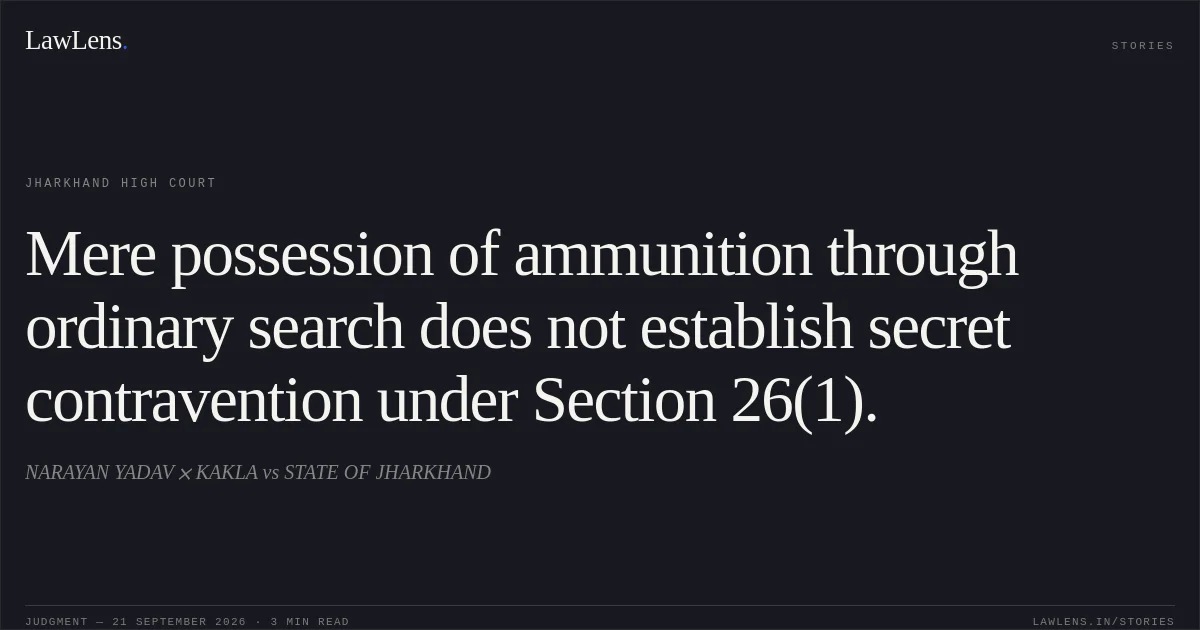
Source reference: p.7, para. 13Mere possession or recovery of a firearm or ammunition through an ordinary search does not, by itself, establish the secrecy element required under Section 26(1).
Source reference: p.7, para. 13In determining sentence, the Court considered the law prevailing at the time of the occurrence, under which Section 25(1-B)(a) prescribed imprisonment of not less than one year, subject to reduction below one year for adequate and special reasons recorded by the Court.
Source reference: p.7, para. 14Reasoning
The Court found that the prosecution had proved that the appellant was apprehended and that two live cartridges were recovered from his possession. Although the Sergeant Major was not examined, the Court accepted the prosecution case that the recovered cartridges were live and upheld the conviction under Section 25(1-B)(a).
Source reference: p.7, para. 12However, the prosecution evidence showed only an ordinary search and seizure. It did not establish that the appellant had deliberately concealed the contravention or acted with the intention that it remain unknown to a public servant or other authorised person. Accordingly, the essential secrecy requirement under Section 26(1) was not satisfied, and that conviction could not stand.
Source reference: p.7, para. 13On sentence, the Court considered that the appellant had already undergone approximately four months’ custody, the occurrence was more than two decades old, and the appellant had endured prolonged criminal proceedings. These circumstances constituted adequate and special reasons to reduce the sentence below the statutory minimum applicable at the time of the offence.
Source reference: p.7, para. 14; p.8, para. 15Holding
The appeal was dismissed on merits with modification.
The appellant’s conviction under Section 25(1-B)(a) of the Arms Act was upheld, but his sentence was reduced to the period already undergone.
Source reference: p.8, paras. 15–16His conviction under Section 26(1) of the Arms Act was set aside because the prosecution failed to prove a secret contravention.
Source reference: p.7, para. 13; p.8, paras. 15–16As the appellant was on bail, he was discharged from the liability of his bail bond, and his sureties were also discharged.
Source reference: p.8, para. 17Acts & Sections Cited
9 provisions across 2 statutes referred to in this judgment. Each provision opens on LawLens.
Indian Penal Code, 18602
Original Court PDF
NARAYAN YADAV KAKLAvsSTATE OF JHARKHAND
Click to open original judgment
Original judgment, available to read, download and summarize on LawLens.in