Facts
The plaintiffs (daughters of late Tarachand) filed a suit for declaration of title, partition, possession, and permanent injunction regarding ancestral and self-acquired property totaling 3.33 hectares
Source reference: para. 2Tarachand died on 19.11.2011, leaving heirs from two wives
Source reference: para. 2, 3(b)The defendant/appellant (son from the second wife) contended that a family partition had already occurred on 25.07.2011 via mutual settlement, which was acted upon in revenue records by the Tahsildar on 06.03.2013
Source reference: para. 3(b), 7The Trial Court dismissed the suit, accepting the prior partition
Source reference: para. 4However, the First Appellate Court reversed this decision, holding that the daughters had equal rights and had not relinquished them
Source reference: para. 4, 7The appellant challenged this reversal before the High Court under Section 100 of the CPC
Source reference: para. 1, 5Issues
1. Whether the daughters of the deceased are entitled to an equal coparcenary share in the suit property under the Hindu Succession (Amendment) Act, 2005, in the absence of a lawful partition or proof of relinquishment
Source reference: para. 82. Whether the findings of the First Appellate Court regarding the invalidity of the alleged prior partition suffer from perversity or material irregularity
Source reference: para. 11, 123. Whether the Second Appeal involves any substantial question of law as required under Section 100 of the Code of Civil Procedure
Source reference: para. 13, 16Law Applied
The court primarily applied Section 6 of the Hindu Succession Act, 1956 (as amended in 2005), which grants daughters equal coparcenary rights by birth
Source reference: para. 8, 10It further applied Section 100 of the Code of Civil Procedure, 1908, which limits the scope of a Second Appeal to cases involving substantial questions of law and prohibits interference with findings of fact unless they are perverse or based on no evidence
Source reference: para. 1, 12, 13The court distinguished the precedent Ratnam Chettiar v. S.M. Kuppuswami Chettiar (1976) 1 SCC 214, noting it pertained to the pre-2005 amendment era
Source reference: para. 5(ii), 10Reasoning
The Court observed that while the Trial Court relied on an alleged partition deed (Ex. D-8) from 2011, the First Appellate Court correctly found no evidence that the plaintiffs had consciously relinquished their statutory shares
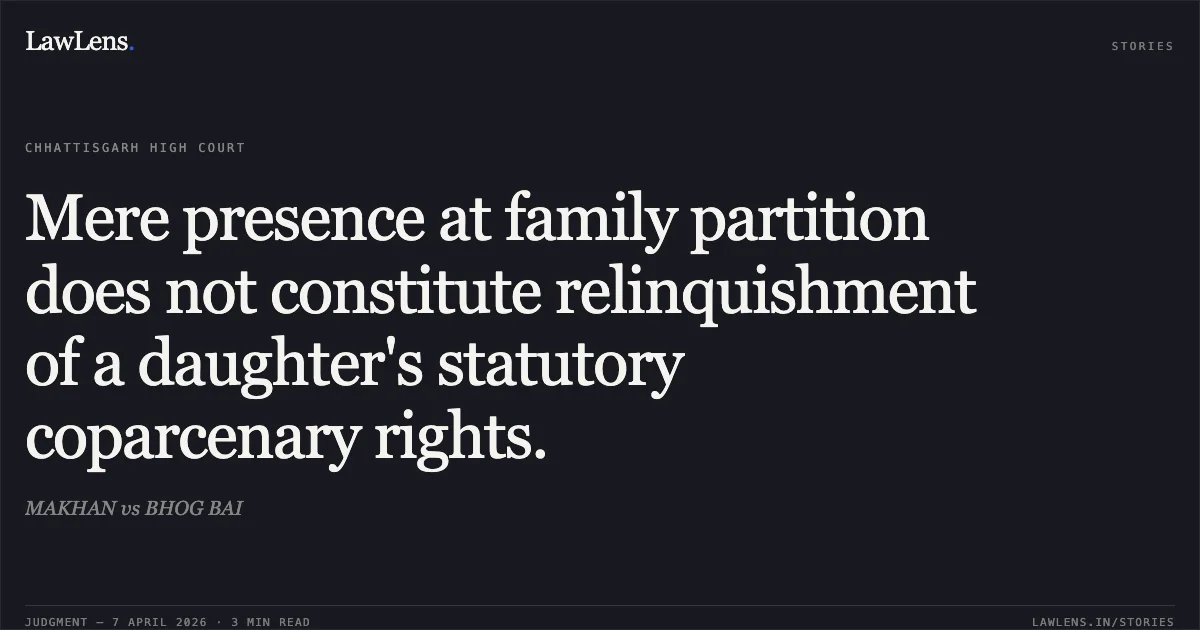
Source reference: para. 7Presence at a village meeting does not constitute a legal relinquishment of property rights
Source reference: para. 7Under the 2005 Amendment, daughters' rights are crystallized by law; therefore, any partition that fails to specify their shares or comply with legal distribution standards cannot defeat their claims
Source reference: para. 8The High Court noted that the appellant's reliance on Ratnam Chettiar was misplaced because statutory amendments now supersede older principles regarding the reopening of partitions when those partitions ignore the vested rights of daughters
Source reference: para. 10Since the First Appellate Court’s findings were based on a proper appreciation of evidence and correct legal principles, the High Court determined there was no perversity or substantial question of law to warrant interference
Source reference: para. 11, 15, 16Holding
The High Court dismissed the Second Appeal and upheld the judgment and decree of the First Appellate Court
The Court held that daughters possess equal coparcenary rights under the amended Section 6 of the Hindu Succession Act and cannot be deprived of their share based on an alleged partition that lacks proof of their relinquishment
Source reference: para. 8, 10It further held that findings of fact by the First Appellate Court are binding in a Second Appeal unless proven perverse, and no substantial question of law was raised in this instance
Source reference: para. 12, 16Acts & Sections Cited
3 provisions across 2 statutes referred to in this judgment. Each provision opens on LawLens.
Code of Civil Procedure, 19082
Hindu Succession Act, 19561
Original Court PDF
MAKHANvsBHOG BAI
Click to open original judgment
Original judgment, available to read, download and summarize on LawLens.in


