Facts
The appellant, a Clerk/Junior Assistant in the Punjab Scheduled Castes Land Development and Finance Corporation, was prosecuted under Sections 7 and 13(2), read with Section 13(1)(d), of the Prevention of Corruption Act, 1988.
Source reference: pp. 2–5; paras. 2–4The complainant alleged that the appellant demanded ₹200 for furnishing the dispatch number of his buffalo-loan application.
Source reference: pp. 2–5; paras. 2–4A vigilance trap was organised, during which two treated currency notes of ₹100 each were allegedly recovered from the appellant’s trouser pocket, and the sodium-carbonate solution allegedly turned pink.
Source reference: pp. 2–5; paras. 2–4The Trial Court convicted the appellant on 18.02.2005 and sentenced him to two years’ rigorous imprisonment with fine under each provision.
Source reference: p. 1; para. 1In appeal, the appellant relied on documentary evidence showing that the loan case had already been dispatched to the State Bank of Patiala on 30.01.2001.
Source reference: pp. 6–8; paras. 6–7He also alleged false implication arising from prior recovery proceedings conducted against relatives of the complainant and the shadow witness.
Source reference: pp. 6–8; paras. 6–7The prosecution relied principally on the testimony of the complainant, the shadow witness, the trap witnesses, recovery of the tainted money, and the statutory presumption under Section 20 of the PC Act.
Source reference: pp. 12–13; paras. 18–20Issues
Whether the prosecution proved beyond reasonable doubt that the appellant demanded and accepted illegal gratification of ₹200, thereby committing offences under Sections 7 and 13(2), read with Section 13(1)(d), of the Prevention of Corruption Act, 1988?
Source reference: pp. 15–18; paras. 25–37Whether recovery of the tainted currency and the presumption under Section 20 of the PC Act could sustain the conviction in the absence of reliable proof of demand and acceptance?
Source reference: p. 18; para. 36Whether the defence evidence regarding prior dispatch of the loan case and the alleged motive for false implication created a reasonable doubt in the prosecution case?
Source reference: pp. 14–18; paras. 22–37Law Applied
The Court applied Sections 7 and 13(1)(d), punishable under Section 13(2), of the Prevention of Corruption Act, 1988, requiring proof of the essential foundational facts of demand and acceptance of illegal gratification.
Source reference: p. 18; para. 36It further applied Section 20 of the PC Act, holding that the statutory presumption cannot arise or operate in isolation from the prosecution’s proof of the foundational facts.
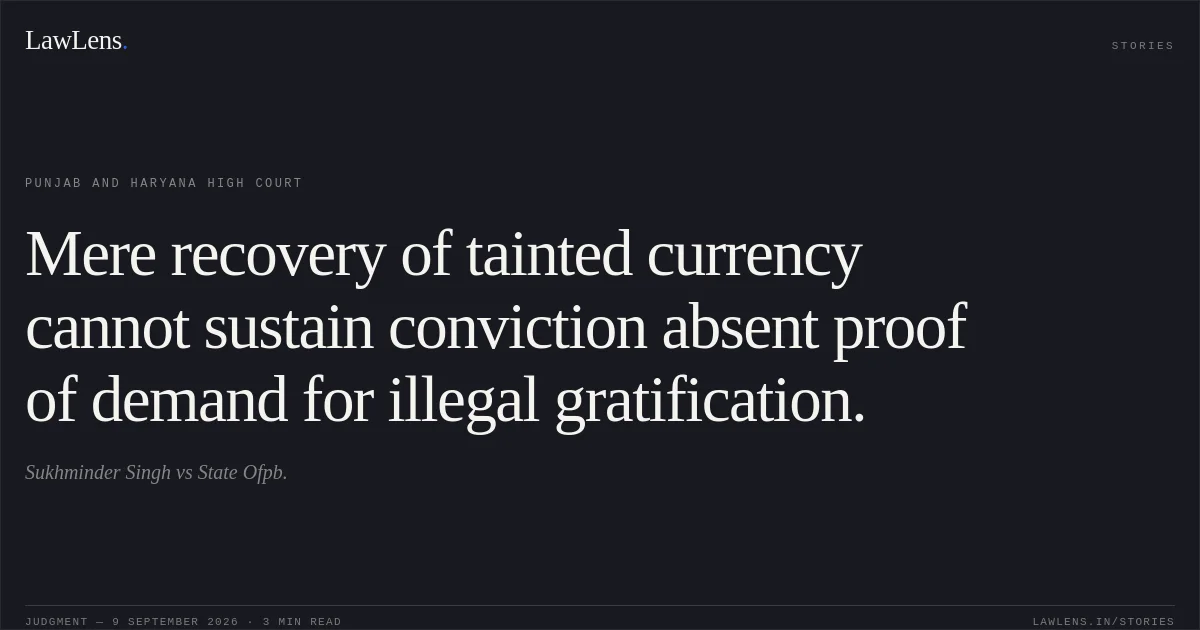
Source reference: p. 18; para. 36Relying on P. Satyanarayana Murthy v. District Inspector of Police, State of Andhra Pradesh, (2015) 10 SCC 152, and K. Shanthamma v. State of Telangana, Criminal Appeal No. 261 of 2022, decided on 21.02.2022, the Court reiterated that proof of demand is a sine qua non for conviction under the PC Act and that mere recovery of money, by itself, is insufficient.
Source reference: pp. 10–11, 18; paras. 14, 35–36Reasoning
The Court found material inconsistencies between the complainant and the shadow witness regarding the duration of their acquaintance, the circumstances preceding the trap, the timing of the alleged demand, and the events leading to the vigilance proceedings.
Source reference: pp. 15–16; paras. 26–31The shadow witness and the complainant also had potential reasons for hostility because the appellant had participated in recovery proceedings against their close relatives.
Source reference: pp. 14–15; paras. 22–24, 29The defence documentary evidence established that the complainant’s loan case had already been dispatched on 30.01.2001, weakening the allegation that the appellant demanded money for supplying its dispatch number.
Source reference: p. 17; para. 32In these circumstances, the Court held that the prosecution failed to establish demand and acceptance with the requisite certainty.
Source reference: pp. 17–18; paras. 34–36Consequently, the recovery of ₹200 could not independently sustain the conviction, and the Section 20 presumption could not cure the failure to prove the foundational facts.
Source reference: pp. 17–18; paras. 34–36Holding
The Court answered the issues in favour of the appellant and held that the prosecution had failed to prove the charges beyond reasonable doubt.
The appeal was allowed; the judgment of conviction and order of sentence dated 18.02.2005 passed by the Special Judge, Patiala, were set aside, and Sukhminder Singh was acquitted of the offences under the Prevention of Corruption Act, 1988.
Source reference: p. 19; para. 38His bail bonds, if any, were ordered to stand discharged, subject to the benefit of acquittal in accordance with law.
Source reference: p. 19; para. 39Acts & Sections Cited
5 provisions across 2 statutes referred to in this judgment. Each provision opens on LawLens.
Prevention of Corruption Act, 19883
Code of Criminal Procedure, 19732
Original Court PDF
Sukhminder SinghvsState Ofpb.
Click to open original judgment
Original judgment, available to read, download and summarize on LawLens.in