Facts
The appellant, a Block Resource Coordinator in the Rajeev Gandhi Shiksha Mission, was convicted by the Special Judge under Sections 7 and 13(1)(d) read with Section 13(2) of the Prevention of Corruption Act, 1988, and sentenced to three years’ rigorous imprisonment with fine under each provision, the sentences to run concurrently.
Source reference: para. 1The complainant, a food supplier, alleged that the appellant demanded ₹10,000 as illegal gratification for release of a balance contractual payment, later allegedly settling for ₹5,000.
Source reference: paras. 2–3An Anti-Corruption Bureau trap was organised; phenolphthalein-treated currency was handed to the complainant, who allegedly delivered it to the appellant. The currency was recovered from the appellant’s purse, and the hand-wash, purse-wash and pant-wash allegedly turned pink.
Source reference: paras. 3–4The appellant denied the demand and asserted that the contractual payment had already been released and encashed, that he had no authority to issue the cheque, and that the complainant had falsely implicated him due to a dispute concerning the quality of food supplied.
Source reference: para. 6In appeal, he challenged the proof of demand, acceptance and recovery, and relied on contradictions concerning the dates and custody of the tape-recorder, preparation of the transcript, absence of voice identification or expert examination, and the absence of a certificate under Section 65-B of the Evidence Act.
Source reference: paras. 8–9Issues
1. Whether the prosecution proved beyond reasonable doubt the essential ingredients of demand and acceptance of illegal gratification under Sections 7 and 13(1)(d) read with Section 13(2) of the Prevention of Corruption Act, 1988.
Source reference: paras. 12–14, 30–332. Whether recovery of the tainted currency and the phenolphthalein-positive washes were sufficient to sustain conviction in the absence of reliable proof of demand.
Source reference: paras. 31–33, 383. Whether the tape-recorded conversations and their transcripts were admissible and reliable when the appellant’s voice was not identified or subjected to expert examination, the chain of custody was doubtful, and no Section 65-B certificate was produced.
Source reference: paras. 25–28, 37Law Applied
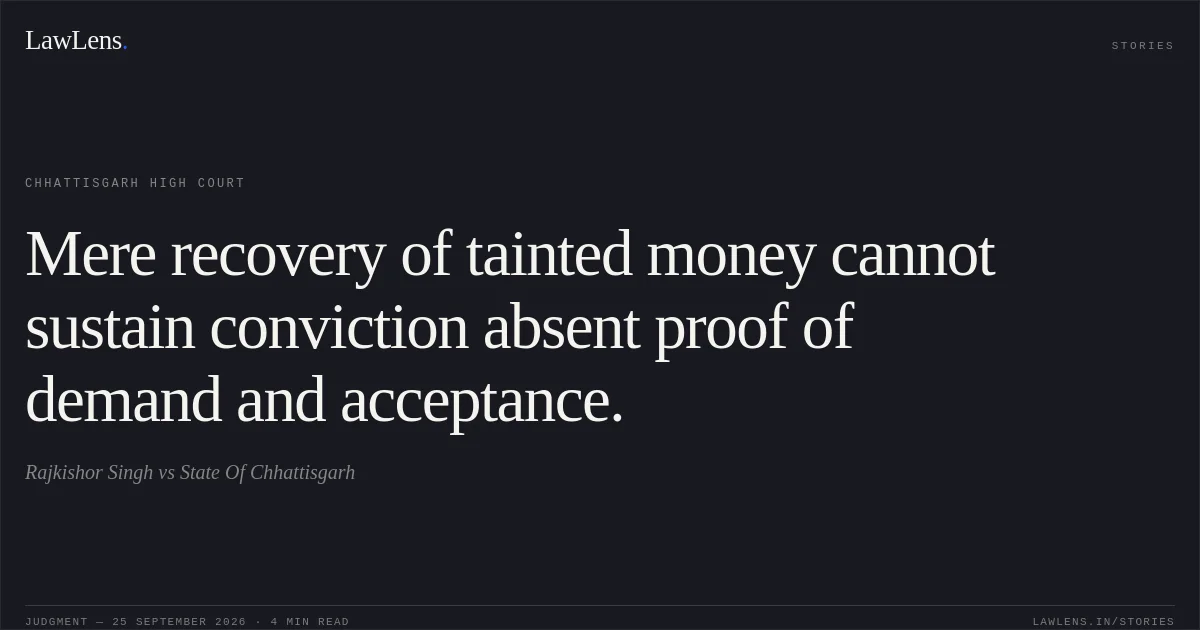
The Court applied Sections 7 and 13(1)(d) read with Section 13(2) of the Prevention of Corruption Act, 1988, holding that proof of demand, acceptance or obtainment, and recovery forms the essential evidentiary chain; mere possession or recovery of tainted money is insufficient without proof of demand.
Source reference: paras. 12–14, 30–33Under Mukhtiar Singh v. State of Punjab, B. Jayaraj v. State of A.P., P. Satyanarayana Murthy v. District Inspector of Police and Sejappa v. State, demand of illegal gratification is the gravamen of the offence.
Source reference: paras. 13, 32–33Relying on the Constitution Bench decision in Neeraj Dutta v. State (NCT of Delhi), the Court held that demand and acceptance must first be established by direct or circumstantial evidence before any presumption can arise; the statutory presumption under Section 20 is available only after foundational facts are proved.
Source reference: para. 14For electronic or tape-recorded evidence, the Court relied on Ram Singh v. Col. Ram Singh and Rajesh Gupta v. State through CBI, requiring identification of the speaker’s voice, proof of accuracy, exclusion of tampering, clear audibility and safe custody.
Source reference: paras. 25, 37It further relied on Sanjay Singh Ramrao Chavan v. Dattratray Gulabrao Phalke in holding that electronic evidence lacking authenticity and the requisite Section 65-B certificate could not be relied upon.
Source reference: paras. 27–28Reasoning
The Court found that the prosecution failed to establish the initial demand. The complainant’s own evidence and the documents indicated that the balance payment had already been released and the relevant cheque had been encashed, leaving no credible basis for the alleged demand to secure release of that payment.
Source reference: paras. 18, 20, 31The evidence concerning the tape-recorder was materially inconsistent: the complainant stated that it was supplied, used and returned on dates different from those stated by the Investigating Officer; the place of preparation of the transcript was also disputed; and the complainant denied receiving the second recorder allegedly relied upon by the Investigating Officer.
Source reference: paras. 23–24The recorded voice was neither properly identified as the appellant’s voice nor subjected to expert frequency or spectrographic examination. The prosecution also failed to prove safe custody and excluded neither tampering nor distortion, while no Section 65-B certificate was produced.
Source reference: paras. 25–28Although recovery of the currency and positive phenolphthalein washes could support acceptance, they could not independently establish that the money was accepted as illegal gratification pursuant to a proved demand. Consequently, the statutory presumption under Section 20 could not be invoked.
Source reference: paras. 30–33, 38Holding
The High Court held that the prosecution failed to prove demand and acceptance of illegal gratification beyond reasonable doubt.
Recovery of the tainted currency, even if accepted, was insufficient in the absence of reliable proof that it was received pursuant to an illegal demand.
Source reference: para. 38The appeal was allowed; the judgment of conviction and order of sentence were set aside, and the appellant was acquitted of the charged offences.
Source reference: para. 39As the appellant was on bail, his bail bond was directed to remain operative for six months under Section 481 of the Bharatiya Nagarik Suraksha Sanhita, 2023.
Source reference: para. 39Acts & Sections Cited
6 provisions across 3 statutes referred to in this judgment. Each provision opens on LawLens.
Code of Criminal Procedure, 19732
Prevention of Corruption Act, 19883
Bharatiya Nagarik Suraksha Sanhita, 20231
Original Court PDF
Rajkishor SinghvsState Of Chhattisgarh
Click to open original judgment
Original judgment, available to read, download and summarize on LawLens.in