01Facts
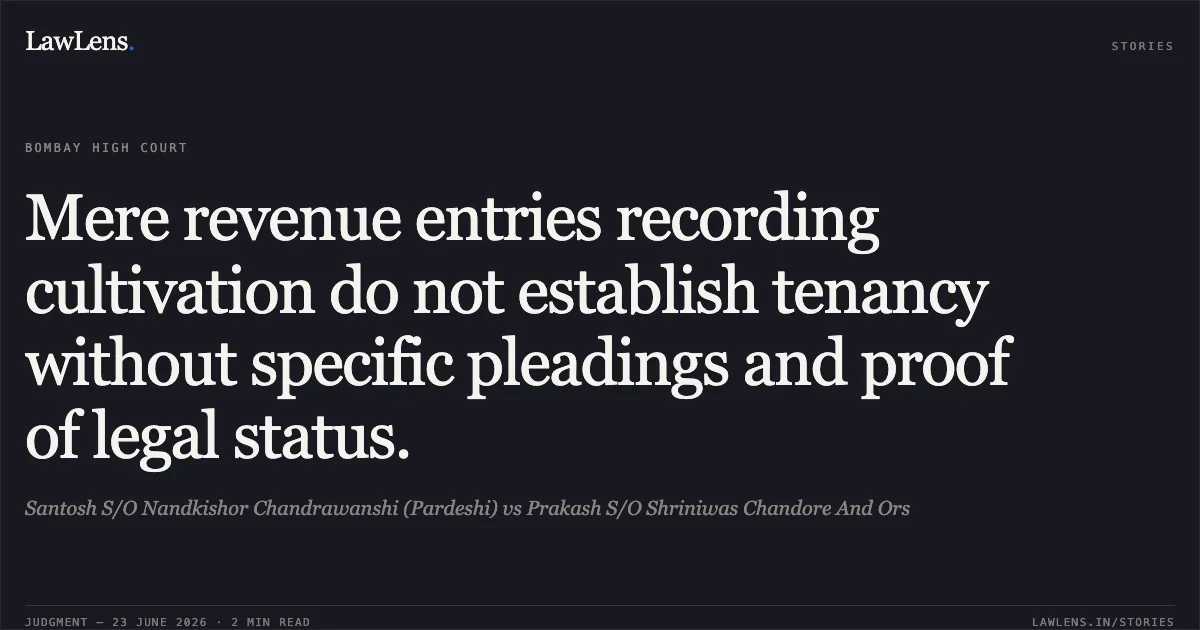
The petitioner claimed that his father, Nandkishor, was inducted as a protected lessee of agricultural land (Gat No. 193/2) in 1951-52 under the Berar Regulation of Agricultural Leases Act, 1951
¶ 2-3Following Nandkishor’s death in 1990, the petitioner sought fixation of the purchase price and conferment of ownership rights under the Bombay Tenancy and Agricultural Lands (Vidarbha Region) Act, 1958 ("Tenancy Act, 1958")
¶ 4-5The Tahsildar (2005) and Sub-Divisional Officer (2008) dismissed the claim, finding no evidence of tenancy beyond mere cultivation entries in revenue records
¶ 5The Maharashtra Revenue Tribunal (MRT) affirmed these orders in 2011, holding that 7/12 extract entries reflected actual cultivation but not legal tenancy status
¶ 6The petitioner challenged these concurrent findings via this Writ Petition
¶ 702Issues
i.1. Whether the petitioner established a jural relationship of landlord and tenant to claim benefits under the Tenancy Act, 1958
¶ 19ii.2. Whether the petitioner could be recognized as a "deemed tenant" under Section 6(1) of the Tenancy Act, 1958, in the absence of specific pleadings
¶ 25-2703Law Applied
The court applied Section 2(32) and Section 6 of the Tenancy Act, 1958, defining "tenant" and "deemed tenant" respectively
¶ 9, 25It relied on the principle that the person asserting a tenancy bears the burden of proof
¶ 21Under Jaichand Housilal Gujarathi v. Ananda Tanji Patil (1972), the court established that "deemed tenancy" under Section 6 is not a pure question of law and requires foundational factual pleadings
¶ 16, 26It further distinguished Jagannath Vithu Jadhav v. State of Maharashtra (2013), noting that revenue entries showing cultivation do not automatically prove the legal character of possession as tenancy
¶ 28-29Provisions in the judgment · 7 · Linked ones open on LawLens
Maharashtra Tenancy and Agricultural Lands (Vidarbha Region) Act. Section 2Section 6Section 41Section 46Section 50Section 59
Industries (Development and Regulation) Act, 1951 Section 3
04Reasoning
The court reasoned that the petitioner failed to produce any lease deed, rent receipts, or mutation entries evidencing the start or terms of the alleged tenancy
¶ 22While the petitioner's name appeared in the cultivation columns of 7/12 extracts, the court held that such entries prove "actual cultivation" but not "tenancy status"
¶ 24Regarding the "deemed tenancy" argument under Section 6, the court found the petitioner's pleadings deficient as they did not specify the date of commencement, rent, or the nature of induction
¶ 23Citing Jaichand Housilal, the court emphasized that Section 6 cannot be invoked for the first time in writ proceedings without a prior factual foundation in the lower courts
¶ 27The court concluded that the lower authorities' concurrent findings were not perverse, as mere long-term possession does not equate to a lawful tenancy
¶ 32-3305Holding
The court answered both issues in the negative, holding that the petitioner failed to establish the essential jural relationship of a tenant
¶ 33The High Court declined to interfere with the concurrent findings of the MRT, SDO, and Tahsildar under Articles 226 and 227. The Writ Petition was dismissed, and the rule was discharged
¶ 34, 35Original Court PDF
Santosh S/O Nandkishor Chandrawanshi (Pardeshi)vsPrakash S/O Shriniwas Chandore And Ors
Click to open original judgment
Original judgment, available to read, download and summarize on LawLens.in