Facts
The applicant, while serving as an Inspector in the Income Tax Department (joined 12.11.2015), qualified for the post of Assistant Section Officer (ASO) in the Ministry of External Affairs (MEA) through the Combined Graduate Level Examination 2015
Source reference: para. 4.1, 4.4The MEA issued an offer of appointment on 31.08.2016, granting 45 days for acceptance
Source reference: para. 4.3Although the applicant requested an extension via email on 14.10.2016, he did not formally accept the offer or diligently pursue technical resignation from his parent department until 19.12.2017—over a year after the offer was issued
Source reference: para. 4.2-4.4Consequently, the MEA issued an order on 15.05.2018 cancelling the offer of appointment
Source reference: para. 4The applicant filed the present Original Application (OA) on 16.11.2024, approximately 5.5 years after the cancellation order, accompanied by a Miscellaneous Application (MA) to condone a delay of 1650 days
Source reference: para. 2, 6Issues
1. Whether the delay of 1650 days in filing the Original Application should be condoned under Section 21 of the Administrative Tribunals Act, 1985
Source reference: para. 2, 52. Whether the applicant's failure to join the post within the stipulated period, allegedly due to delays by his parent department, entitles him to seek the setting aside of the cancellation order dated 15.05.2018
Source reference: para. 1, 4.6Law Applied
The Tribunal applied Section 21 of the Administrative Tribunals Act, 1985, which stipulates that an application must be filed within one year from the date the final order is made
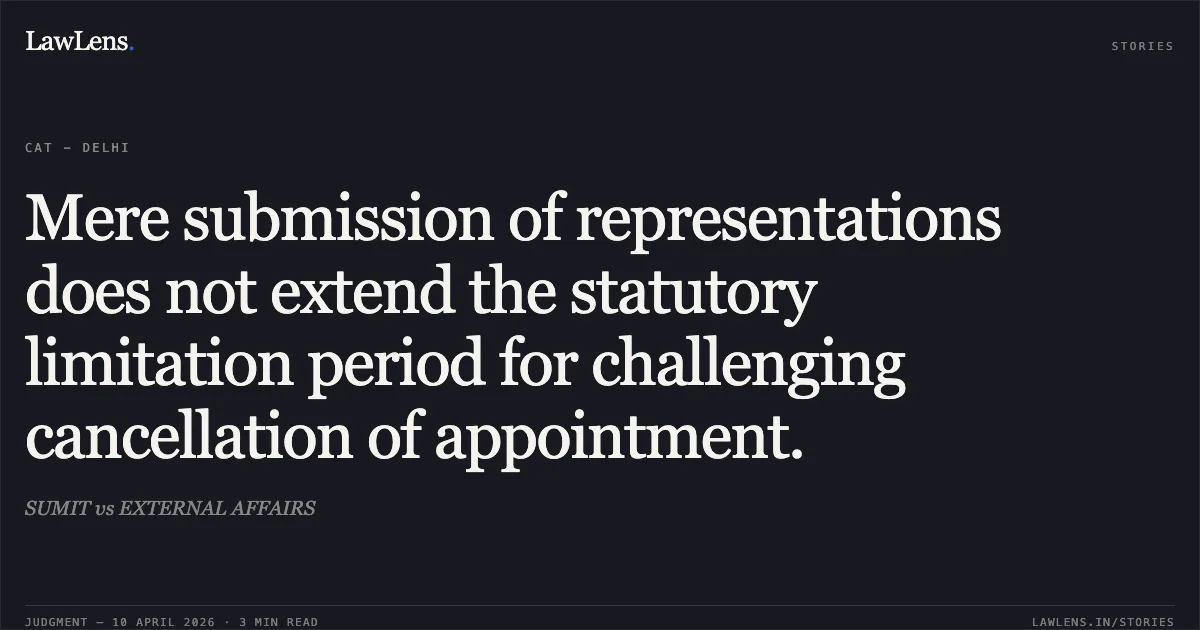
Source reference: para. 5It relied on the precedent in S.S. Rathore v. State of M.P. and State of Haryana v. Miss Ajay Walia, which establish that repeated representations do not furnish a fresh cause of action or extend the limitation period
Source reference: para. 5.1The court further cited Ex-Captain Harish Uppal v. Union of India, affirming that "delay defeats equity" and the law assists the vigilant, not the indolent
Source reference: para. 5.2Finally, it applied D.C.S. Negi v. Union of India, which mandates that the Tribunal must first examine the issue of limitation before admitting an application
Source reference: para. 5.2Reasoning
The Tribunal determined that the cause of action arose on 15.05.2018 upon the issuance of the cancellation order, meaning the statutory period for filing the OA expired on 15.05.2019
Source reference: para. 6The applicant’s filing on 16.11.2024 represented a delay of 5 years and 6 months
Source reference: para. 6The Tribunal rejected the applicant's argument that the delay was due to "miscommunication" or the fault of the parent department, noting that the applicant failed to implead the parent department (CBDT) as a necessary party and failed to pursue legal remedies when the NOC was allegedly withheld
Source reference: para. 3, 4.6Referencing The Chief Executive Officer & Others v. S. Lalitha & Others (2025), the Tribunal noted that representations do not extend the limitation period and that appointment matters do not constitute a recurring cause of action
Source reference: para. 6.1The Tribunal found the applicant's conduct indolent, as he forfeited his rights by remaining silent for years after the cancellation
Source reference: para. 4.7Holding
The Tribunal dismissed M.A. No. 4401/2024 for condonation of delay and subsequently dismissed the Original Application as barred by limitation under Section 21 of the Administrative Tribunals Act, 1985
The court held that no "sufficient cause" was shown to justify the 1650-day delay and that the OA was also devoid of merit, as the right to appointment had been extinguished by the applicant's failure to act within the prescribed timeframes
Source reference: para. 5.2, 7All pending MAs were disposed of with no costs
Source reference: para. 7Acts & Sections Cited
3 provisions across 1 statute referred to in this judgment. Each provision opens on LawLens.
Administrative Tribunals Act, 19853
Original Court PDF
SUMITvsEXTERNAL AFFAIRS
Click to open original judgment
Original judgment, available to read, download and summarize on LawLens.in