Facts
On March 9, 1995, a Food Inspector visited the respondents' shop, "M/S. Bharat Sweets and Farsan Mart," and purchased a sample of "Kajukatri" (silver foiled) for analysis
Source reference: p. 1-2The Public Analyst and subsequently the Central Food Laboratory, Ghaziabad, found the sample to be substandard/adulterated because it was coated with aluminium foil instead of silver foil
Source reference: p. 2The Judicial Magistrate, First Class, Vyara, convicted the respondents on November 24, 2006, sentencing them to three years of simple imprisonment
Source reference: p. 3On appeal, the Additional Sessions Judge, Vyara, reversed this decision and acquitted the respondents on November 6, 2007
Source reference: p. 1, 3The State of Gujarat filed the present appeal against said acquittal
Source reference: p. 3Issues
1. Whether the failure of the Food Inspector to prove that the sample bottles were cleaned as per the mandatory requirements of Rule 14 of the Prevention of Food Adulteration Rules, 1955, vitiates the prosecution
Source reference: p. 6-72. Whether the presence of aluminium foil on a food article, in the absence of evidence proving it is injurious to health, is sufficient to sustain a conviction for food adulteration
Source reference: p. 6Law Applied
Rule 14 of the Prevention of Food Adulteration Rules, 1955, which mandates that samples be taken in clean, dry bottles or jars
Source reference: p. 7Section 378 of the Code of Criminal Procedure, 1973, regarding the scope of appeals against acquittal
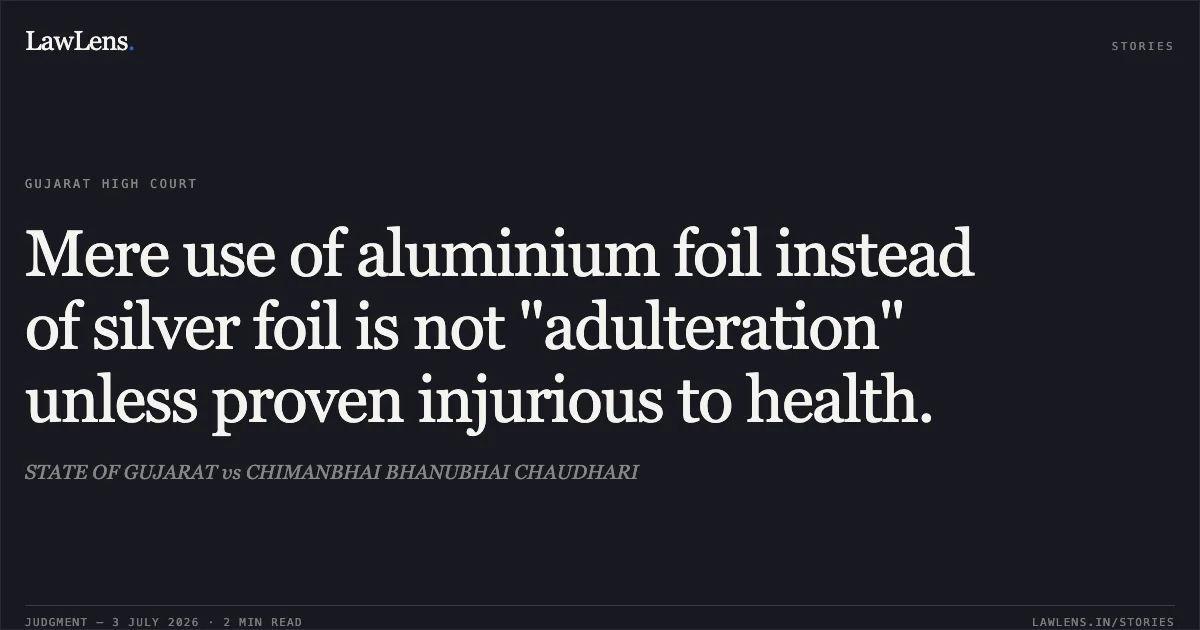
Source reference: p. 1, 9Principles from State of Gujarat v. Rasiklal Shah [1994 Cr.L.R. (Guj) 94] and State of Gujarat v. Punabhai Ramabhai Machhi [2005 FAJ 376], which establish that non-compliance with Rule 14 is a significant procedural lapse and that the mere use of aluminium foil is not "adulteration" unless proven injurious to human health
Source reference: p. 5-7Principles of appellate review in acquittals as laid down in Chandrappa v. State of Karnataka [(2007) 4 SCC 415], emphasizing the double presumption of innocence
Source reference: p. 8-10Reasoning
The High Court observed that the Food Inspector (PW-1) admitted during cross-examination that he did not clean the sample bottles as required by Rule 14, nor did he possess evidence that the bottles were dry or clean before use
Source reference: p. 6-7The Court noted a lack of statutory evidence or expert testimony proving that aluminium foil is inherently hazardous or unfit for human consumption
Source reference: p. 6The Court reasoned that since the prosecution failed to prove the coating was injurious to health, the article could not be deemed "adulterated" under the Act
Source reference: p. 6Applying the standard of review for acquittals, the Court found that the appellate court's view was a reasonable conclusion based on the evidence and that no manifest illegality or perversity existed to warrant interference
Source reference: p. 11Holding
The High Court dismissed the State's appeal and confirmed the judgment of acquittal passed by the Additional Sessions Judge
The Court held that the prosecution failed to prove the charges beyond a reasonable doubt due to the non-compliance with Rule 14 regarding clean containers and the failure to establish that the presence of aluminium foil rendered the food injurious to health
Source reference: p. 6, 12The bail bonds were cancelled, and the record was ordered back to the Trial Court
Source reference: p. 12Acts & Sections Cited
2 provisions across 1 statute referred to in this judgment. Each provision opens on LawLens.
Code of Criminal Procedure, 19732
Original Court PDF
STATE OF GUJARATvsCHIMANBHAI BHANUBHAI CHAUDHARI
Click to open original judgment
Original judgment, available to read, download and summarize on LawLens.in


![Subsequent exoneration does not retrospectively invalidate a finalized promotion select list.. UNNIKRISHNAN M vs M/o Environment And Forests. CAT - ['Ernakulam']. LawLens](/stories/thumbnails/subsequent-exoneration-does-not-retrospectively-invalidate-a-finalized-promotion-select-li-ce80a0e84f2f4887857271e8b4341c42.webp)