Facts
The deceased, Bhatehri Devi, married the respondent in 2011 and resided in village Trehal
Source reference: p. 2The prosecution alleged that the respondent subjected the deceased to physical beatings and cruelty, leading her to commit suicide by consuming poison on August 23, 2012, while she was pregnant
Source reference: p. 3FIR No. 108 of 2012 was registered under Sections 498-A and 306 of the IPC following a complaint by the deceased's father, Kashmir Singh (PW-1)
Source reference: p. 3The Trial Court acquitted the respondent on November 16, 2013, citing a lack of evidence regarding dowry demands or specific instances of instigation
Source reference: p. 4The State appealed this acquittal, arguing the Trial Court ignored the testimony of the parents and the proximity of the alleged beatings to the death
Source reference: p. 4-5Issues
1. Whether the respondent's conduct amounted to "abetment" under Section 107 IPC so as to satisfy the ingredients of Section 306 IPC
Source reference: para. 62. Whether the evidence presented by the prosecution established "cruelty" as defined under Section 498-A IPC
Source reference: para. 73. Whether the Trial Court erred in discarding the testimonies of PW-1, PW-2, and PW-3 regarding the alleged harassment
Source reference: para. 9Law Applied
The court applied Section 306 IPC (Abetment of suicide) and Section 107 IPC (Definition of abetment), emphasizing that "instigation" requires a clear mens rea to provoke or goad the deceased into ending their life
Source reference: para. 6It relied on Mariano Anto Bruno v. Inspector of Police (2023) and Prakash v. State of Maharashtra (2024), which establish that mere harassment or "snap-shows of anger" without a positive act proximate to the time of death do not constitute abetment
Source reference: para. 13-15Regarding Section 498-A IPC, the court followed Dara Lakshmi Narayana v. State of Telangana (2025) and Achin Gupta v. State of Haryana (2025), holding that vague, generalized, and sweeping allegations in matrimonial disputes, without specific instances of criminal conduct, are insufficient for conviction
Source reference: para. 24-25Reasoning
The Court observed that PW-1 (father) admitted in cross-examination that there were no demands for dowry or money before or after the marriage
Source reference: p. 27-28The medical testimony of PW-8 (SMO) indicated no marks of violence or injury on the deceased's body, and he noted that the large quantity of insecticide found suggested it could not have been administered forcibly
Source reference: p. 30The Court found that the testimonies of the mother (PW-3) and uncle (PW-2) consisted only of vague allegations of "torture" without specific details or active roles attributed to the respondent that would leave the deceased with no option but suicide
Source reference: p. 29, 33Furthermore, the Investigating Officer (PW-15) confirmed that no prior complaints had been lodged with the Panchayat or courts regarding maintenance or cruelty
Source reference: p. 31The Court reasoned that the prosecution failed to prove a direct nexus or "active act" of incitement proximate to the suicide, failing the test of mens rea required for Sections 306 and 107 IPC
Source reference: p. 32-33Holding
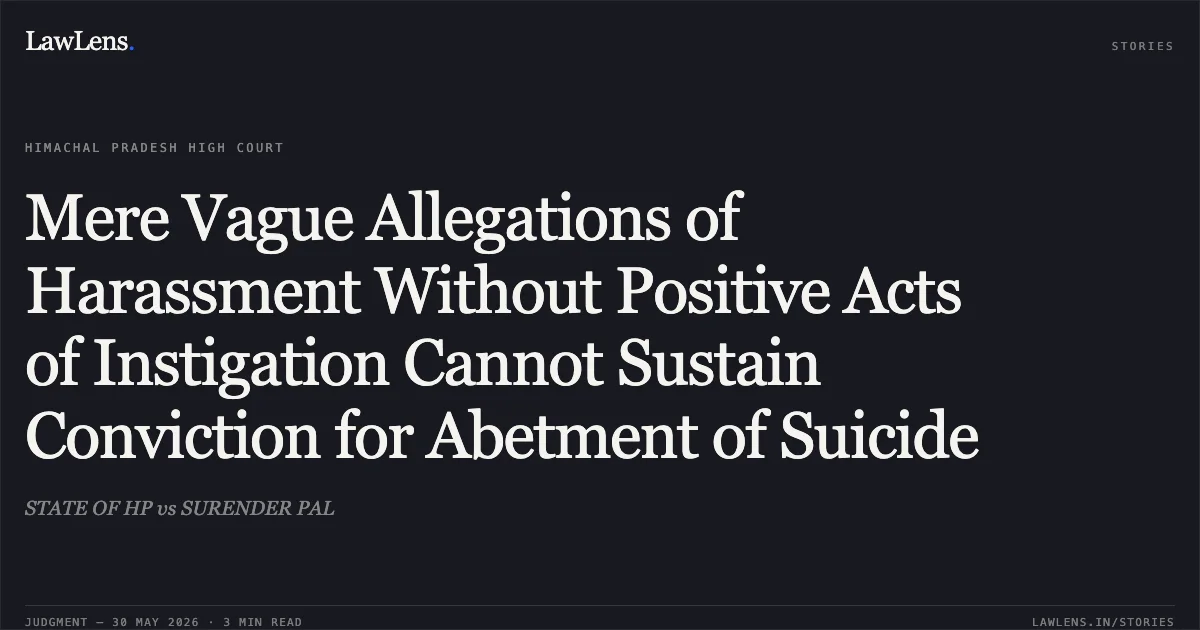
The High Court held that the prosecution failed to establish the essential ingredients of abetment or specific cruelty, as the evidence presented was characterized by "hypothetical reason and conjectures" rather than concrete proof of incitement
The High Court dismissed the State's appeal and reaffirmed the acquittal of the respondent, finding the Trial Court's judgment was based on a proper appreciation of evidence and did not suffer from any infirmity or illegality
Source reference: p. 34-35Acts & Sections Cited
6 provisions across 2 statutes referred to in this judgment. Each provision opens on LawLens.
Code of Criminal Procedure, 19733
Indian Penal Code, 18603
Original Court PDF
STATE OF HPvsSURENDER PAL
Click to open original judgment
Original judgment, available to read, download and summarize on LawLens.in