Facts
S.S. Das, a former Indian Trade Service officer appointed in 1989, received consistently high ACR/APAR gradings, including repeated “Outstanding” and “Very Good” assessments, and was promoted to the Senior Administrative Grade at the level of Joint Secretary in November 2017, with regular promotion in February 2018.
Source reference: paras. 3, 20–24On 10 May 2018, shortly after his promotion, the competent authority compulsorily retired him under Fundamental Rule 56(j), stating that such retirement was in the public interest.
Source reference: paras. 2, 25–26The decision relied principally on a 2017 confidential note alleging questionable integrity, unprofessional handling of files, and oral allegations that he had sought favours from representatives of domestic industry, as well as two entries in his service record: a 1998–99 remark that complaints had been received but had “no substance” and a 2014–15 observation that there was “room for improvement” in integrity.
Source reference: paras. 30, 52–56Das’s representation led to a remand for reconsideration, but the Review Committee reaffirmed the recommendation and the Representation Committee ultimately upheld it.
Source reference: paras. 27–31The Central Administrative Tribunal dismissed his challenge, and the Delhi High Court declined interference. Das appealed to the Supreme Court.
Source reference: paras. 5–12Issues
Whether the order of compulsory retirement under FR 56(j) was based on credible and relevant material capable of sustaining the requisite satisfaction that Das’s continuation in service was contrary to public interest.
Source reference: para. 13Whether the appellant’s recent merit-based promotion, consistently excellent service record, and absence of intervening adverse material rendered the compulsory-retirement decision arbitrary, perverse, or vitiated by malice in law.
Source reference: paras. 41, 48–51Whether the confidential note and isolated service-record remarks relied upon by the Review Committee provided a rational nexus between the material considered and the conclusion that compulsory retirement was warranted.
Source reference: paras. 52–57Law Applied
Compulsory retirement under FR 56(j) is ordinarily non-punitive and does not attract Article 311, but the power must be exercised in the public interest on the basis of the government’s bona fide subjective satisfaction.
Source reference: paras. 36–39; Shyam Lal v. State of U.P., (1955) 1 SCR 26; Union of India v. Col. J.N. Sinha, (1970) 2 SCC 458Judicial review is limited, but interference is permissible where the order is mala fide, based on no evidence, arbitrary, perverse, based on collateral considerations, or formed by overlooking relevant material.
Source reference: para. 37; Baikuntha Nath Das v. District Medical Officer, (1992) 2 SCC 299; Ram Murti Yadav v. State of U.P., (2020) 1 SCC 801The entire service record may be considered, including uncommunicated adverse entries, although recent performance must receive due weight.
Source reference: paras. 37–40; State of Punjab v. Gurdas Singh, (1998) 4 SCC 92; State of Gujarat v. Umedbhai M. Patel, (2001) 3 SCC 314A promotion does not automatically erase past adverse material, but a recent merit-based promotion is a significant factor in favour of the employee and may negate a finding that the employee has become “dead wood” or is of doubtful integrity.
Source reference: paras. 40, 43–45; Pyare Mohan Lal v. State of Jharkhand, (2010) 10 SCC 693; Rajasthan SRTC v. Babu Lal Jangir, (2013) 10 SCC 551FR 56(j) cannot be used as a substitute for disciplinary proceedings, or as a device to act on suspicion, vengeance, or extraneous considerations.
Source reference: paras. 39, 41, 51, 62Reasoning
The Court accepted that the authorities were entitled to review Das’s service under FR 56(j) notwithstanding his promotion, and that the entire service record could legally be examined.
Source reference: paras. 43–48However, the authorities failed to meaningfully weigh the decisive contrary material: Das’s nearly continuous “Outstanding” or high numerical gradings, the absence of substantive adverse integrity remarks, his strong recent APARs, and his merit-based promotion to Joint Secretary only a few months before compulsory retirement.
Source reference: paras. 20–24, 33–34, 50The 1998–99 entry merely recorded that complaints had been received but had “no substance,” and the 2014–15 remark that there was “room for improvement” was accompanied by a high performance grading of 8.75 and followed by an improved grading of 9.6.
Source reference: paras. 53–55The confidential note was treated as unreliable because it was unsupported by any written complaint or corroborating evidence and rested substantially on oral allegations by industry representatives who themselves had not made a formal complaint.
Source reference: paras. 30, 56–57The Review Committee selectively invoked precedents permitting consideration of past material while ignoring the equally important requirement to give due weight to recent performance and promotion.
Source reference: paras. 45–46In the Court’s view, the decision to declare Das’s continuation contrary to public interest immediately after finding him fit for higher responsibilities was internally contradictory and lacked a rational nexus with the material relied upon.
Source reference: paras. 48–51, 57–61The exercise therefore amounted to arbitrariness, malice in law, and a colourable use of FR 56(j).
Source reference: paras. 48–51, 57–61Holding
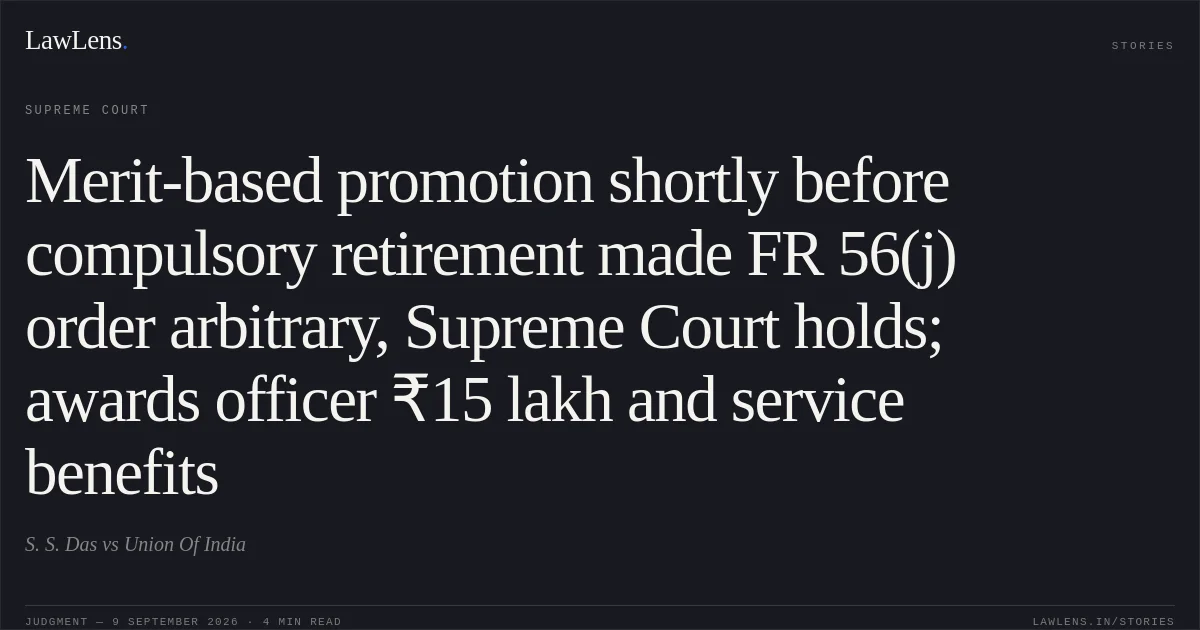
The Supreme Court allowed the appeal and set aside the Delhi High Court judgment, the CAT order, and the compulsory-retirement order dated 10 May 2018.
It held that the retirement decision was arbitrary, perverse, and vitiated by malice in law because it disregarded the appellant’s consistently outstanding service record and recent merit-based promotion and relied on material lacking credibility and probative value.
Source reference: paras. 49–62As Das had already reached the age of superannuation, reinstatement was not ordered; instead, he was granted all service benefits that would have accrued had the impugned retirement order not been passed, including notional promotion, if applicable.
Source reference: paras. 66–67The respondent was directed to call him back for an honourable farewell, pay ₹6 lakh as costs and ₹9 lakh as compensation for loss of reputation, and release the service benefits and monetary amounts within three months.
Source reference: paras. 68–71The Union of India was given liberty to recover the costs and compensation from responsible officers in accordance with law.
Source reference: paras. 68–71Original Court PDF
S. S. DasvsUnion Of India
Click to open original judgment
Original judgment, available to read, download and summarize on LawLens.in