Facts
The petitioner was appointed as a Regular T-Mate with the erstwhile Punjab State Electricity Board on 24.10.1990 and was promoted as an Assistant Lineman on 17.10.1996.
Source reference: p. 2On 01.03.2013, PSPCL officials inspected the electricity meter installed outside the petitioner’s residence and alleged theft of electricity through bypassing and tampering with the meter.
Source reference: pp. 2–3An FIR was registered under Section 135 of the Electricity Act, 2003, and the petitioner was served with a departmental charge-sheet dated 06.06.2013 based on the same allegations.
Source reference: pp. 3, 7Although the petitioner submitted his reply on 28.06.2013, no departmental inquiry was thereafter conducted.
Source reference: pp. 3, 7The petitioner was convicted by the Special Court, Sri Muktsar Sahib, on 24.01.2017 and was sentenced to two years’ rigorous imprisonment.
Source reference: p. 4Relying exclusively on that conviction, PSPCL dismissed him from service on 23.02.2017.
Source reference: pp. 4, 7His departmental appeal was rejected on 15.10.2020.
Source reference: p. 4The petitioner subsequently challenged that order but withdrew the writ petition with liberty to seek appropriate relief after the decision in his criminal appeal.
Source reference: pp. 4–5On 08.06.2023, this Court allowed the petitioner’s criminal appeal, set aside the conviction, and acquitted him after finding deficiencies in the inspection, seizure, and evidentiary procedure, including the failure to seize the meter and properly document the alleged theft.
Source reference: pp. 7–9The petitioner thereafter sought reinstatement, but PSPCL rejected his representations by communication dated 29.11.2023, relying on the earlier appellate order.
Source reference: pp. 5–6He consequently filed the present writ petition under Article 226 of the Constitution.
Source reference: p. 1Issues
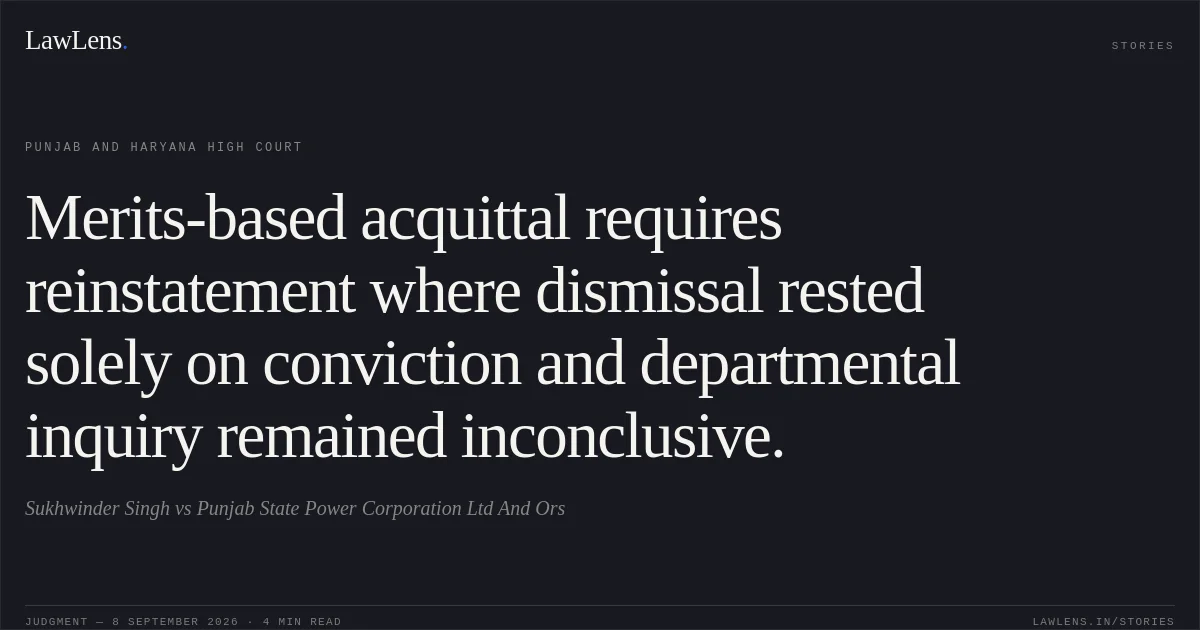
1. Whether the petitioner’s dismissal, founded solely on his criminal conviction, could survive after the conviction was set aside and he was acquitted on merits, particularly when the departmental inquiry had never been concluded?
Source reference: pp. 7–9, 112. Whether the rejection of the petitioner’s departmental appeal prior to his acquittal barred reconsideration of his claim for reinstatement after the subsequent acquittal?
Source reference: pp. 9–103. Whether the petitioner was entitled to consequential monetary benefits, including back wages, and if so, for what period?
Source reference: pp. 10–12Law Applied
The Court exercised jurisdiction under Article 226 of the Constitution to review the legality of the dismissal and consequential administrative orders.
Source reference: p. 1It applied the principle that where dismissal is founded exclusively on a criminal conviction, and the conviction is subsequently set aside by an appellate court on merits, the basis of the dismissal ceases to exist, particularly where no independent departmental finding of guilt has been recorded.
Source reference: pp. 7–9Relying on Raj Narain v. Union of India, (2019) 5 SCC 809, the Court held that entitlement to back wages after acquittal depends on the circumstances in which the employee remained out of service, and that wages may ordinarily be granted from the date of acquittal where the employer thereafter unjustifiably denies reinstatement.
Source reference: pp. 10–11The Court distinguished Union of India v. Jaipal Singh, (2004) 1 SCC 121, which holds that acquittal does not automatically entitle an employee to full back wages for the entire period where the employee’s own conduct had led to prosecution and dismissal.
Source reference: p. 11The Court also relied upon the criminal appellate judgment, which held that the prosecution had failed to prove the case beyond reasonable doubt because of deficiencies in the inspection and seizure procedure.
Source reference: pp. 7–9Reasoning
The Court found that the departmental charge-sheet and the criminal prosecution arose from the same allegations, but the departmental proceedings were never taken to their logical conclusion.
Source reference: p. 7The dismissal order was therefore not based on an independently established departmental charge; it was passed solely because of the petitioner’s criminal conviction.
Source reference: p. 7Once the conviction was set aside and the petitioner was acquitted on merits, the sole foundation of the dismissal disappeared.
Source reference: pp. 7–9The Court rejected PSPCL’s argument that the earlier appellate order had attained finality, holding that the subsequent acquittal constituted a material change in circumstances and required the respondents to reconsider the petitioner’s claim rather than mechanically rely on the earlier order.
Source reference: pp. 9–10However, the Court did not grant back wages from the date of dismissal.
Source reference: pp. 10–12Applying the distinction between Raj Narain and Jaipal Singh, it held that the period before acquittal was connected with the criminal proceedings and could not automatically be treated as a period for which full back wages were payable.
Source reference: pp. 10–12In contrast, after 08.06.2023, the petitioner had been acquitted and had promptly sought reinstatement; his continued exclusion from service was thereafter attributable to the respondents’ refusal to take consequential action.
Source reference: pp. 10–12Holding
The writ petition was allowed.
The Court quashed: (i) the dismissal order dated 23.02.2017; (ii) the appellate order dated 15.10.2020; and (iii) the communication dated 06.11.2023, conveyed on 29.11.2023, rejecting the petitioner’s claim for reinstatement.
Source reference: p. 12PSPCL was directed to reinstate the petitioner in service.
Source reference: p. 12The petitioner was held entitled to back wages from 08.06.2023, the date of his acquittal, until the date of actual reinstatement.
Source reference: p. 12The respondents were directed to calculate and release the arrears within three months from receipt of a certified copy of the judgment.
Source reference: p. 12Acts & Sections Cited
1 provisions across 1 statute referred to in this judgment. Each provision opens on LawLens.
Electricity Act, 20031
Original Court PDF
Sukhwinder SinghvsPunjab State Power Corporation Ltd And Ors
Click to open original judgment
Original judgment, available to read, download and summarize on LawLens.in