Facts
The petitioner, an industrial unit manufacturing alloy steel ingots through an electrical induction furnace, entered into a High Tension Specified Service Agreement dated 27 February 2006 with the erstwhile Bihar State Electricity Board for a contract demand of 1,887 KVA at 33 KV.
Source reference: p.2–3During October 2009, the petitioner alleged that a transformer breakdown caused severely interrupted and insufficient electricity supply, preventing effective operation of its furnace, despite repeated representations to the respondents.
Source reference: p.3The respondents nevertheless raised a bill dated 9 November 2009 for approximately Rs.13.20 lakhs towards minimum guaranteed/demand charges.
Source reference: p.3–4After this Court permitted the petitioner to approach the Consumer Grievances Redressal Forum, the Forum acknowledged the claim but declined to grant remission in the absence of a specific tariff mechanism and directed the parties to approach the Bihar Electricity Regulatory Commission.
Source reference: p.4–5The Electricity Ombudsman dismissed the petitioner’s appeal by order dated 9 February 2017.
Source reference: p.1, p.6–7The petitioner thereafter challenged that order under Article 226 of the Constitution, seeking quashing of the Ombudsman’s order and proportionate remission of demand charges.
Source reference: p.1, p.6–7Issues
1. Whether an HTSS consumer is liable to pay minimum guaranteed or maximum demand charges for the entire contracted demand when the electricity licensee failed to supply electricity to the extent of that demand during the relevant period.
Source reference: para. 23; p.14–152. Whether the absence of an express tariff provision or formula for remission disentitles the consumer from claiming proportionate reduction in charges for inadequate or interrupted supply.
Source reference: para. 27–28; p.163. Whether the orders of the Consumer Grievances Redressal Forum and the Electricity Ombudsman were legally sustainable in light of the contractual obligation to supply electricity and the applicable judicial precedents.
Source reference: para. 25, p.15–16Law Applied
The Court applied the contractual and tariff principle that minimum guarantee or demand charges are not an unconditional liability of the consumer; they depend upon a corresponding obligation of the electricity licensee to supply electricity to the guaranteed or contracted extent.
Source reference: p.10–12; para. 21Relying on Raymond Limited v. Madhya Pradesh Electricity Board, 2001 (1) SCC 534, the Court held that a minimum-consumption guarantee presupposes corresponding supply by the Board, without which the agreed minimum consumption becomes impossible due to the Board’s own default.
Source reference: para. 21It further relied on Tata Iron & Steel Company v. Bihar State Electricity Board, AIR 1989 Patna 119, which recognised that where supply at the contracted demand is not maintained, the consumer may claim a proportionate reduction in annual or demand charges for the period of deficient supply.
Source reference: para. 22The Court also applied the principles arising from the petitioner’s HTSS agreement and the applicable tariff framed under the Electricity Act, 2003, while rejecting the proposition that the absence of a prescribed remission formula extinguishes the consumer’s substantive entitlement.
Source reference: para. 24, 26–28Reasoning
The Court treated the petitioner’s contract demand of 1,887 KVA and its liability under the applicable HTSS tariff as undisputed, but held that the demand-charge obligation had to be read together with the licensee’s corresponding obligation to provide electricity at the contracted level.
Source reference: para. 24Applying Raymond Limited and Tata Iron & Steel Company, the Court reasoned that charging the full minimum guaranteed or maximum demand amount despite failure to provide the contracted supply would impose an unconditional monetary liability on the consumer, contrary to the contractual and tariff framework.
Source reference: para. 25–26The Forum and the Ombudsman had declined remission solely because the tariff did not contain a specific formula. The Court held that this approach failed to consider the substantive contractual right to proportionate remission and the legal principles governing minimum guaranteed charges.
Source reference: para. 27–28Accordingly, the authorities were required to assess the petitioner’s claim by examining the actual extent and duration of deficient supply in light of the agreement and applicable law.
Source reference: para. 28Holding
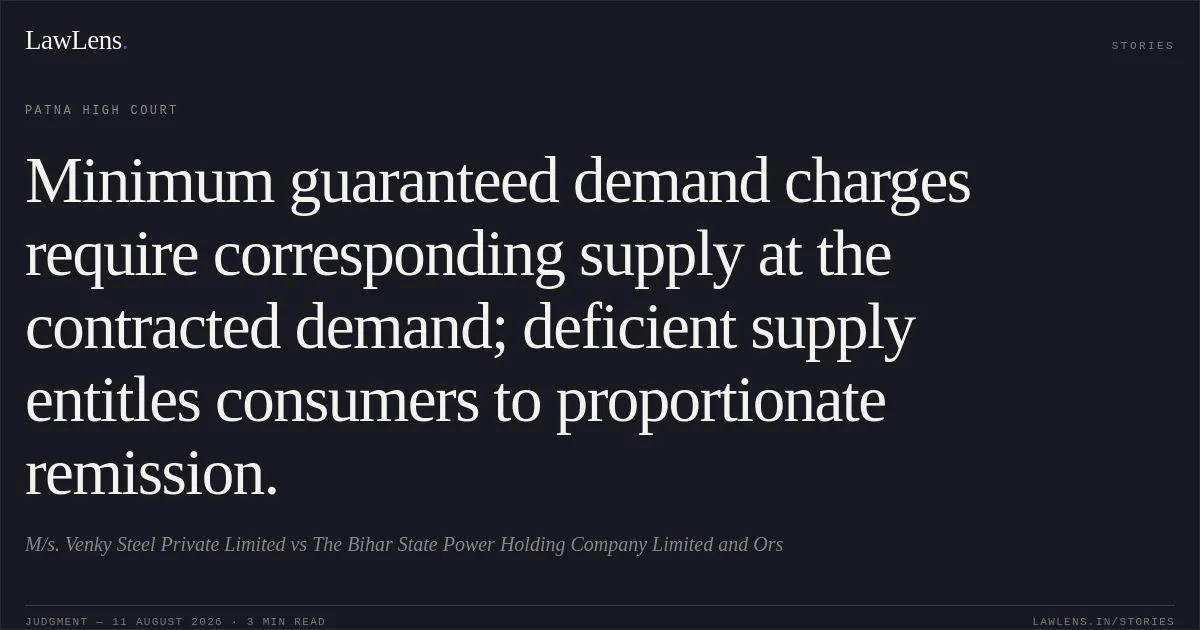
The Court held that a consumer may claim proportionate remission in minimum guaranteed or maximum demand charges where the licensee fails to supply electricity to the contracted extent; the absence of an express tariff formula does not, by itself, defeat that entitlement.
It found the orders of the Consumer Grievances Redressal Forum and the Electricity Ombudsman legally unsustainable.
Source reference: para. 29The order dated 9 February 2017 passed by the Electricity Ombudsman in Appeal Case No. 10 of 2014 was quashed and set aside, and the writ petition was allowed.
Source reference: para. 30–31Original Court PDF
M/s. Venky Steel Private LimitedvsThe Bihar State Power Holding Company Limited and Ors
Click to open original judgment
Original judgment, available to read, download and summarize on LawLens.in